archives

Invasive Animals

This category contains 14 posts

The crown-of-thorns starfish–despite the prickly reputation, this species is native to Hawai‘i, and beneficial to the reef

The crown-of-thorns starfish does munch on coral, but new research is showing that this species, native to Hawai‘i, benefits the reef. Photo courtesy of the National Oceanic and Atmospheric Administration

The crown-of-thorns starfish does munch on coral, but new research is showing that this species, native to Hawai‘i, benefits the reef. Photo courtesy of the National Oceanic and Atmospheric Administration

A single crown-of-thorns starfish is impressive. This unusually large, sinister-looking sea star grows to three feet in diameter with as many as 19 spiny arms. It’s hard to miss on the reef, where it munches on coral. Crown-of-thorns have the highest fertilization rate of any invertebrate: each female can produce up to 60 million eggs during a single spawning season. When too many of these survive, it’s considered an “outbreak.” An overabundance of crown-of-thorns can spell trouble for Pacific reefs. It’s an unusual case of a native animal acting invasively in the marine environment. But it’s not clear that all outbreaks are bad or how environmental changes might exacerbate the problem.

Proliferations of the spiny creatures can destroy 90 percent of a reef, as past outbreaks in Saipan, the Marshall Islands, and Guam have shown. In situations where the reef is stressed, an abundance of coral-eating starfish can trigger a cascade of changes. First the corals go, replaced by algal overgrowth. The resulting shift in fish populations can take years to recover. In Hawai‘i and Australia, concerns about crown-of-thorns outbreaks have focused on the reduced aesthetic value of the reef, and consequently, a decline in tourism. For some communities the reef is the icebox, and crown-of-thorns outbreaks can leave it empty.

But outbreaks rarely occur in Hawai‘i. Many crown-of-thorns starfish larvae die off, while adults are eaten by triton’s trumpet snails, stripebelly pufferfish, and harlequin shrimp. A healthy reef can support small numbers of prickly stars, and it’s probable that they benefit the reef in some way. According to Russell Sparks, aquatic biologist with the Department of Land and Natural Resources Division of Aquatic Resources, “In Hawai‘i, crown-of-thorns starfish feed on fast-growing, quick-to-settle corals, such as rice and cauliflower coral. These corals can overrun other species like lobe and finger coral, so a periodic bloom of crown-of-thorns could be an important way for reefs to maintain coral diversity.”

In 2004, marine biologists observed a crown-of-thorns outbreak in ʻĀhihi Kīna‘u. “Although the coral cover impacts were dramatic, the recovery seems to be well on its way,“ says Sparks. “It may increase overall coral diversity, which should make the reef more resilient to future disturbances.”

Until recently scientists hypothesized that crown-of-thorns outbreaks in remote locations such as Hawai‘i, Guam, and French Polynesia resulted from an influx of larvae from elsewhere in the Pacific. In Australia, massive starfish outbreaks spread south along the reef in waves, seeded from larvae upstream. But new research indicates that Hawaiian blooms occur within the native population. A team of scientists from the University of Hawai‘i-Manoa looked at the genetics of crown-of-thorns starfish and found that these supposed “invaders” were actually locals—they weren’t some rogue population from across the Pacific. What does this mean?

Crown-of-thorns outbreaks are not fully understood. The species may be acting invasively because of human interference. Some biologists theorize that heavy rainfall and coastal nutrient runoff contribute to a higher than normal survival rate for larvae, resulting in a larger number of adults. Over-harvesting of the species’ natural predators could be another potential trigger. Researcher Dr. Rob Toonen recommends that marine wildlife managers “seriously consider the role that environmental conditions and local nutrient inputs play in driving crown-of-thorns outbreaks.”

You can help scientists learn more. The citizen-monitoring project Eyes of the Reef relies on reports from regular reef users to monitor reef health. Crown-of-thorns sea stars are one species of focus. Early detection of outbreaks is critical to protecting the reef. Report any occurrence of 20 or more crown-of-thorns starfish through the Eyes of the Reef monitoring project at reefcheckhawaii.org/eyesofthereef.html

By Lissa Fox Strohecker. Originally published in the Maui News, March 10th, 2013 as part of the Kia‘i Moku Column from the Maui Invasive Species Committee.

Traveling by boat? Swab those hulls and propellors to stop invasive stowaways.

Each year over ships make over 1000 trips to Hawai‘i. Container ships and barges, fishing boats, cruise

Organisms colonize an anchor chain. Photo courtesy of Hawaii DLNR-DAR

Organisms colonize an anchor chain. Photo courtesy of Hawaii DLNR-DAR

ships, and sailboats, aircraft carriers and military ships come bearing cargo for Hawai‘i or stop over on their way across the Pacific. Any of these boats could carry tiny stowaways from distant places, and that has resource managers concerned. Even an interisland boating trip could translate into trouble for your local reef.

“The majority of Hawai‘i’s aquatic invasive species came in via ballast water and hull-fouling,” explains Sonia Gorgula, the state coordinator recently hired by the Hawai‘i Department of Land and Natural Resources’ aquatic division to address the problem. Ballast water is taken by ships at sea or in port to maintain stability, and can contain organisms or larvae that may be harmful when released into a new environment, oftentimes thousands of miles from where they originated. Hull-fouling, or bio-fouling refers to the plants and animals that grow on any aquatic vessel, be it ship or yacht, dingy or dock. When these living organisms reach new waters, they can cause problems.

Of the two types of marine contamination, Gorgula says biofouling is the bigger worry in Hawai‘i. One species introduced this way is snowflake coral, a fast-growing soft-coral from the Caribbean. Since arriving in Hawaiian waterways, it has devoured the zooplankton that supports the marine food web and destroyed numerous black coral colonies. Hypnea, the rank invasive algae that washes up on Maui beaches, spread between the Islands attached to the underbelly of a fishing or sailboat.  Hypnea is not only stinky and expensive to deal with on the beach, it outcompetes native limu.

Biofouling happens on any type of vessel, ocean or freshwater, that remains in port or dock long enough for organisms to become attached. “Broadly speaking it’s mussels, algae, barnacles,” says Gorgula. “When you start to see an assemblage become quite dense, you can even find crabs.” Boats function as floating reefs, transporting these aquatic aliens to Hawai‘i, where they may or may not find a home.

“Some species arrive and establish, then fail. Yet many species become invasive here that were not thought to be invasive until they get here,” says Gorgula. “Often there’s not enough information to predict what will become invasive.” One way to approach the situation is to treat all biofouling as harmful and focus on prevention—keeping boats with Hawai‘i on their itinerary free of small stowaways.

Biofouling is a drag, literally. Barnacles colonize the hull of a ship and reduce fuel efficiency as well as pose a risk of becoming invasive. Photo courtesy of Hawaii DLNR-DAR

Biofouling is a drag, literally. Barnacles colonize the hull of a ship and reduce fuel efficiency as well as pose a risk of becoming invasive. Photo courtesy of Hawaii DLNR-DAR

Most commercial ships have incentives to keep hulls relatively free of growth; biofouling creates drag that reduces fuel economy. But other hidden “niche” areas underneath the boat—propellers and intake pipes used to pull in water for cooling the engine and fire-fighting—often house alien species. Cleaning the hull is part of regular boat maintenance; focusing on niche areas will help prevent the spread of hitchhikers. Certain paints are designed specifically to discourage fouling, and hidden spots can be painted as well as hulls, simple steps that feed into regular maintenance.

Policies and regulations for ballast water are well established worldwide, but biofouling has only received attention of recently. One of Gorgula’s tasks is to develop policy to protect Hawai‘i. “The biofouling policy issue is complex,” she says. “Around the world, only California, New Zealand, and Australia have developed policy. Globally, there aren’t many people working on it. We’re forging new territory” In 2007 the state legislature approved rules requiring ships planning to release ballast water to exchange the water first in the open ocean more than 200 nautical miles out to sea, reducing the likelihood ballast water will contain organisms that could find safe haven in Hawai‘i

It may seem trivial n a world of big ships and global transportation, but paying attention to the details can

A diver inspects a propeller for biofouling. Photo courtesy of Hawaii DLNR-DAR

A diver inspects a propeller for biofouling. Photo courtesy of Hawaii DLNR-DAR

make a big impact. Every boat, even those going interisland can help stop the spread of invasive aquatics. “Clean off biofouling in the same port where it accumulated,” says Gorgula. Be sure to clean your hull, anchor, props, bilge compartment, and any associated gear in the same watershed to prevent its spread to other watersheds and islands.

By Lissa Fox Strohecker. Originally published in the Maui News, January 13th, 2013 as part of the Kia‘i Moku Column from the Maui Invasive Species Committee.
You can find all the articles in the Kia‘i Moku series
http://www.hear.org/misc/mauinews/

Ants and Hawaiian Seairds–A Totally Unnatural Combination

The Hawaiian archipelago is crawling with ants and not a single one belongs here. Humans

A petrel is covered by big-headed ants on Kure Atoll. While ants can be a nuisance for people, the insects can maim or kill nesting seabirds.
SHELDON PLENTOVICH photo

introduced over forty-five ant species to the islands.  While they’re a nuisance to people, to Hawaiian seabirds they are a major problem.

Sheldon Plentovich is the Coastal Program Coordinator with the Pacific Islands Fish and Wildlife Office.  She has studied some of these impacts. “Seabirds nesting in Hawaii do not have effective defenses against dense supercolonies of invasive ant species,” she says. And even though high densities of invasive are present, the seabirds return to the same areas to nest as they have for generations.

In March, throughout Hawai‘i, Wedge-tailed Shearwaters dig burrows for nesting along the coastline. Unfortunately tropical fire ants, Solenopsis geminata, often inhabit these areas. Plentovich isn’t sure whether the ants are trying to eat the birds or if the ants are just defending their nest. Adult birds can fly away to escape the ants but the chicks can’t. “They’re programmed to stay in the nest,” explains Plentovich. In their fury, the six-legged invaders destroy the tender webbing on the chicks’ feet. These ant attacks affect the development of the chicks as well. Oftentimes chicks that have been attacked fail to grow feathers.

Plentovich knocked back the population of tropical fire ant on one islet off the coast of O‘ahu and, as expected, found that the seabirds had greater fledgling success compared to those on an islet still infested by tropical fire ant.

Tropical fire ants attack a wedge tailed shearwater chick on islet off Oahu. These attacks can permanently disfigure birds’ feet and even lead to chick’s death. Photo Sheldon Plentovich

Tropical fire ants belong to a group designated as “tramps.” Tramp ants are omnivorous, and because they do not compete between colonies, form dense supercolonies made up of multiple queens. These dense supercolonies can outcompete everything else for food and resources. And since it takes a queen to start a new colony, the greater density of queens makes it easier for these ants to be spread around by people. Not surprisingly tramp ants include some of the Pacific’s most devastating invasive species, such as the little fire ant. They’ve hitched rides to the furthest reaches of the Hawaiian archipelago.

Johnston Atoll is one of the most isolated atolls in the world, 860 miles west of Hawai‘i. The Atoll is strictly a wildlife refuge where red-tailed tropicbirds nest alongside shearwaters, petrels, terns, noddies, and boobies. Unfortunately the atoll has become a haven for the yellow crazy ant or Anoplolepis gracilipes. This tramp ant doesn’t bite or sting the birds, rather it sprays them with formic acid and birds don’t respond well to formic acid.  Animals that can seek out fish from the sky are left with swollen puffy eyes. Plentovich has seen Red-tailed Tropicbirds that have “toughed it out” staying to nest despite being swarmed by ants, spraying formic acid.

Footage of a Red-tailed Tropicbird swarmed by yellow crazy ants on Kure Atoll. These invasive ants swarm nesting seabirds and spray formic acid. Seabirds show high nest fidelity and return to the same location to rear their young despite the presence of these ants. Video by Sheldon Plentovich

Ants impacts can vary from place to place. The big-headed ant, Pheidole megacephala, is one of the most common ants in Hawai‘i.  On Moku‘auia off Oahu, eradicating big-headed ant had no effect on the hatching and fledging success of shearwater chicks. But on Kure Atoll the

Big-headed ant attacks Bonin Petrel chick on Kure Atoll. Big-headed ants are one of the most common ants in Hawaii but on Kure the population reached such a high density the ants were attacking everything in sight. Photo by Cynthia Vanderlip

big-headed ant has been seen swarming birds and eating chicks alive. Plentovich thinks ant density is the reason. On Kure, the population of big-headed ants was 5 times more dense than it ever was on Moku‘auia. “They’re eating everything they encounter,” says Plentovich.

Chances are people inadvertently brought ants to isolated Johnston and Kure Atolls. All it takes is a single queen ant in a piece of cargo to start an infestation. And eradicating an established infestation is extremely difficult work. Plentovich is hopeful that new techniques will lead to the eradication of yellow crazy ant on Johnston atoll where other techniques have been unsuccessful. She’s seen how controlling an invasive ant can influence the whole ecosystem. When she reduced the population of invasive ants on offshore islets she saw an increase in the diversity of insects and “native plants survived better-the ‘ilima started taking off.”

By Lissa Fox Strohecker. Originally published in the Maui News, October 14th, 2012 as part of the Kia‘i Moku Column from the Maui Invasive Species Committee.
You can find all the articles in the Kia‘i Moku series
http://www.hear.org/misc/mauinews/

A hidden world in Maui’s streams

After 27 years of working with the Department of Land and Natural Resources, aquatic biologist Skippy Hau has become pretty familiar with Maui’s streams and the creatures dwelling in them. But there are always surprises. Several years ago, Hau discovered

This hīhīwai, a native Hawaiian snail, clings to a rock in a Maui stream. The presence of slow-movnig hīhīwai can indicate the frequency and quantity of water needed for a healthy stream.

hīhīwai, one of two species of native Hawaiian freshwater snails, crawling single file up the cement bottom of a channeled stream next to a West Maui grocery store. The stream is typically dry, with few rocks to shelter the hīhīwai, but there they were.

It’s amazing that Hawaii has any native freshwater species to begin with. Streams in Hawai‘i are 2,400 salty miles away from the nearest continental sources of freshwater. Yet fish, crustaceans and mollusks colonized island waterways well before the first Polynesians arrived, most evolving into species found no where else in the world. These animals have evolved to cope with intermittent stream flow and climb waterfalls. ‘Ōpae kala‘ole, an endemic crustacean, is the best climber of all, known to scale 100-foot cascades. But like other native Hawaiian plants and animals, these riparian creatures now face threats from introduced species.

Invasive armored catfish have added the eggs of the native ‘o‘opu (goby) to their diet. Guppies and mosquito fish devour Hawaiian stream dwellers’ larvae and contribute to the decline of native damselflies at low elevations. Swordtails and other non-native aquatics spread new diseases to native fish. Tilapia compete with native water birds for food and released pet turtles dine on ‘o‘opu.

‘O‘opu nōpili. Photo by Skippy Hau

‘O‘opu nākea in ‘Iao stream. Photo by Skippy Hau

Most of these invasive species were intentionally introduced – starting with Asian immigrants bringing in Chinese catfish, rice-paddy eels and other

‘O‘opu ‘alamo‘o. Photo by Skippy Hau

species for food in the 1800s. Mosquito fish, or topminnows, were released into streams from the 1900s through 1960s to control mosquitoes. This was an era when state officials frequently introduced game species, such as trout, bass and tucunare, or peacock bass, into streams. During the 1970s, managing resources for native species became more important; game fish are no longer introduced.

In the 1980s and ’90s, aquarium fish and mollusks began appearing in Hawaiian streams. In addition to guppies and swordtails, a variety of cichlids and ramshorn snails now snack on larvae of native stream animals returning to the ocean. Aquarium owners who dump unwanted pets are the most likely source of this problem, which is ongoing.

Hīhīwai, like all Hawaiian stream dwellers, are only part-time residents. They spend the first year of life in the ocean, then ascend single file into a freshwater stream. Not all make it as they colonize the stream’s upper reaches, instead becoming a source of food for other riparian species. In addition to the hīhīwai, another native mollusk, five species of fish and two crustaceans spend a part of their lives in the ocean. During rare flood events, these freshwater animals move quickly upstream for the less salty part of their lives, finding shelter in upper elevation pools.

Hau regularly monitors the slender tributary of ‘Iao where he first witnessed the climbing snails. When it exceeds a trickle, he dons a snorkel mask and peers under rocks for slow-moving hīhīwai. By carefully studying Maui’s streams, Hau has documented the frequency and volume of water necessary for our native freshwater animals need to move between ocean and stream.

These remarkable aquatic animals need our help. Don’t release unwanted pets into streams. If your fish is too large for your aquarium, contact a local pet store. They often take back fish and snails. Consider selling or gifting your unwanted fish or turtle online or to a friend.

Learn more about the fascinating animals in Hawaii’s streams and how to help protect them at hawaii.gov/dlnr/dar/streams.html.

By Lissa Fox Strohecker. Originally published in the Maui News, June 10th, 2012 as part of the Kia‘i Moku Column from the Maui Invasive Species Committee.
You can find all the articles in the Kia‘i Moku series
http://www.hear.org/misc/mauinews/

The ‘Ua‘u and the threat of invasive species

Hawai‘i is famous for rare birds: scarlet honeycreepers that dart through the rainforest and gold-flecked owls that hunt at twilight. But another Hawaiian bird lives most of its life at sea. The ‘ua‘u , or Hawaiian petrel, returns to land under the cover of darkness—and then only to nest. Now is the time to be on the look out for this cryptic bird; the chicks are fledging.

An ‘ua‘u chick hides in his burrow awaiting his parents return. In the meantime the chick is vulnerable to passing rats, cats, and mongoose who can quickly scoop the chick from his hiding place.Photo by Jay Penniman

­­Named for their eerie nighttime call, “uuua-uuuu,” the ‘ua‘u  alight on land for only a few minutes before ducking into their underground burrow. Their nesting locations are remote, difficult to access. Counts at sea estimate the population at around 20,000, low enough to earn a place on the Federal Endangered Species list.

Fossils indicate that ‘ua‘u were once so plentiful in Hawai‘i  they blackened the sky. Prior to humans’ arrival in these Islands, ‘ua‘u  and their feathered friends ruled these Islands. ‘Ua‘u  built burrows from the coastline to the mountaintop, digging into soil and taking advantage of existing crevices. But populations have dwindled to a fraction of what they were, due to habitat loss and predation. Now invasive species threaten to overrun the sliver of habitat remaining for native birds, while predators lurk outside their burrows.

Having evolved without mammalian predators, ‘ua‘u  are particularly naïve, both in their choice of nesting location and how they rear their young. Ground nesting, even in a burrow, leaves petrel chicks and eggs vulnerable to attacks by stealthy rodents or felines. Pigs, goats, cattle, deer, and people trample burrows, crushing the egg or the chick inside.

‘Ua‘u  only lay one egg per season, and both parents invest much energy and effort in rearing the chick. A trip to the grocery store for an ‘ua‘u  parent is a two-week, 6000 mile journey along the northwest Hawai‘i an islands to the Aleutians and circling back down to Hawai‘i , among the longest feeding routes of any known seabird. Unfortunately, there is no babysitter; the chick’s safety depends on remaining underground, hidden from predators.

While the species as a whole demonstrates remarkable flexibility in choosing nesting sites—from dense thickets of uluhe fern to frigid cliff faces on the summit of Haleakalā –individual birds are guided by habit. They return to the same burrow year after year, despite the likelihood of a cat laying in wait.

Many people are working to protect the ‘ua‘u . Biologists arelearning more about these remarkable birds by observing their burrows and tracking their movements. A major colony was re-discovered on Lāna‘i in 2006, but the birds’ native habitat was being choked out by invasive trees. To protect this colony, staff from the Lāna‘i Native Species Recovery Program and volunteers are fighting back acres of strawberry guava and replanting the uluhe fern that form a protective blanket over the burrows. Within Haleakalā National Park, park staff controls predators that attack ‘ua‘u .

‘Ua‘u, like this one, are often disoriented by streetlights and end up on the ground. If you find an ‘ua‘u safely pick it up and call the Maui Nui Seabird Recovery Project, (808) 280-4114. Photo by Jay Penniman

You can help as well. When petrel chicks leave the burrow for their first time they can become disoriented by the bright lights of civilization. Some birds come crashing down onto buildings or roads. A grounded chick is defenseless against predators and threatened by cars. If you see a petrel on the ground, carefully pick it up with a cloth or towel and place it in a well ventilated box. Do not try to feed the bird. Call Maui Nui Seabird Recovery Project (808) 280-4114.­­­

By Lissa Fox Strohecker. Originally published in the Maui News, September 9th, 2012 as part of the Kia‘i Moku Column from the Maui Invasive Species Committee.
You can find all the articles in the Kia‘i Moku series
http://www.hear.org/misc/mauinews/

The nose knows: dogs sniff out invasive species

A beagle with the U.S. Customs and Border Protection inspects passengers luggage in an airport. The Hawaii Department of Agriculture has done similar work with dogs in the past; a recent bill passed by the Hawaii State Legislature will help bring the program back. Photo by James Tourtellotte.

This fall there will be some new faces at the Hawai‘i Department of Agriculture (HDOA)– furry faces.   The Hawai‘i  Detector Dog Program is returning, thanks to restored funding from the state legislature and matching federal funds.  Alongside their human handlers, these four-legged inspectors will screen incoming cargo and luggage on O‘ahu to help prevent plant and animal pests from becoming established in Hawai‘i.

Hawai‘i’s detector dogs will be sniffing for brown tree snakes that may have stowed away in shipments from Guam, but they will also inspect other cargo arriving at both the Honolulu airport and O‘ahu military bases, including mail and parcel shipments.

The 20 year-old program was cut in 2009 due to a lack of funds. Prior to the program’s demise, busy beagles and handlers bagged seven snakes in a 14-15 year period. During inspection blitzes at the Maui airport, dogs uncovered more than a thousand instances of undeclared produce and vegetation, including a shipment of persimmons infested with mealybugs not known to be in Hawai‘i. Hawai‘i’s airport dogs also serve as ambassadors for HDOA, letting passengers know with a friendly wag that their luggage was inspected behind the scenes as well as in the baggage claim area.

The new inspectors will be in good company. Man’s best friend, long called upon for helping humans in search and rescue, hunting, and police work, now is lending a nose on a variety of conservation fronts.

Kristine Lesperance and Dexter hunt the invasive rosy wolf snail in the Waianae Mountains of Oahu. Photo by Oahu Army Natural Resource Program.

Kristine Lesperance of O‘ahu Detection Dog Services and her lab-mix named Dexter have been working hard to save native Hawai‘i an tree snails, or Achatinella,in the Wai‘anae Mountains.  Dexter sniffs out invasive animals that prey on native tree snails: the cannibalistic rosy wolf snail and Jackson’s chameleon. Dexter can distinguish between a rosy wolf snail, a giant African snail, and native snails by scent.  When he finds one, he sits down and waits for his reward. He can track chameleons by the smell of their scat, a definite advantage for finding these cryptic creatures.

Lesperance says dogs are great for determining the presence or absence of an animal across large areas. Depending on the species the dog is searching for and how odoriferous it is, it may take awhile. With the rosy wolf snail, Dexter doesn’t cue into the scent until he’s one-half inch to two inches from the snail, taking up to 30 minutes to find one; he does better with Jackson’s chameleon scat, finding it from several feet away, but, when working as a search and rescue dog, Dexter can smell a person a quarter mile away.

In Missoula Montana trainer Dalit Guscio is about to reward Seamus. He’s been tracking down invasive Dyers woad plants. Seamus and Dalit are with the Montana-based Working Dogs for Conservation. Photo by Elizabeth Stone.

In Montana, dogs are sniffing out invasive plants in the field, outperforming their human counterparts at finding scattered small plants. Elsewhere, dogs are finding bees, pythons, rare plants, cane toads, tortoises, termites, and even root fungus. “I think we could use dogs to find pretty much anything that has a scent,” Lesperance says, adding that further work will help determine how dogs can be most effective in different conservation scenarios.

Although dogs have been trained to help in conservation for 10-15 years, “we’re really just seeing the beginning” says Lesperance.  Our new four-legged recruits will help close gaps in agricultural inspection, but many opportunities exist for canine eco-detection services. Who knows whose nose will be hard at work protecting Hawai‘i?

By Lissa Fox Strohecker. Originally published in the Maui News, August 12h, 2012 as part of the Kia‘i Moku Column from the Maui Invasive Species Committee.
You can find all the articles in the Kia‘i Moku series
http://www.hear.org/misc/mauinews/

Check out the MISC Summer 2012 Newsletter: Kia’i i Na Moku o Maui Nui

Click this link for a PDF version of the newsletter: 2012 MISC Newsletter Kia’i i na Moku o Maui Nui

In this issue:

Moeana Besa and her family live in a part of Tahiti plagued by little fire ants. Photo by Masako Cordray

Moeana’s Message―What Tahiti Can Teach us about Little Fire Ants
“This place used to be paradise” said Moeana Besa. Find out what happened.
On Page 1

Fire at the Farm
How Christina Chang helped stop the establishment of the little fire ant on Maui.
On Page 3

On the Job
Where can you find a snake handler, exploratory entomologist, educator, advocate, law enforcer, pesticide applicator examiner, irrigation specialist, and ant wrangler? Try the Hawaii Department of Agriculture.
On Page 5

New Science
Paintball guns,  scuba tanks, and spacklers—the promising new techniques for treating little fire ants.
On Page 6 (check out the video of the spackler in action!)

Tiny Ants, Huge Nuisance
Learn more about the little fire ant and why this wee creature is such a big problem
On Page 6

Education Saves the Day!
How a class visit led to the detection of the little fire ant on Maui.
On Page 9

Dauntless Darrell

MISC field crew leader Darrell Aquino is up for any challenge

The keen eye of Darrell Aquino, pig hunter and dedicated MISC employee.
On Page 10

PLUS:

  • MISCommunication-The Comics of Brooke Mahnken
  • Managers Corner
  • Is that fire ant Little? Tropical? or Red Imported? Dr. MISCellaneous knows the difference!

To receive a hard copy version of the newsletter fill out the form below and we will add you to our mailing list. Be sure to subscribe to our blog to stay updated on all things MISC!

Learn more about the little fire ant at lfa-hawaii.org or littlefireants.com

What you need to know to recognize BBTV-the 97 second video

In Maui County contact the Maui Invasive Species Committee at 573-6472 to confirm and control infested plants. Always get banana plants locally (like from your neighbor!) to minimize risk of spreading BBTV to an uninfested area.

Moving on from the mongoose: the success of biological control in Hawai‘i

­­Achieving balance–in your workplace, at home, on your surfboard, or with your checkbook—makes life manageable. Natural environments depend upon balance as well.

Invasive pests have been disturbing the natural balance of Hawaiian ecosystems for centuries, ever since the arrival of the rat with early Polynesian explorers. Bringing invasive species into better balance with the environment is nothing new here in Hawai‘i.  An effective biological control, or natural predator, can transform a devastating invasive species into a mild pest.

Wiliwili

The invasive Erythrina gall wasp that threatened the native wiliwili trees, such ans this one, was brought into balance by a parasatoid wasp.

The vast majority of biological control efforts in Hawaii have been successful: pānini cactus that once choked pasture land is now checked by three predatory insects and a plant fungus; white loosestrife or pāmakani is continually attacked by two insects and another plant fungus; and recently, the Erythrina gall wasp, that wiped out ornamental coral trees and threatened the native wiliwili with extinction, was leveled by a parasitoid wasp.

Yet, just as impulsive actions sabotage balance in our own lives—think diet fads and over-exercising–the same kind of recklessness results in greater instability in our environment.

Such is the case with the small Indian mongoose, Herpestus javanicus. In 1872, a sugar planter released nine mongoose on Jamaica with the hope it would control rats in cane fields.  The planter considered it successful and published a paper about it. Mongoose populations grew and offspring were sold to plantations throughout the Caribbean, Cuba, and Puerto Rico. In 1883, Hawai‘i plantation owners jumped on the mongoose bandwagon. With little regard for potential impacts, the now defunct Hilo Planters Association released seventy-two mongoose from Jamaica in Hilo. Another batch of mongoose from eastern India was brought to the Hāmākua coast in 1885. Subsequent offspring were released on Maui, O‘ahu, and Kaua‘i. For an unknown reason the crate delivered on Kaua‘i was kicked off the dock. To date mongoose have not established on Kaua‘i, though a single female was found killed by a car in 1972.

The mongoose is an opportunistic predator, introduced to Hawaii in 1883 with little regard to potential impacts on species other than the rat. Today, a potential biological control goes through years of testing to ensure it will have no unanticipated impacts.

Mongoose do eat rats, in Hawai‘i and elsewhere, but mongoose are opportunistic predators eating primarily insects, with birds, eggs, and a handful of plants mixed in. Additionally, mongooses are active during the day, rats at night.  The introduction of the mongoose further tipped the balance of the environment in the wrong direction: now both mongoose and rats threaten populations of native birds, particularly ground-nesting species like nēnē and petrels.

The mongoose introduction was not an example of classical biological control; it was an impulsive, untested whim. Today, when researchers look for biological controls for a particular pest, they survey the pest’s native habitat for species that counteract the pest’s invasive characteristics. Before any new organisms are introduced in Hawai‘i, they are subjected to intensive testing in quarantine to determine potential impacts on any other species.

Successful candidates for biological control have evolved over millennia alongside their target; some are dependent solely on the target species for survival. For example, the Eurytoma wasp that saved the wiliwili will die without access to Erythina gall wasps.  Consequently, Eurytoma populations will stop short of entirely eliminating the Erythrina gall wasp. Rather it will restore balance, keeping the pest wasp in check.

When mongoose were brought to Hawai‘i, there were no restrictions on plant and animal imports. Impacts on other species were an afterthought, if considered at all. It wasn’t until King David Kalākaua enacted the “Laws of the Hawaiian Islands” that any regulation existed to limit the introduction of new species to Hawai‘i.

Government-led pest management didn’t begin until ten years after sugar growers introduced the mongoose.  The provisional government appointed Albert Koebele as the chief entomologist, the first of many tasked with preventing new and controlling existing pest populations

Biological control has a long and successful history in Hawai‘i. In fact, California and Hawai‘i lead the world in successful releases of natural predators. Ever since testing of biological controls began, there have been no incidences of “host-jumping” or biological controls attacking other species.  Yes, the infamous mongoose ran amok, but it arrived during an “anything goes” era in Hawaiian history. The mongoose–or any opportunistic predator–would never be considered suitable for introduction by today’s standards. Biological controls are an important tool—sometimes the only tool—that can restore balance in Hawaiian ecosystems.

Originally published in the Maui News, April 8th, 2012 as part of the Kia‘i Moku Column.
You can find all the articles in the Kia‘i Moku series
http://www.hear.org/misc/mauinews/

Make National Invasive Species Week last all year

National Invasive Species Week is February 26 to March 3. While it’s great to pay attention for the week, here are a few simple actions, one for each month, to help make a difference on the invasive species front:

*Note: This list was originally published in the January 8th edition of the Maui News.

Start by removing invasive species in your own back yard, like this ornamental pampas grass.

Start by removing invasive species in your own back yard, like this ornamental pampas grass.

January—check backyard first. Take a look in your own yard to see what invasive species you might be harboring– then remove ‘em! Backyards are often the source for plants and animals that escape to wreak havoc in our environment. If the plant or animal is a target for the Maui Invasive Species Committee, such as pampas grass or coqui frogs, call us and we’ll give you a hand.

February—be pest-savvy. The last week of February is National Invasive Species Awareness week. Take part by learning about a new invasive plant or animal and how to control or report it. Start at mauiisc.org, mauiinvasive.org, reportapest.org, or check for monthly editions of this column, then share what you know.

March—buy local—Maui local. Many pests are limited to just one island, but they spread when potted plants, cut flowers, equipment, even produce is moved between islands. Support Maui’s economy and protect our island by bringing home locally grown products. Avoid ordering seeds on the Internet as some plants may be invasive in Hawaii.

April—clean your gear. Headed out diving, snorkeling or hiking?  Give your gear a thorough rinse or

Clean your gear-boots, fins, packs, and cars-regularly to prevent the spread of hithchiking invasive species.

Clean your gear-boots, fins, packs, and cars-regularly to prevent the spread of hithchiking invasive species.

scrub to remove any hitchhiking seeds (check the tongue of your boots), algae, or insect eggs before you head out. And don’t neglect to check your car periodically, both the underside as well as the inside.

May—volunteer. You will meet interesting people and learn more about Maui. Many groups have weekend volunteer trips where you can lend a hand removing invasive species or planting native species. Find an organization at hear.org/volunteer/maui/

June—survey your yard for the little fire ant. This tiny ant often arrives unnoticed, but it can become a huge problem. Currently no known infestations exist on Maui, but there is a high likelihood they will arrive again. Surveying is as easy as peanut butter and a chopstick. Learn more at lfa-hawaii.org

July—travel smart. Check twice before you bring something interisland. Plants and plant cuttings must be inspected by the Hawaii Department of Agriculture before being taken interisland to ensure there are no unwanted pests or diseases riding along.

August—take a hike, but with new eyes.  Public reports are one of the best ways we learn about new invasive species.  So cruise around the neighborhood, or go for a walk in the forest. See a bird you’ve never seen before or a new plant that looks like it’s taking over? Take a photo and let someone know.

September—be neighborly.  Some invasive species problems are too big to tackle alone, but left unchecked will become everyone’s problem.  Offer to help out your neighbors with an invasive species in their yard.

Landscaping with native species, like this ālula, will also help save water. Photo by Forest and Kim Starr.

October—go native in your yard. Hawaiian plants have never been more available for landscaping. In addition to being a unique addition to your landscape, these species won’t be invasive and offer habitat for native animals. Another plus – these plants evolved to survive on rainfall, so when selected to match your climate, they can help you save water.

November—eat an invasive. The season of eating offers plenty of edible invasive species, from axis deer to pigs to.  Make a meal, or part of a meal, in the spirit of removing invasive species. For more information (and recipes) check out invasivore.org.

December—celebrate in holiday style with an invasive pine tree.  Each year Friends of Haleakala National Park and The Nature Conservancy lead December trips to remove invasive pines from areas in and near Haleakala National Park. Find details for the Friends trip at fhnp.org and for the TNC trip by calling 572-7849. Other trips may be listed in the newspaper.

This year make a resolution to help address invasive species— just one simple activity a month can add up to make a big difference in our community.

Article by Lissa Fox Strohecker

Originally published in the Maui News, January 8th, 2012 as part of the Kia‘i Moku Column.
You can find all the articles in the Kia‘i Moku series
http://www.hear.org/misc/mauinews/

Creative solutions for controlling the little fire ant

Check out the video below to see Dr. Cas Vanderwoude and the “Spackler of Death,” a creative solution to solve the problem of getting ant bait into trees to control the little fire ant or Wasmannia auropunctata. Learn more about the little fire in Hawai‘i and the Pacific at lfa-hawaii.org and littlefireants.com.

A most unwanted neighbor–coqui frogs

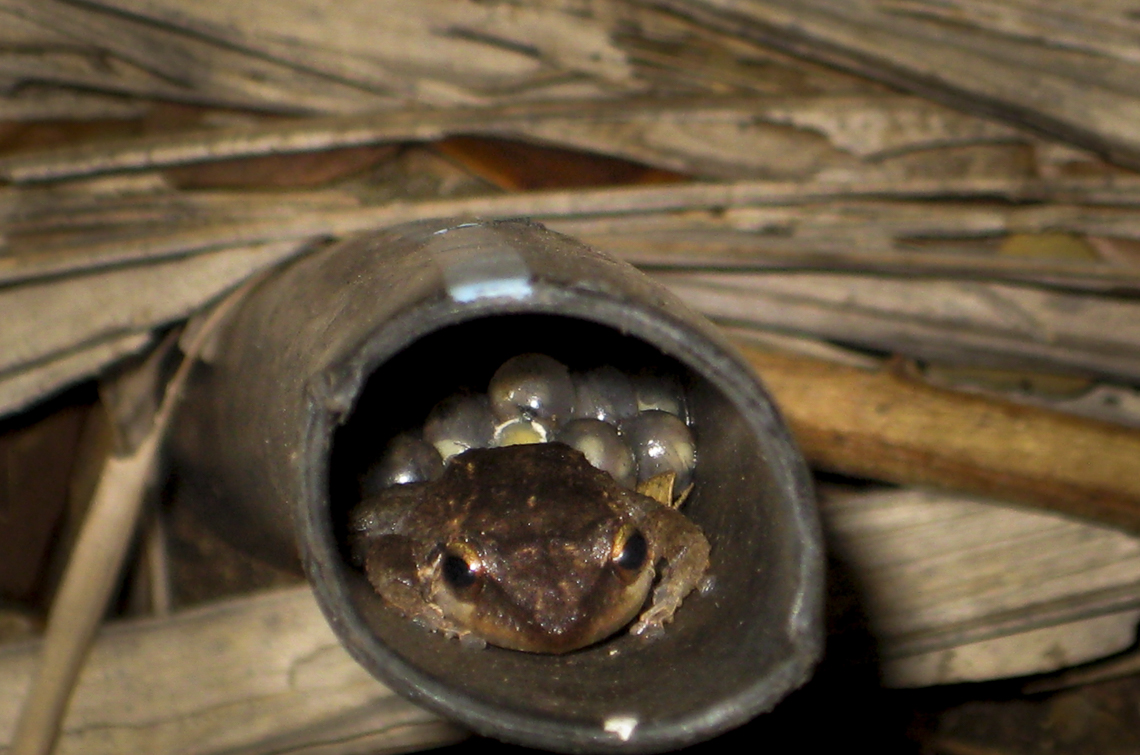
A coqui frog hiding on a landscape plant

A coqui frog hiding on a landscape plant

A recent trip to Hilo highlighted the impact coqui frogs can have on our quality of life. It was not just the chorus heard throughout town and in my hotel room, but the fact that they could be heard while having dinner, enjoying a beach park and hiking through native forests. They’re everywhere. Recent estimates indicate that coqui have infested more than 60,000 acres of East Hawaii, from the ocean to 4,000 feet in elevation. With Hawaii County now planning to liquidate its coqui-control equipment, this noisy neighbor seems to have become a permanent resident on the island of Hawaii.

My work creates many opportunities to talk about coqui, and I am often asked why they are perceived as a nuisance in Hawaii when they are beloved in their native home of Puerto Rico.

One consideration is that they have no natural enemies here and can reach population densities more than twice that of their native range. This may cause significant problems for native insects (which they eat), change soil composition to the benefit of non-native plant species and compete with Hawaii’s native birds for food. Possible economic impacts in infested areas include diminished property values and sales, a change in the quality of visitor experiences due to their persistent nocturnal calls and decreased sales in the floriculture and nursery industry.

During my short visit to Hilo, I learned that a colleague with deep ties to Hawaii agriculture was facing the prospect of moving and foregoing personal professional opportunities, primarily because of the coqui. These experiences strengthened my motivation to keep coqui from becoming widely established on Maui.

Coqui are believed to have been introduced to Hawaii by hitchhiking on plants or associated products in the late 1980s. Since then, coqui have shown up on most of the main Hawaiian Islands, in California, and Guam on plant shipments. This is still the primary avenue for dispersal, particularly from heavily infested areas. To help minimize the risk of introducing coqui to your neighborhood, the Maui Invasive Species Committee

Signage indicating the coqui-free status of a local business.

Signage indicating the coqui-free status of a local business.

started a coqui-free certification program. The voluntary program encourages plant industry participants to adopt specific practices to reduce movement via the nursery trade. If you see a business designated as “coqui-free,” you can feel confident that you will not be purchasing coqui along with your plants or plant products.

Like the Big Island, Maui has coqui. Unlike the Big Island, Maui has only six infested areas, which cover an estimated 227 acres. Eleven population centers (areas with five or more calling males) have been removed since 2004. Five others have very low numbers of coqui. Really, only one substantial population remains. Maui has kept populations from becoming established by quickly responding to reports of new coqui locations. Although new introductions from infested areas are a constant concern for Maui residents, quickly identifying and capturing a few rogue males typically prevents a couple of coqui from becoming thousands. Left unchecked or unreported, coqui populations on Maui would be sure to rival East Hawaii at some point.

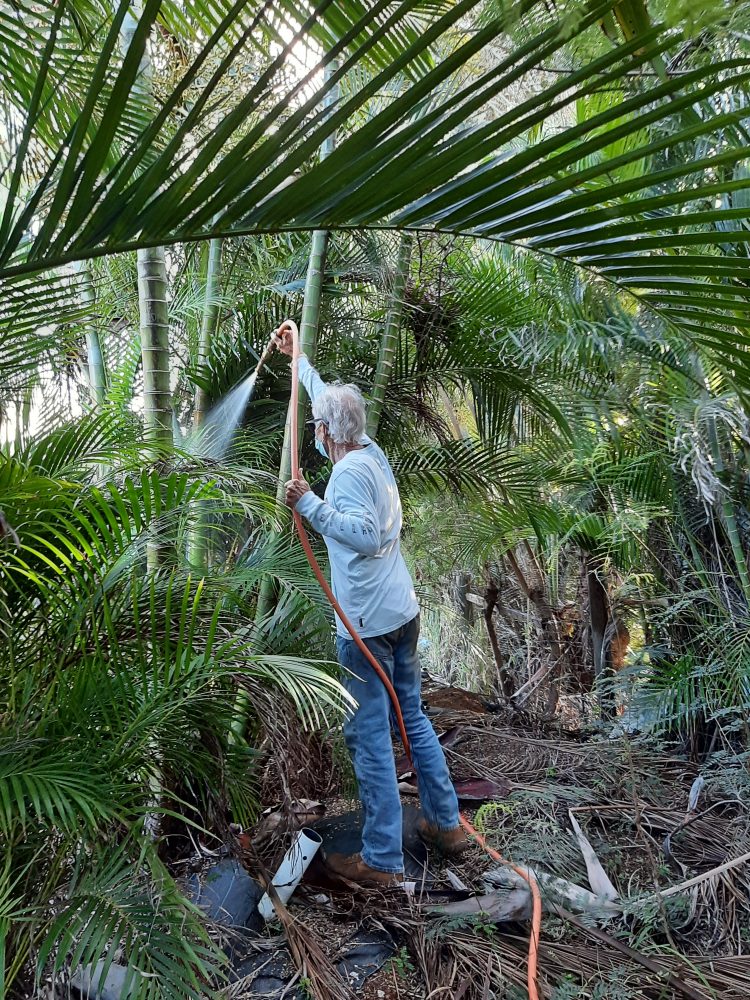
The author preparing a large-volume sprinkler for citric acid delivery.

The author preparing a large-volume sprinkler for citric acid delivery.

In Haiku, for example, an area that once had low numbers of coqui has now spilled over into a steep-sided gulch. Efforts have begun to remove coqui from the 225-acre area by applying a 12 to 16 percent solution of citric acid (a food additive). But challenging terrain and trying to work at night (when coqui are most active) have demanded the development of creative citric application tools. These include fixed-line sprinklers, high-volume sprayers and even limited use of a helicopter in inaccessible areas. Although daunting, successful control efforts over the last four years have shown that the key to preventing coqui from permanently establishing is early detection of new locations, repeated systematic treatment of known populations and removal of frog-friendly habitat.

Unfortunately, even the combined resources of state and county agencies on Hawaii, as well as regular outings by community-based coqui control groups, have been no match for the coqui.

On Maui, we only have one large population left. We still have a strong chance to become and remain coqui-free. Please help by calling the Maui Invasive Species Committee at 573-MISC (6472) if you happen to hear a coqui frog.

More information about the coqui-free program can be found at www.coquifreemaui.org.

Adam Radford is the operations manager for the Maui Invasive Species Committee. He manages MISC’s efforts to control invasive plants, animals, and banana bunchy top virus.

Originally published in the Maui News, March 14, 2010 as part of the Kia‘i Moku Column.
You can find all the articles in the Kia‘i Moku series
http://www.hear.org/misc/mauinews/

Get involved! Help survey for Little Fire Ants Saturday, October 22.

MISC staff assist the Hawaii Department of Agriculture surveying for little fire ants. MISC file photo.

MISC staff assist the Hawaii Department of Agriculture surveying for little fire ants. MISC file photo.

Little fire ants (LFA) are devastating communities across the Pacific. Passive and deceitfully small in size, these South American imports pose a grave threat to Hawaii. They can deliver a painful sting, blind animals, and reduce biodiversity.

A cat on the big island blinded from a fungal infection, the likely outcome of little fire ant stings. MISC file photo.

A cat on the big island blinded from a fungal infection, the likely outcome of little fire ant stings. MISC file photo.

You can help!  We’re conducting a neighborhood survey for the LFA Saturday, October 22, from 8:30 am to 12pm. The little fire ant has been found once on Maui, and because the infestation was small it was eradicated. However, the source of the infestation has never been determined and there’s a good chance LFA are somewhere else on Maui. Your help in getting the word out is greatly appreciated!

Please contact us through the form below or at miscpr@hawaii.edu by October 19th if you are interested in participating. We’ll contact you with more details.

More about the little fire ant…

If LFA were to become established in Hawaii, they would become the state’s most devastating pest. Throughout the Pacific, LFA has overwhelmed communities. If we do not stop the spread of the little fire ant we stand to lose much of our agricultural industry. We will lose our ability to grow our own food, enjoy our yards, and hike through the forest. Ground nesting seabirds and sea turtle hatchlings will be attacked, along with many of our rare insect species. Once little fire ant is established, there is little hope of eradication. Learn more through the postings on this blog under the category invasive animals.

I thought we already had fire ants here?

Don't confuse the little fire ant with the much larger and widspread tropical fire ant (above). Photo courtesy of HDOA

Don't confuse the little fire ant with the much larger and widspread tropical fire ant (above). Photo courtesy of HDOA

Yes, the tropical fire ant, Solenopsis geminata, has been in Hawaii since the 1940s. While the tropical fire ant is a serious and unpleasant pest, it pales in comparison to the little fire ant. LFA are ½ the size of the tropical fire ant, only as long as a penny is thick. LFA typically sting people on their necks as they rain down from trees . Learn to tell the difference here or at www.reportapest.org.

To report suspected infestation of the little fire ant in Maui County call MISC at 573-6472. Visit www.lfa-hawaii.org to learn more and to report infestations throughout the state.

Residents urged to report unusual stinging fire ants


An infestation of the much-dreaded little fire ant (LFA), Wasmannia auropunctata, was discovered on a farm in Waihee, Maui, in early October of 2009, the first known LFA foothold on the island. As reported in the Oct. 16 Maui News, Hawaii Department of Agriculture (HDOA) will be working with the owner to eradicate the ½-acre infestation; LFA may have been at this site for a year. These tiny pale-orange ants deliver painful stings that develop into large red welts; some people are more sensitive to them than others. LFA may be perceived by many as less of a threat than the red imported fire ant but is nevertheless a very serious pest that can attain high densities, and its powerful sting poses problems for domestic animals, wildlife, agricultural workers and others who come in contact with it.  When populations build up outdoors, they eventually come indoors and sting people in their homes. In this regard it is actually worse than the other “imported fire ants” on the mainland.  Details of the LFA threat and how to combat it are nicely summarized in a CTAHR leaflet, available at www.ctahr.hawaii.edu/oc/freepubs/pdf/IP-LFA.pdf

An entire colony of the little fire ant can fit inside a macadamia nut shell. Photo by Hawaii Department of Agriculture

An entire colony of the little fire ant can fit inside a macadamia nut shell. Photo by Hawaii Department of Agriculture

Native to South and Central America, LFA has invaded locations in West Africa, Florida, the Galapagos Islands, several Pacific island nations (New Caledonia, Wallis and Futuna, Solomon Islands, Vanuatu, and Tahiti), Israel, and Australia.

Though LFA was first detected in Hawaii on the Big Island in March 1999, it is believed to have been there for at least four years before it was discovered; a lag between invasion and detection is regarded as “normal.” In retrospect, LFA likely had reached Hawaii from Florida; genotypes of Hawaii LFA are essentially identical to some LFA specimens from the Lake Placid area of central Florida. As soon as LFA was discovered in Puna in 1999, HDOA realized the seriousness of the situation. They developed a pest advisory and assigned an entomologist to lead efforts to address this new invasion, involving detection, experimental efforts at eradication of local populations, and inter-island quarantine.

A 2005 review of HDOA’s efforts to address this serious ant pest suggested that they were “hindered by low staffing levels; lack of public and commercial awareness; lack of access to nursery sales records; the difficulty of detecting this ant; lack of a registered ant control product for use in orchard fruit and vegetable crops; the failure of most people to take the threat of its invasion seriously. HDOA demurred from an all out eradication effort and enactment of an intra-island quarantine to prevent infected nurseries from selling plants.”  The fact that some plant nurseries were infested and probably selling infested plants made containment virtually impossible.  By September 1999, LFA was known to occupy 30 acres in three populations. By January 2004, there were known to be 31 populations totaling nearly 200 acres; eight of the populations at that time involved nursery infestations and the nurseries were still selling plants. LFA is currently coalescing in Hilo and Puna, much as coqui frogs are doing.

Don't confuse the little fire ant with the widespead tropical fire ant (top). Report little fire ants imediately!  Photo by Hawaii Department of Agriculture.

Don't confuse the little fire ant with the widespead tropical fire ant (top). Report little fire ants imediately! Photo by Hawaii Department of Agriculture.

Maui has been determined to keep this ant out. Early detection efforts have been underway here for almost a decade, some involving students in intermediate and high schools. HDOA has implemented largely effective interisland quarantine that has at least helped to delay the infestation for a decade. What’s next?

Maui residents have shown impressive resolve in keeping the coqui frog confined to a relatively few areas, and coqui eradication is still considered a possibility. Most on Maui consider LFA a much more serious pest than coqui. We have the advantage of being able to learn from the Big Island’s experience. Obviously, the community needs to play a major supporting role if there is to be hope of sustained LFA eradication. One way to prevent LFA from being established is to report unusual stinging ants.  True to their name LFA are small, about as long as a penny is thick, with a sting disproportionate to their size.  Please call HDOA at 873-3962 or MISC at 573-6472 if you think you may have found LFA.

Will Maui citizens be able to pull together to effectively address the LFA threat?

Visit www.lfa-hawaii.org to report an infestation or www.littlefireants.org to learn more.

By Committee Member Lloyd Loope. Dr. Loope is a research scientist with the U.S. Geological Survey stationed at the Haleakala Field Station.  He holds a doctorate in botany from Duke University and is an active member of the Maui Invasive Species Committee.

Originally published in the Maui News, September 14, 2009 as part of the Kia‘i Moku Column.
You can find all the articles in the Kia‘i Moku series
http://www.hear.org/misc/mauinews/

Follow

Get every new post delivered to your Inbox.