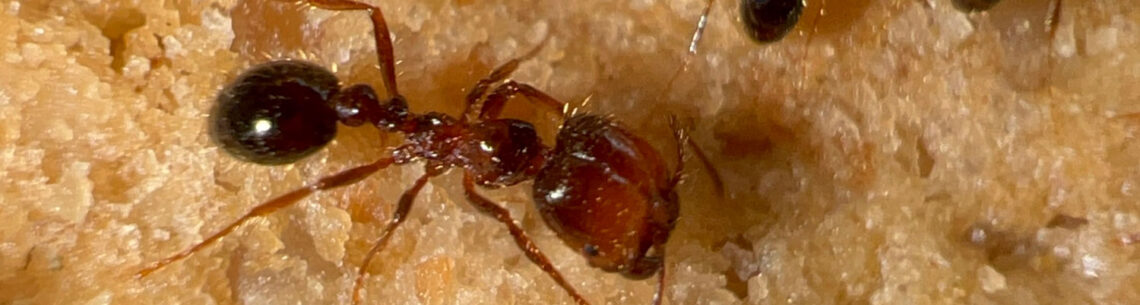
Tropical Fire Ant
Solenopsis geminata
Species Info General
Other common names include: Red Ant, Big-headed Native Fire Ant
This is the aggressive and common fire ant that has been bothering Hawaiʻi residents since at least as far back as the 1860s. Wheeler (1910) wrote “Solenopsis geminata, the ‘fire-ant,’ is armed, as its popular name indicates, with a formidable sting which it uses on the slightest provocation.” Forel (1893) wrote “These ants are very pugnacious, especially when their central nest is disturbed. The sting is unpleasant, but not very painful.” However, many would beg to differ: the sting of this ant is both unpleasant and pretty painful. Indeed, Creighton (1950) referred to this ant’s sting as “particularly painful”. Forel (1893) went on to say “They seem to live principally, if not entirely, on vegetable matter; they are especially fond of sweet substances. I have found considerable quantities of grass-seeds stored in small chambers in their nests.” In Hawaiʻi, Tropical Fire Ants thrive best in dryer, leeward areas where it has less competition with the moisture-preferring African Big-headed Ants with which it does not get along. As a result, encounters with this fire ant are frequently reported from beach parks, sand dunes, road shoulders, and other sunny, open areas like lawns, soccer fields and the like. This preference for dry, sunny locations is in stark contrast to the Little Fire Ant (Wasmannia auropunctata) which thrives best in the wet, hot and humid forested areas of the north shore.
Deyrup (2017) preferred the common name “Big-headed Native Fire Ant” in his book on the ants of Florida, perhaps because this ant is native to not just tropical zones but also to temperate areas in the American South, and perhaps also to distinguish this species from the non-native invasive fire ants that began showing up in the U.S. in the early 1900s. As for the Tropical Fire Ant’s native range, Trager (1991) wrote, “S. geminata is apparently native from the southeast coastal plain and Florida to Texas . . . south through Central America to northern South America”.
With such a widespread footprint in the Islands, Tropical Fire Ants are not targeted for eradication by MISC or any other agency. Fortunately, they tend to respond readily to many ant baits available at most any hardware or garden store. Despite this ant being so common, MISC encourages community members to submit samples of any suspected fire ant that they encounter: in addition to confusion with the much smaller Little Fire Ant (which is targeted for eradication), the very similar-looking Red Imported Fire Ant (RIFA) that plagues the American South could show up here in Hawaiʻi at any time. RIFA would absolutely be targeted for eradication if it were to show up. Frequent fire ant samples sent in by community members will increase our chances of catching a RIFA invasion early while there is still a chance to eradicate it.
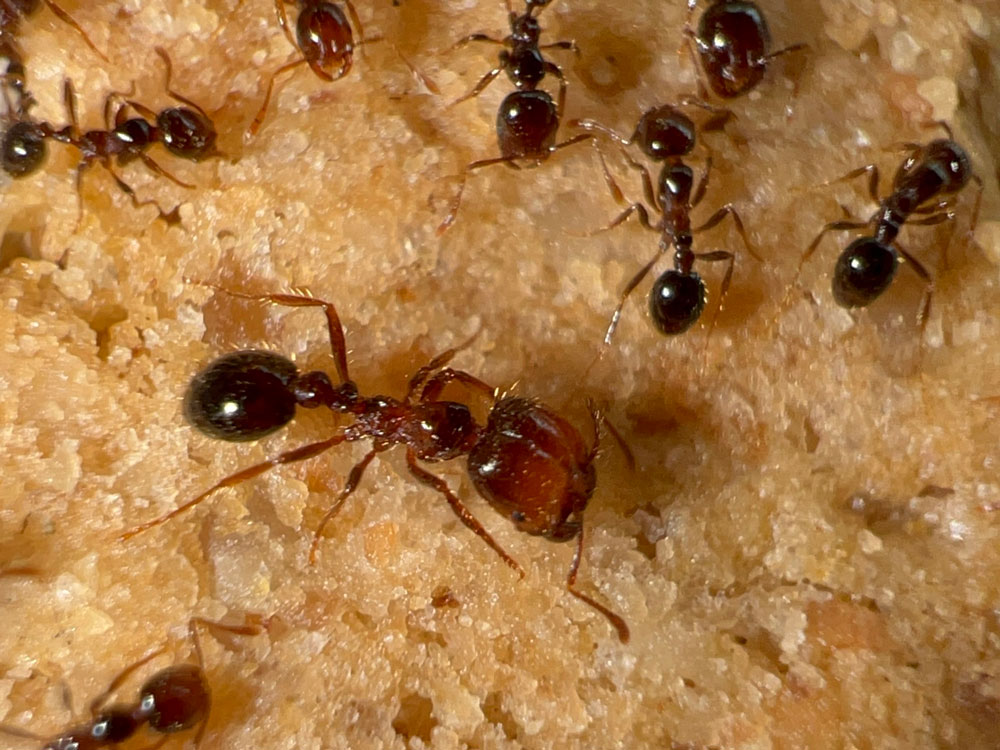


Identification/Description
Tropical Fire Ants are variable in both size and color, but tend to be a light red to dark brick-red color and noticeably larger than the ants you tend to find on the kitchen counter. This species is noted for having occasional individuals with disproportionately large heads. Most of the ants in the colony, however, have heads that are quite normal looking. Forel (1893) wrote “In their movements the small-headed workers are moderately active; the large-headed ones move slowly, and in a staggering way.”


Impacts
- Serious nuisance species with painful stings that occasionally lead to dangerous allergic reactions
- At times, a nuisance to agriculture via its appetite for fresh seeds: they will sometimes collect seeds from your garden soon after you plant them, while later they chew on the freshly sprouted seedlings of the seeds that they previously missed (Jerdon 1851; Forel 1893; Wheeler 1910; Lewis 1912; Essig 1926; Holdaway & Look 1941; Wolcott 1948; Reimer, Beardsley & Jahn 1990, Tschinkel 2006)
- From Smith (1936): “This is one of the most versatile ants known. The workers are noted for their predaciousness, as well as for their love of seeds, the juices or sap of plants, and honeydew. To one who has lived in Puerto Rico it would seem that there are very few plant lice, soft scales, mealybugs, etc., that these ants do not attend.”
- Like many ants, it will tend aphids, scale, mealybugs and similar agricultural pest insects: “It is one of the species that are very fond of attending scale insects and, by protecting these, must cause, indirectly, considerable damage.” (Mann 1920)
- At other times, however, this ant “might safely be placed in the list of beneficial insects. W. E. Hinds, of the Department of Agriculture, reports that it is an established enemy of both the Cotton leaf worm and Cotton boll weevil, while I have personally seen these ants capture and carry off several leaf roller larvae.” (Lewis 1912). Others have observed this ant attacking melon flies & corn leafhoppers (Fullaway & Osborn (1917).
History
- This species was on the first annotated list of ants in Hawaiʻi, published in 1879, but for nearly a century was confined almost exclusively to Oʻahu. In 1945 Fullaway & Krause wrote “Apart from the Mahukona district in the northwest section of the island of Hawaii, where it was observed on one occasion, this ant is found only on Oahu”. These fire ants made it to Molokaʻi in the 1950s, Maui in the 1960s, Lānaʻi in the 1980s, Kauaʻi in the 1990s and were first detected on Kahoʻolawe in 2003.
Resources/References
- Solenopsis geminata – AntWiki
- Creighton, W. S. 1950. The Ants of North America. Bulletin of the Museum of Comparative Zoölogy at Harvard College 104: 1–585.
- Deyrup, M. 2017. Ants of Florida – Identification and Natural History. CRC Press, Boca Raton, Florida. 423 pp.
- Essig, E. O. 1926. Insects of Western North America. The MacMillan Company, N.Y. 1035 pp.
- Forel, A. 1893. Formicides de l’Antille St. Vincent. Récoltées par Mons. H. H. Smith. Décrites par le Dr. Auguste Forel [Ants of the Antilles of St. Vincent. Collected by Mr. H. H. Smith. Described by Dr. Auguste Forel]. The Transactions of the Entomological Society of London for the Year 1893 4: 333-418.
- Fullaway, D. T. & Krause, N. H. L. 1945. Common Insects of Hawaii. Tongg Publishing Co., Honolulu. 228 pp.
- Fullaway, D. T. & Osborn, H. T. 1917. [Notes & Exhibitions]. Solenopsis geminata. Proceedings of the Hawaiian Entomological Society 3(4): 284.
- Holdaway, F. G. & Look, W. 1942. Insects of the Garden Bean in Hawaii. Proceedings of the Hawaiian Entomological Society 11(2): 249–260.
- Jerdon, T. C. 1851. A Catalogue of the Species of Ants found in Southern India. Madras Journal of Literature and Science 17: 103–127.
- Lewis, L. V. 1912. [Notes & Exhibitions]. A Few Notes on Solenopsis geminata. Proceedings of the Hawaiian Entomological Society 2(4): 175–178.
- Mann, W. M. 1920. Additions to the Ant Fauna of the West Indies and Central America. Bulletin of the American Museum of Natural History 42(8): 403–439.
- Reimer, N. J., Beardsley, J. W. & Jahn, G. 1990. Pest Ants in the Hawaiian Islands. In Vander Meer, R. K., Jaffe, K. & Cedeno, A. (Editors). Applied Myrmecology – A World Perspective, Westview Press, Boulder, San Francisco, Oxford. pp. 40–50.
- Trager, J. C. 1991. A Revision of the Fire Ants, Solenopsis geminata Group (Hymenoptera: Formicidae: Myrmicinae). Journal of the New York Entomological Society 99(2): 141–198.
- Tschinkel, W. R. 2006. The Fire Ants. Harvard University Press, Cambridge, Massachusetts. 723 pp.
- Wheeler, W. M. 1910. Ants: Their Structure, Development and Behavior (1st ed.). Columbia University Press, New York. 663 pp.
- Wolcott, G. N. 1948b. The Insects of Puerto Rico – Hymenoptera. The Journal of Agriculture of the University of Puerto Rico 32(4): 749–975.