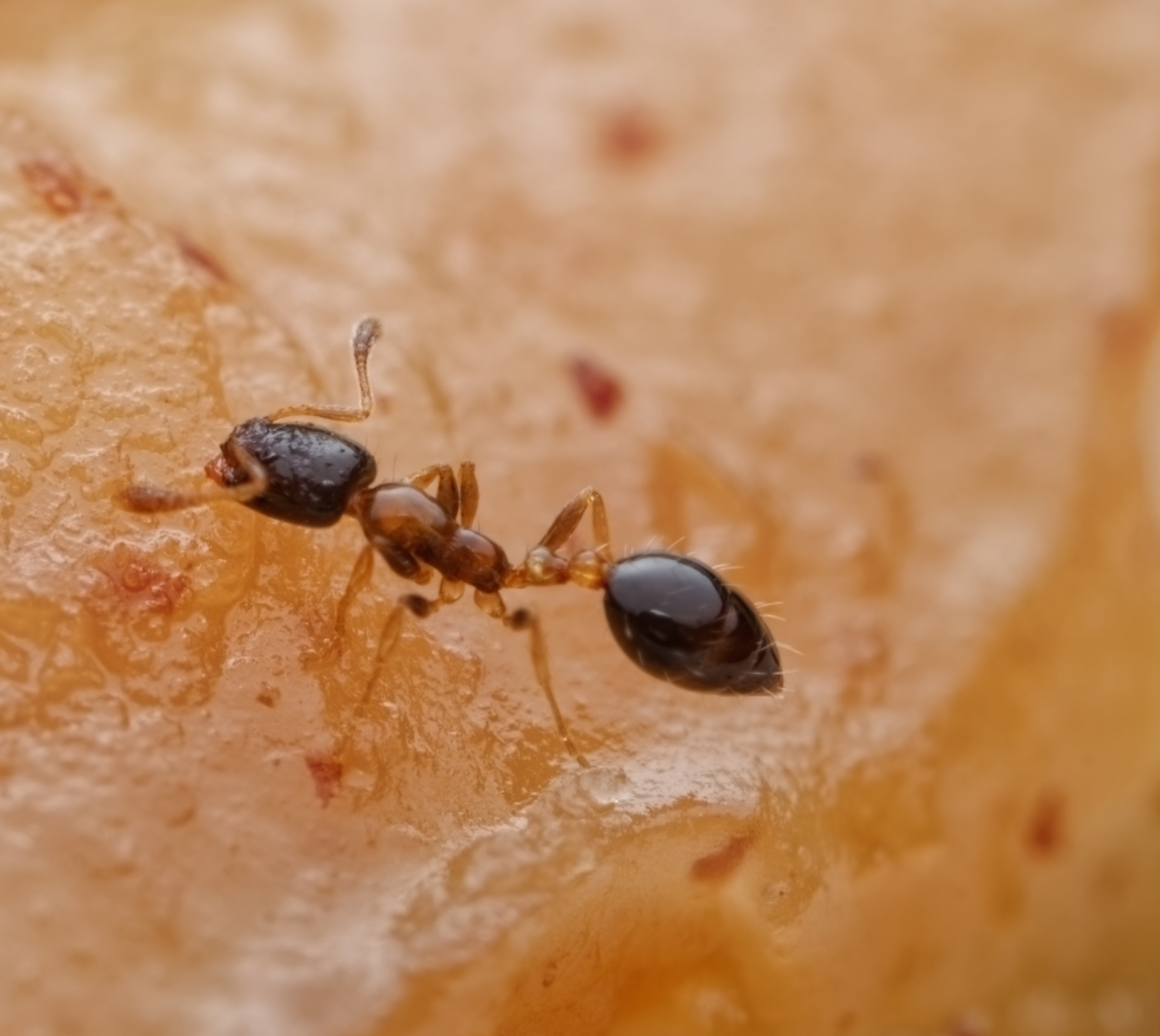
Flower Ant
Monomorium floricola
Species Info General
Other common names include: Bicolored Trailing Ant
This is a very small, slow-moving monochrome-brownish-colored ant. With the common name of “Flower Ant” it should not be surprising that it is often found in the foliage of plants, exploring the flowers. “Under normal conditions floricola appears to be largely, if not exclusively, an arboreal species, nesting in twigs and branches or under the bark of trees and other plants. . . . Workers visit the floral and extrafloral nectaries of plants, tend honeydew-excreting insects, and feed on insects, many of which they doubtlessly kill.” (Smith 1965) Despite its fondness for vegetation, it can also be found on the ground, and is in fact one of the most commonly collected ants on Maui in ground-based ant surveys.
Identification/Description
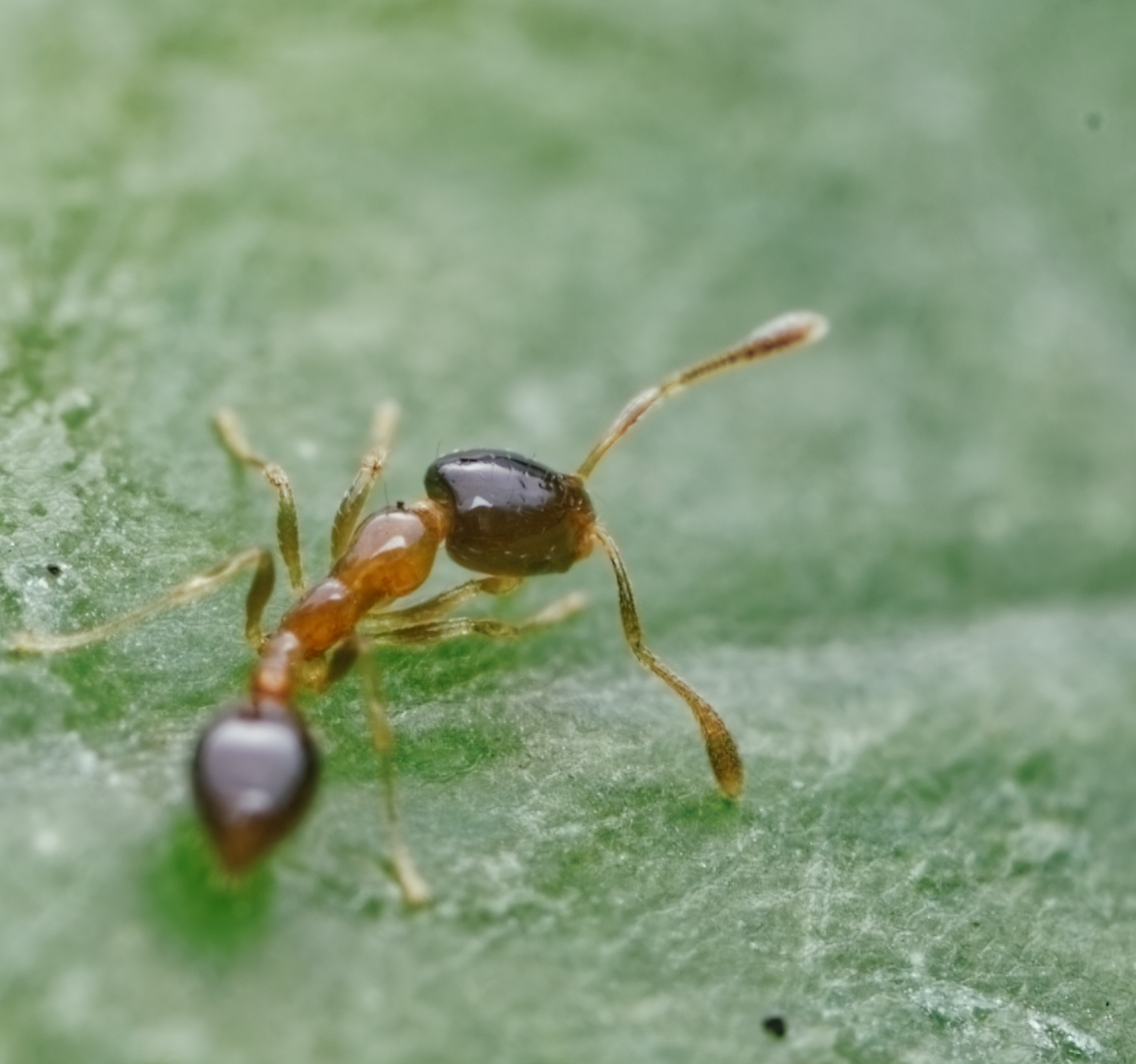
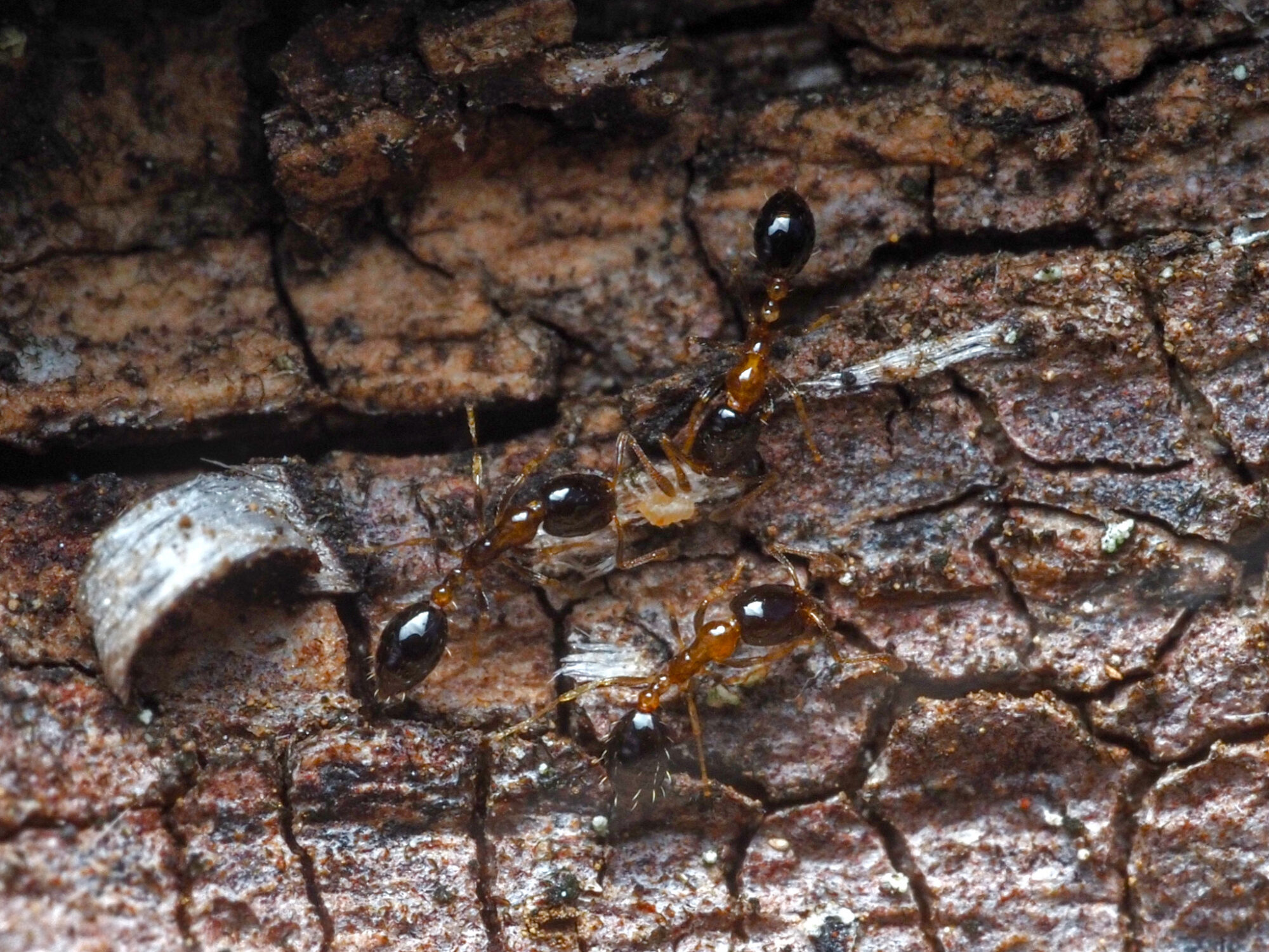
This is a tiny, slender, slow-moving ant most often observed in vegetation. Its coloring is variable, but is consistently shades of brown and black. Most individuals have a paler midsection that contrasts with the darker head and gaster. Though abundant on Maui, it is actually usually unobtrusive and not often noticed: Wetterer (2010) wrote “On our campus here in Jupiter, Florida, M. floricola is inconspicuous and difficult to find in visual searches, yet this tiny species commonly recruits in large numbers to bait placed in trees.”
Impacts
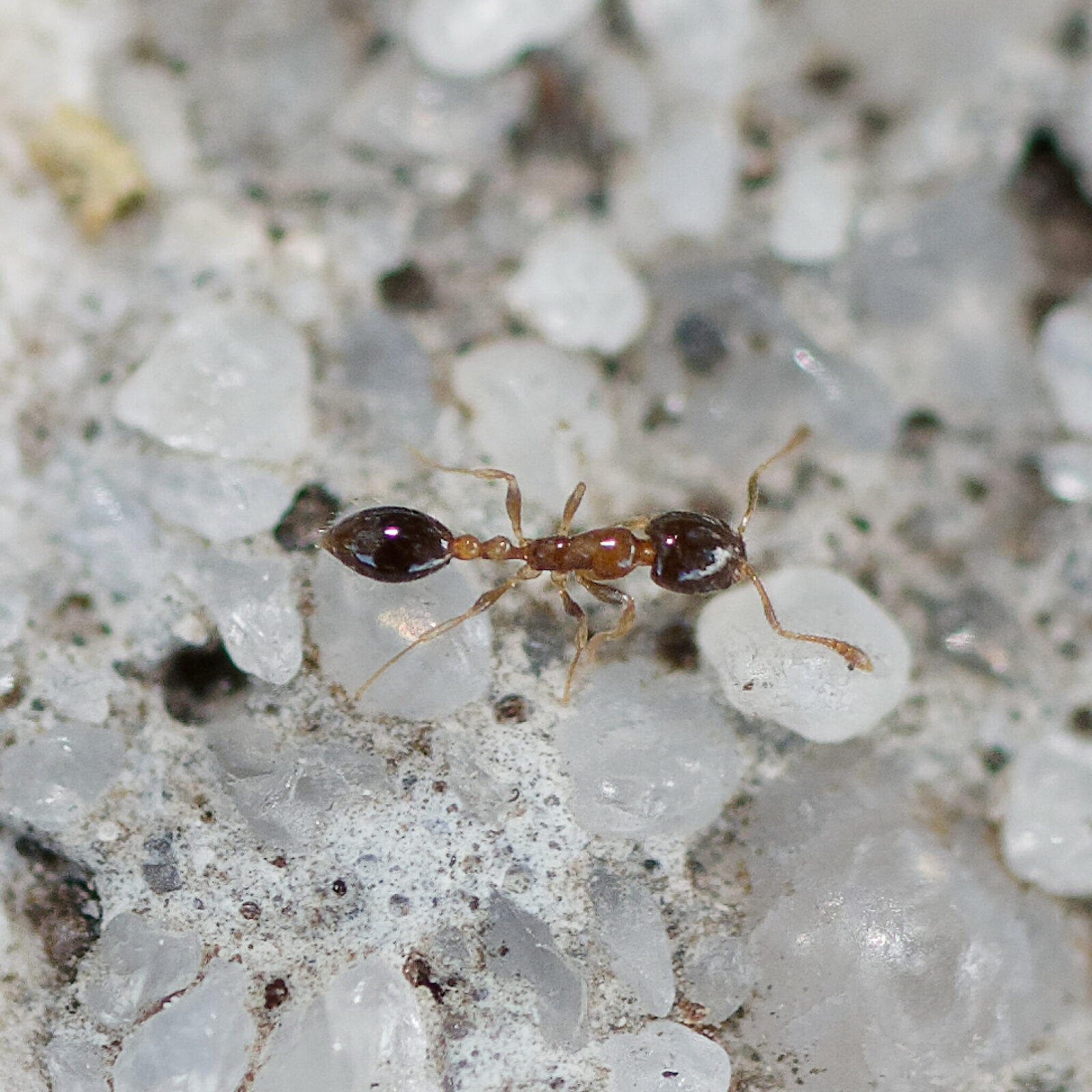
- Wilson & Taylor (1967) wrote that “Colonies seem unable to penetrate undisturbed native forests. However, there is no clear consensus on the impacts of this species. Wetterer (2018) wrote, “Although widespread, M. floricola is rarely considered a serious pest. However, because this species is very small, slow moving, cryptically colored and primarily arboreal, I believe that it is probably often overlooked and its abundance and ecological importance is underappreciated.”
- Smith (1965) wrote that these ants “commonly infest houses”, and Tenorio & Nishida (1995) writing specifically about this ant in Hawaiʻi, reported that it “occurs fairly commonly in homes . . . [and] tends to nest in holes in walls and in trees and plants”.
History
- Flower Ants have a long history in Hawaiʻi, having been first reported in 1886 on Oʻahu (Blackburn & Cameron 1886). By the year 1900 it was believed to be present on all the main islands (Forel 1899). The first record for Kahoʻolawe however was not until 2010 (Starr & Starr 2011).
Resources/References
- Monomorium floricola – AntWiki
- Blackburn, T. & Cameron, P. 1886. On the Hymenoptera of the Hawaiian Islands. Proceedings of the Manchester Literary and Philosophical Society 25: 134–183.
- Forel, A. 1899. Formicidae of Hawaii – Heterogyna. (Formicidae.), Fauna Hawaiiensis 1(1): 116–122.
- Smith, M. R. 1965. House-Infesting Ants of the Eastern United States: Their Recognition, Biology, and Economic Importance. Agriculture Research Service, U.S. Department of Agriculture. Technical Bulletin No. 1326: 1–105.
- Starr, F. & Starr, K. 2011. New arthropod records from Maui Nui. Bishop Museum Occasional Papers 109: 35–42.
- Tenorio, J. M. & Nishida, G. M. 1995. What’s Bugging Me? University of Hawaii Press, Honolulu. 184 pp.
- Wetterer, J. K. 2010. Worldwide spread of the flower ant, Monomorium floricola (Hymenoptera: Formicidae). Myrmecological News 13: 19–27.
- Wetterer, J. K. 2018. Native and Exotic ants (Hymenoptera: Formicidae) nesting in red mangroves (Malpighiales: Rhizophora mangle) of eastern Florida. Transactions of the American Entomological Society 144: 345–356.
- Wilson, E. O. & Taylor, R. W. 1967. The Ants of Polynesia (Hymenoptera: Formicidae). Pacific Insects Monograph 14: 1–109.