Brown Crazy Ant
Nylanderia vaga
Species Info General
Other common names include: n/a
The Brown Crazy Ant is a close cousin of the Robust Crazy Ant (Nylanderia bourbonica), but surprisingly little has been written about this ant. Huddleston & Fluker (1968) wrote, “Occurs sympatrically with [Nylanderia]bourbonica in many habitats, almost as widely distributed with apparently favoring the same ecological conditions”. It is probably safe to assume that this species’ habits are not too unlike those of bourbonica. Like bourbonica, the Brown Crazy Ant does not sting but is known to bite on occasion. Also like bourbonica, the Brown Crazy Ant ant seems to be more common on the windward side of the island. In Fiji, Brown Crazy Ants have been found from sea level up to at least 3300 feet elevation, and “In addition to occurring in even the most disturbed of human landscapes, the species also frequently penetrates into interior forest habitats” (Sarnat & Economo 2012).
This species is one of four widespread ants in Hawaiʻi that share the common name adjective “crazy”, the others being Yellow Crazy Ant, Longhorn Crazy Ant and the aforementioned Robust Crazy Ant. This unofficial term in an ant’s common name refers to its habit of moving around in a speedy, erratic manner.
Identification/Description
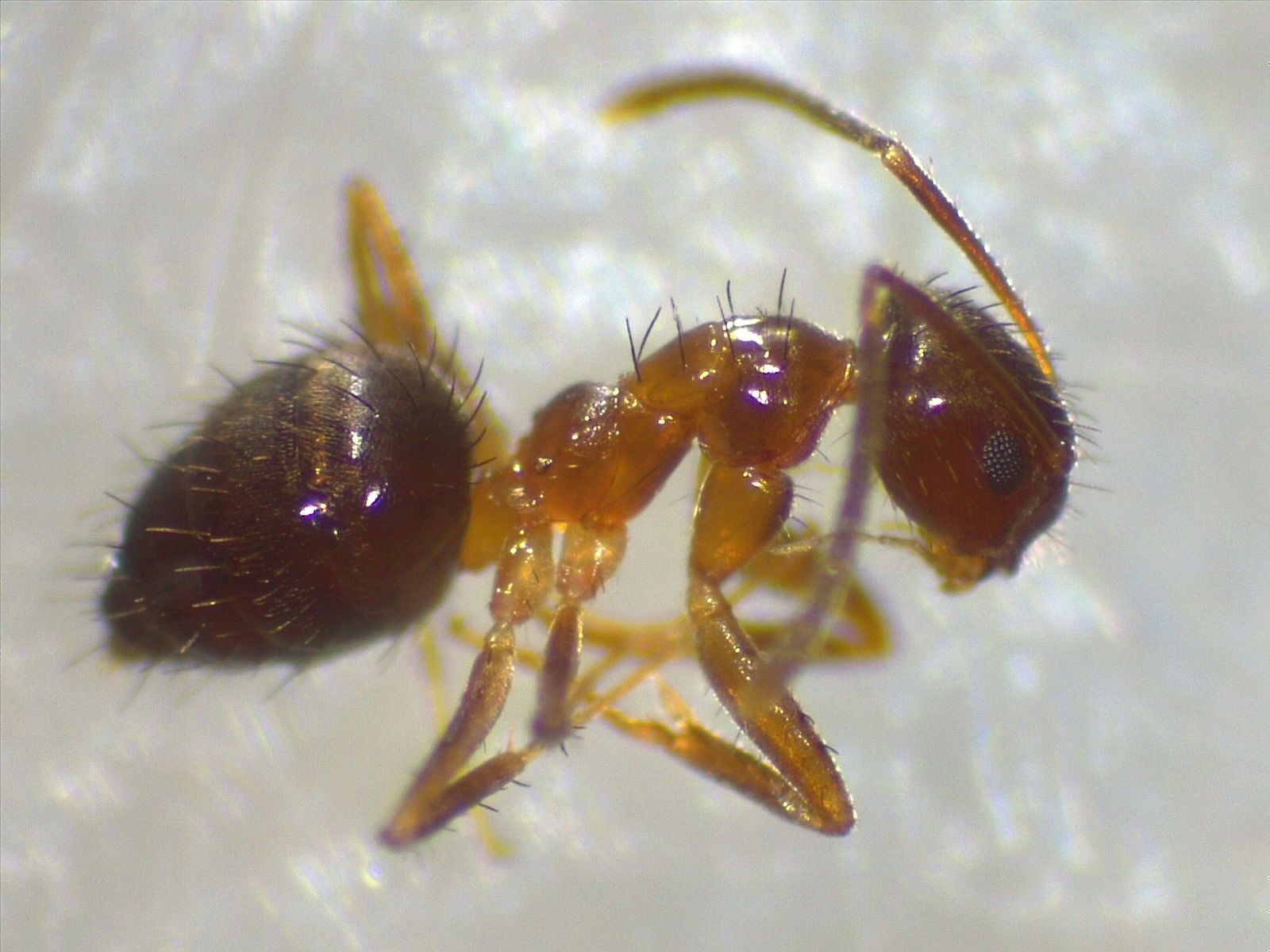
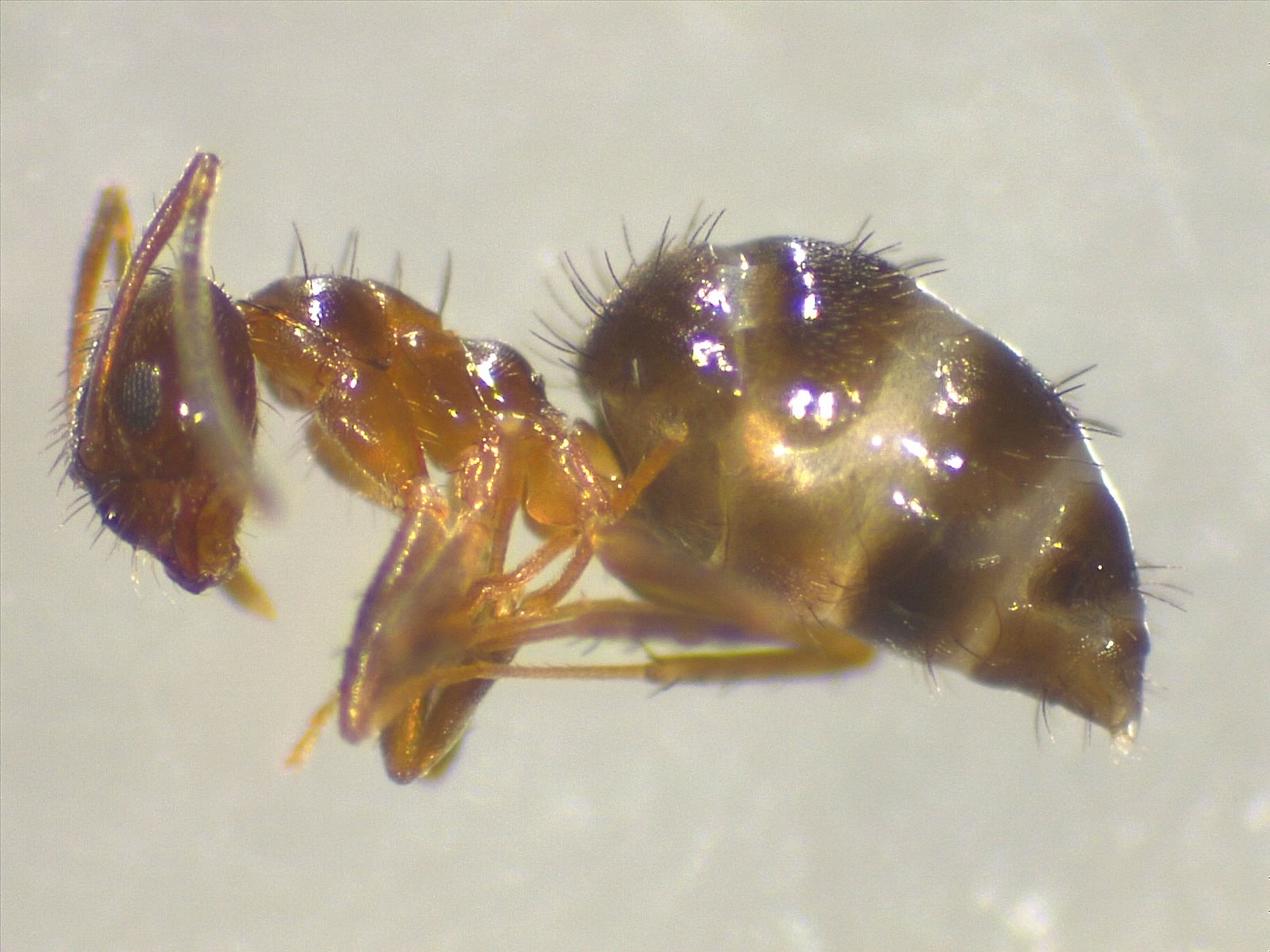
Hawaiʻi has numerous medium-sized, chunky dark ants, and this is one of them. Several of these species are quite black, but Brown Crazy Ants rarely get that dark. Brown Crazy Ants can vary significantly in color from dirty yellow to very dark brown, but most individuals seem to be a smoky honey color with a gaster that is usually a darker shade than the rest of the body. It is a fast moving ant, often moving about erratically, but it does not seem to present itself in large numbers in the same way that its close relative, Nylanderia bourbonica or Robust Crazy Ant, does. Brown Crazy Ants are slightly smaller than Robust Crazy Ants, but this may not be obvious to the naked eye.
Impacts
- Like many ants, Brown Crazy Ants have been seen tending homopterous insects that are agricultural pests, but data is lacking as to whether this ant is a serious problem for either agriculture or biodiversity.
History
- Brown Crazy Ants were detected on Oʻahu in the late 1800s. It was found on Maui as early as 1953 (Starr, Starr & Loope 2008), Molokaʻi in 1967 (Huddleston & Fluker 1968) and on Lānaʻi sometime in the 1980s (Reimer, Beardlsey & Jahn 1990). This ant has not yet been recorded on Kahoʻolawe.
Resources/References
- Nylanderia vaga – AntWiki
- Huddleston, E. W. & Fluker, S. S. 1968. Distribution of Ant Species of Hawaii. Proceedings of the Hawaiian Entomological Society 20(1): 45–69.
- Reimer, N. J., Beardsley, J. W. & Jahn, G. 1990. Pest Ants in the Hawaiian Islands. In Vander Meer, R. K., Jaffe, K. & Cedeno, A. (Editors). Applied Myrmecology – A World Perspective, Westview Press, Boulder, San Francisco, Oxford. pp. 40–50.
- Sarnat, E. & Economo, E. P. 2012. The Ants of Fiji. University of California Press, Berkeley & Los Angeles, California. 384 pp.
- Starr, F., Starr, K. & Loope, L. L. 2008. Survey for Ants on the Island of Maui, Hawaii, with emphasis on the Little Fire Ant (Wasmannia auropunctata). Pacific Cooperative Studies Unit Technical Report 156: 1–47.