Longhorn Crazy Ant
Paratrechina longicornis
Species Info General
Other common names include: Slender Crazy Ant, Brown Crazy Ant, Black Crazy Ant, Hairy Ant, Sugar Ant
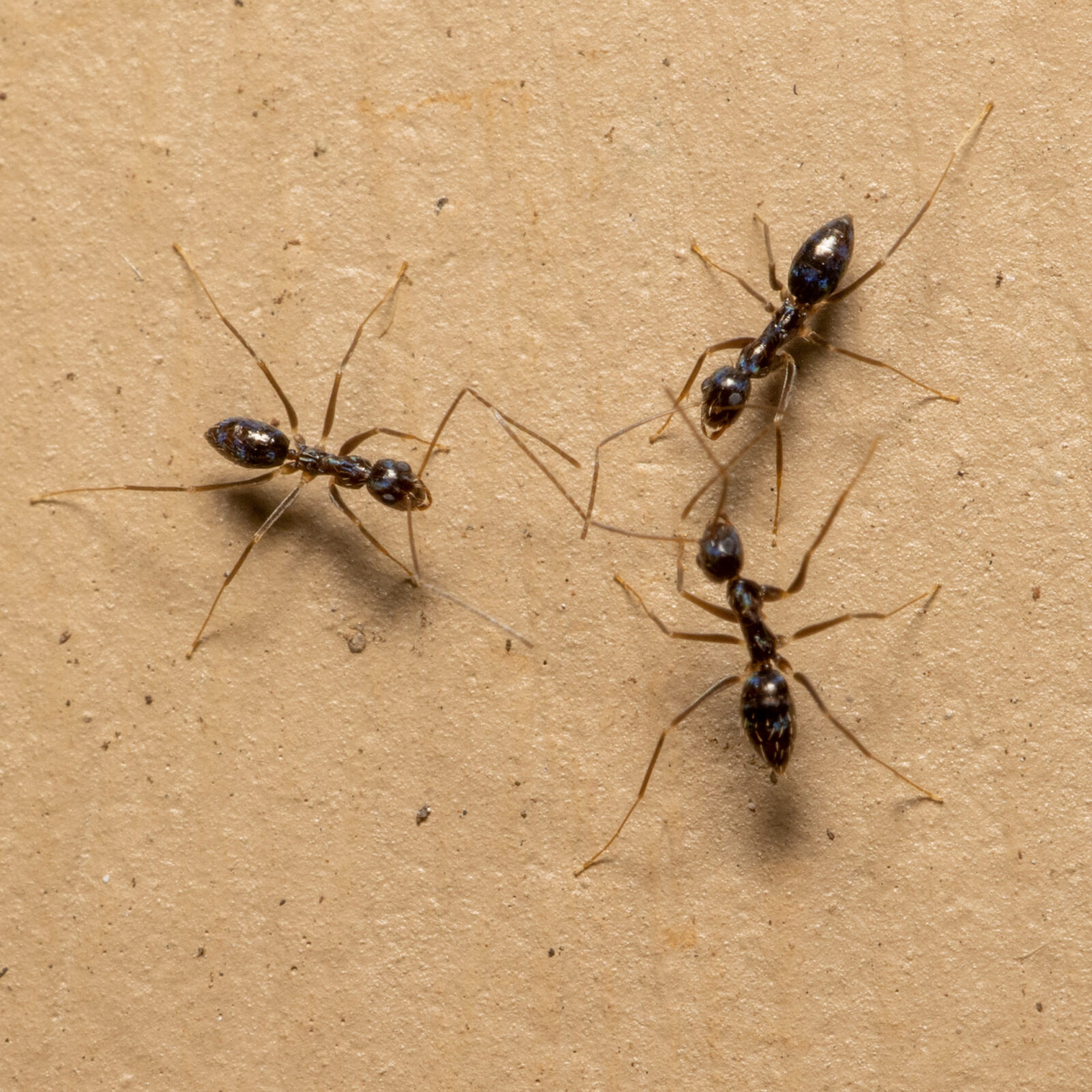
The Longhorn Crazy Ant is one of four widespread ants in Hawaiʻi that share the common name adjective “crazy”, the others being Yellow Crazy Ant, Robust Crazy Ant and Brown Crazy Ant. Seeing this unofficial term in an ant’s common name suggests one can safely infer that this ant tends to move around in a speedy, erratic manner “as if lacking a definite sense of direction” (Smith 1965). This species fits that description quite well. Quoting the famed Dr. William Morton Wheeler, Wolcott (1948) wrote “The slender, long-legged P. longicornis shoots about like an arrow over the rocks and pavements, so that one seems to see only whirling black lines crossing one another on the ground.” It is as if they are in a mortal panic, though there doesn’t seem to be anything threatening around. Although easily seen on open ground at times, this ant seems equally at
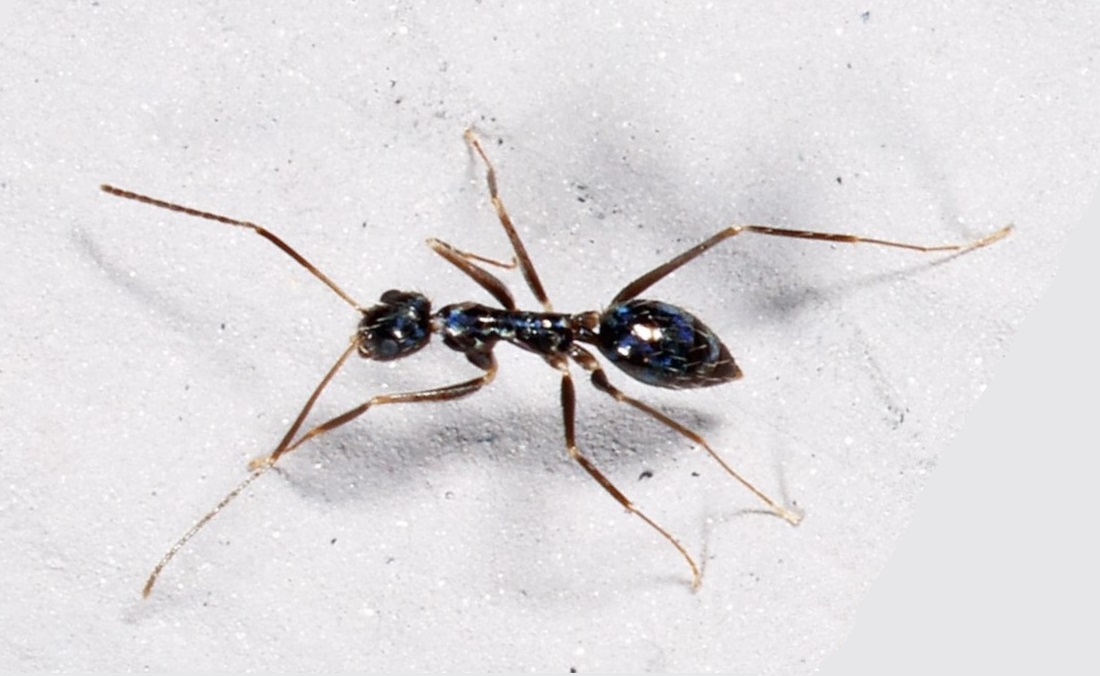
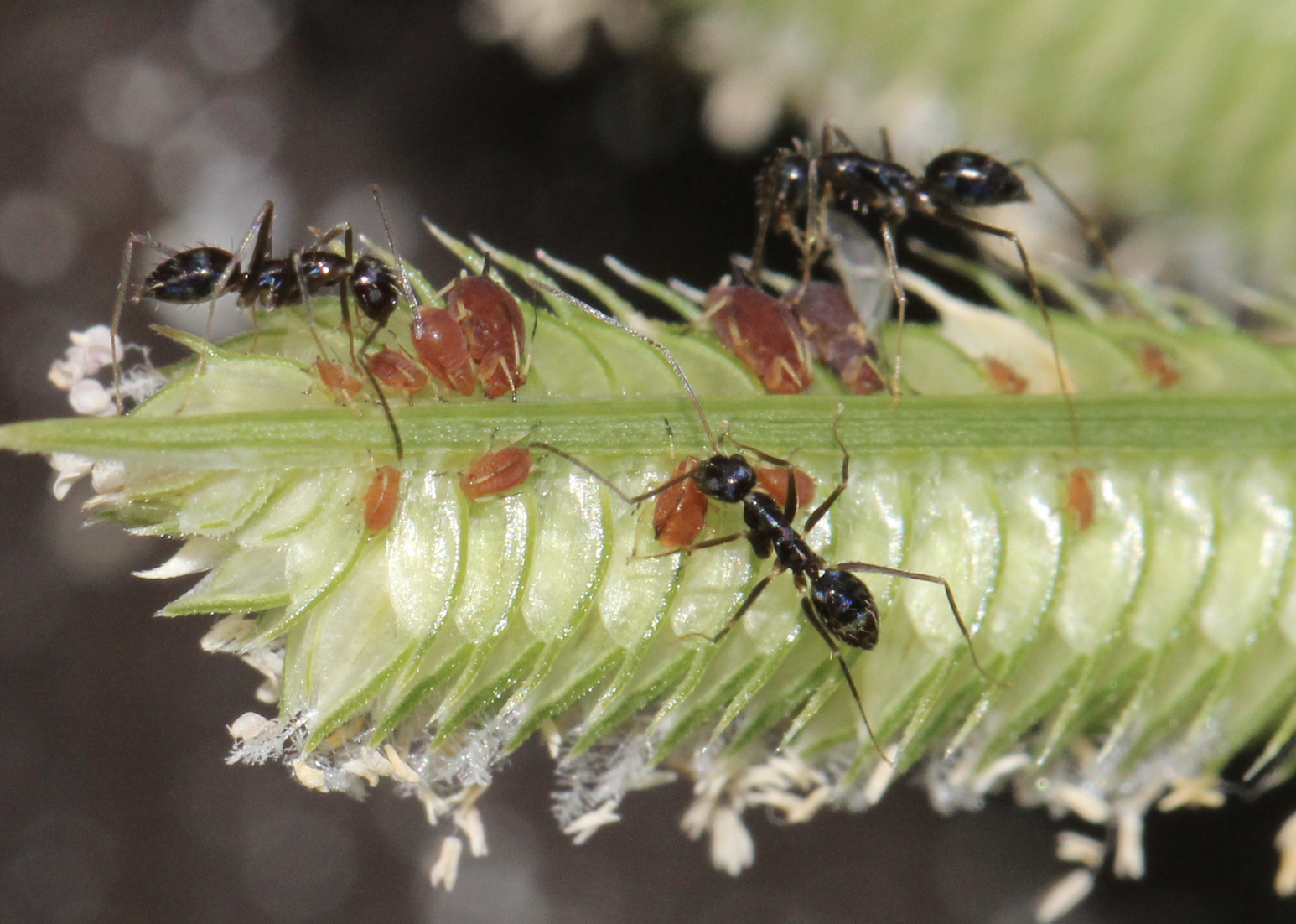
home up in trees (Fullaway & Krause [1945] wrote that it commonly nests in hollows of kiawe trees). This is a slender, long-legged ant with extraordinarily long antennae (hence the other part of its common name – “longhorn”). Deyrup (2017) reports that this species neither bites nor stings.
Wilson & Taylor (1967) wrote “It is especially well adapted to dry habitats and abounds in the most urbanized portions of many tropical towns and cities.” Indeed, on Maui, this ant is more often found thriving from leeward coastal areas like Kīhei and Lahaina through central Maui to Kahului, rather than along the wet parts of the North Shore. This ant’s food habits clearly qualify it as being omnivorous, however they “seem especially fond of sweets” (Smith 1965).
Auguste Forel, a famous Swiss myrmecologist of the late 19th and early 20th centuries with a particular interest in the ants of Hawaiʻi, wrote this entertaining anecdote about this ant pestering him as he tried to mount insect specimens for his collection:
“The workers are very active and bold; when foraging they run jerkily from side to side. They are especially fond of dead animal matter. When working over insects I have often been amused, as well as annoyed, to observe the boldness of these little foragers. If an ant discovers one of the insects she seizes it at once, and tries to drag it from the table. If I brush her off, she dodges around and behind the precious morsel, and seizes it again. Driven quite away, she runs to some shelter, but returns almost immediately, trying to drag the insect even from my fingers; and nothing short of mutilation or death will effectually stop her. One ant will drag away a load ten times as large and heavy as herself, always walking backwards, and pulling the prize after her. If it is too heavy for her unaided efforts, she runs for other foragers. As soon as she finds a companion she communicates her excitement with a touch of the antennae, and both return to drag off the prize. I have seen perhaps a hundred of these ants dragging a dead lizard across the floor; the lizard was about five inches long, and the ants dragged it more than a foot in ten minutes. . . . I have seen about fifty of these ants dragging a large cockroach about three feet up a perpendicular smooth-plastered wall.” (Forel 1893)
Identification/Description
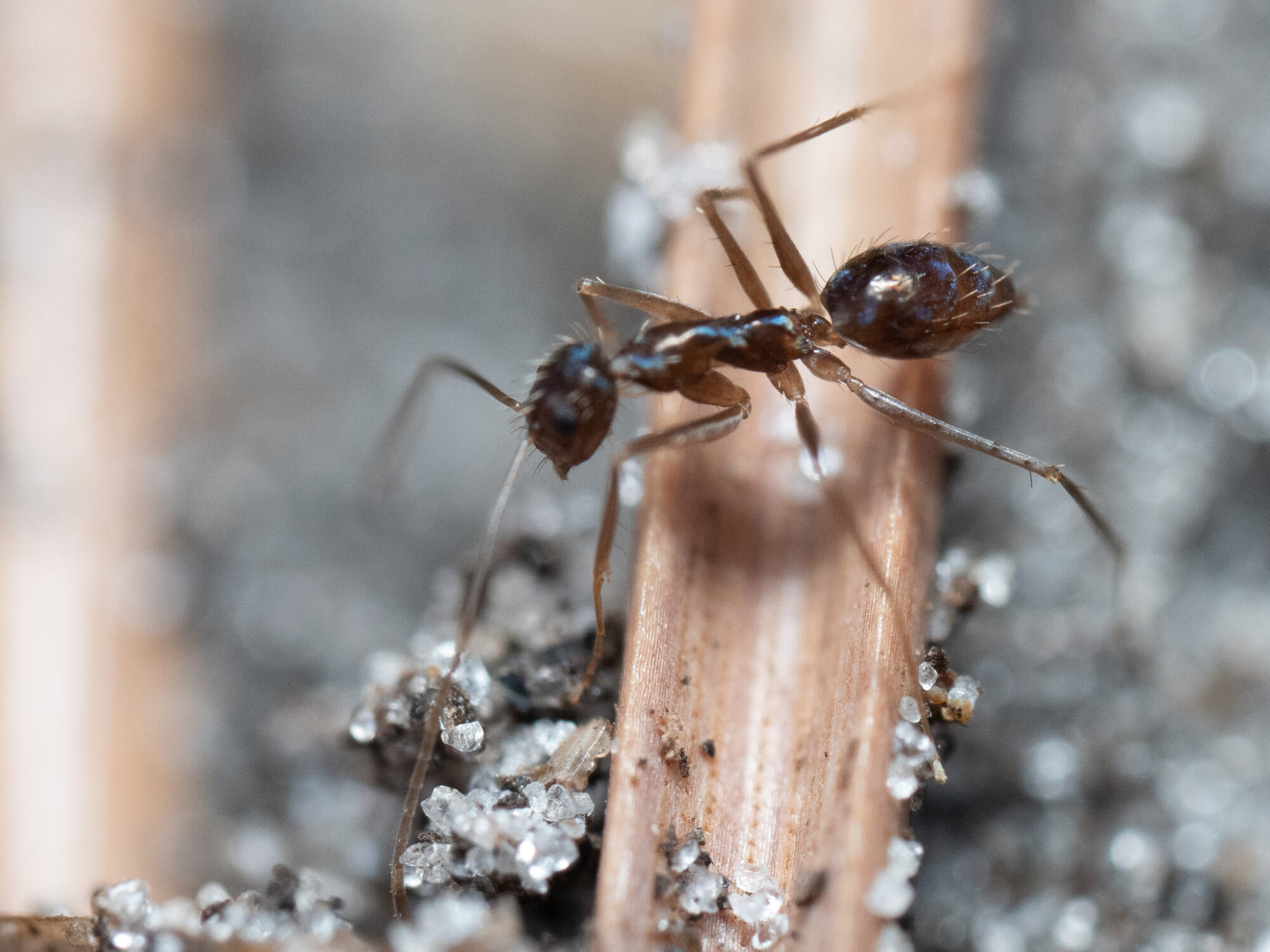
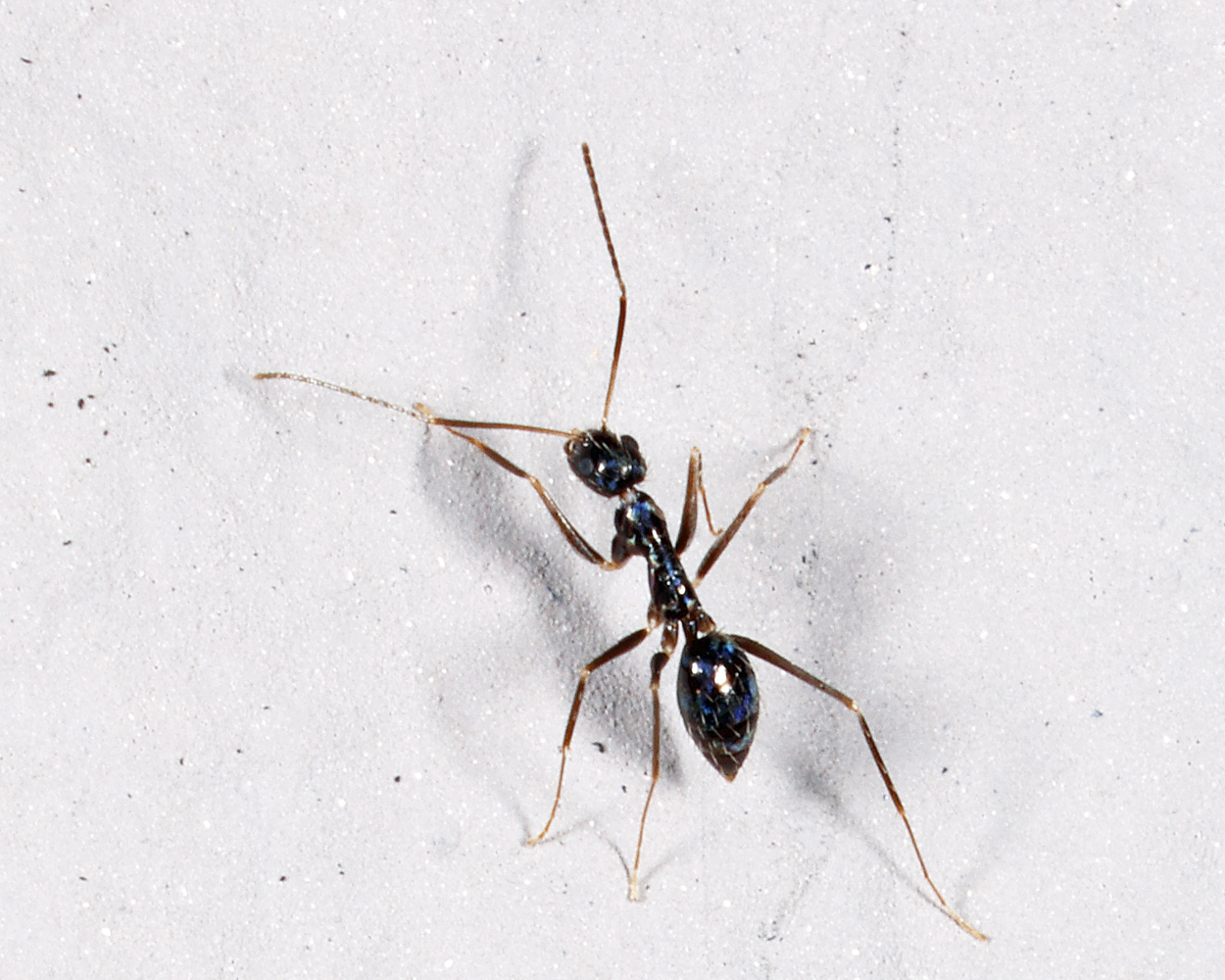
Longhorn Crazy Ants are very dark, nearly black. They are quite hairy and sometimes show a purplish or bluish shine. In comparison to our other blackish ants, many of which are rather plump, this ant is quite slender. Smith (1936) wrote “The worker is easily recognized by its slender, graceful form, black color, and exceedingly long legs and antennae.” Wolcott (1948) wrote “it lives on sandy beaches, especially under the older fronds of coconut palms” and Deyrup (2017) suggested that beaches and high-tide lines were “possibly the natural habitat of longicornis in its primeval range”. Deyrup further relates that this species “seems to be programmed for a constant quest for an ideal nest site. Colonies, or large fragments of colonies, are often seen on the move, with dealate queens, males, and hundreds of workers toting larvae or pupae all racing in one direction, while an adjacent stream of workers runs back the other way for more larvae or pupae.”
Impacts
- There are reports of this ant being a significant indoor pest in some tropical countries, but this doesn’t seem to be the case in Hawaiʻi.
- Can cause problems for agriculture. Smith (1936) notes that “workers are exceedingly fond of honeydew and have been observed on numerous occasions attending aphids, scales and mealybugs. They are known to attend the cotton aphid (Aphis gossypii), the green scale (Coccus viridis), the pineapple mealybug (Pseudococcus brevipes), etc.” (Smith 1936).
- Smith (1965) discusses observations suggesting that this species may be an important predator of both housefly and flea larvae, keeping their numbers in check to some extent.
- Sarnat & Economo (2012), reporting on this species’ occurrence in Fiji, wrote that it “has not been observed penetrating into forested habitats”. Based on his observations in Florida and Cuba, Wilson (1964) suggests that this ant may lack what it takes to invade native forests: “[In Florida this species] was not found in the native woods. During a field trip to eastern Cuba in 1953, I noticed a similar distribution. P. longicornis workers abounded through sugar cane fields and along roads up to the very edge of the native forests . . . ; inside the forests, over a distance of only a few feet, they were replaced by native Cuban ant species.” Whether this trait would extend to Hawaiʻi’s native forests (where there never were native ants) is unclear.
History
- The Longhorn Crazy Ant was first noted in Hawaiʻi on Oʻahu in 1886 (Blackburn & Cameron 1886). By 1899 they were said to be “abundant all over the islands on the plains” (Forel 1899, quoting R.C.L. Perkins); although Perkins did not specify which of our islands he was referring to, surely he was at least referring to Hawaiʻi, Maui, Oʻahu & Kauaʻi. It was recorded on Molokaʻi first in 1943 (Krause 1943), on Lānaʻi in 1967 (Huddleston & Fluker 1968) and on Kahoʻolawe in 2003 (Starr, Starr & Loope 2004).
Resources/References
- Paratrechina longicornis – AntWiki
- Blackburn, T. & Cameron, P. 1886. On the Hymenoptera of the Hawaiian Islands. Proceedings of the Manchester Literary and Philosophical Society 25: 134–183.
- Deyrup, M. 2017. Ants of Florida – Identification and Natural History. CRC Press, Boca Raton, Florida. 423 pp.
- Forel, A. 1893. Formicides de l’Antille St. Vincent. Récoltées par Mons. H. H. Smith. Décrites par le Dr. Auguste Forel [Ants of the Antilles of St. Vincent. Collected by Mr. H. H. Smith. Described by Dr. Auguste Forel] The Transactions of the Entomological Society of London for the Year 1893 4: 333-418.
- Forel, A. 1899. Formicidae of Hawaii – Heterogyna. (Formicidae.), Fauna Hawaiiensis 1(1): 116–122.
- Fullaway, D. T. & Krause, N. H. L. 1945. Common Insects of Hawaii. Tongg Publishing Co., Honolulu. 228 pp.
- Huddleston, E. W. & Fluker, S. S. 1968b. Distribution of Ant Species of Hawaii. Proceedings of the Hawaiian Entomological Society 20(1): 45–69.
- Krauss, N. L. H. 1943. Notes on insects and other arthropods from the Islands of Molokai and Maui, Hawaii. Proceedings of the Hawaiian Entomological Society 12(1): 92–93.
- Sarnat, E. & Economo, E. P. 2012. The Ants of Fiji. University of California Press, Berkeley & Los Angeles, California. 384 pp.
- Smith, M. R. 1936. The Ants of Puerto Rico. The Journal of Agriculture of the University of Puerto Rico 20(4): 819–875.
- Smith, M. R. 1965. House-Infesting Ants of the Eastern United States: Their Recognition, Biology, and Economic Importance. Agriculture Research Service, U.S. Department of Agriculture. Technical Bulletin No. 1326: 1–105.
- Starr, F., Starr, K. & Loope, L. L. 2004. New arthropod records from Kahoʻolawe. Bishop Museum Occasional Papers 79: 50–54.
- Wilson, E. O. 1964. The Ants of the Florida Keys. Breviora 210: 1–14.
- Wilson, E. O. & Taylor, R. W. 1967. The Ants of Polynesia (Hymenoptera: Formicidae). Pacific Insects Monograph 14: 1–109.
- Wolcott, G. N. 1948. The Insects of Puerto Rico – Hymenoptera. The Journal of Agriculture of the University of Puerto Rico 32(4): 749–975.