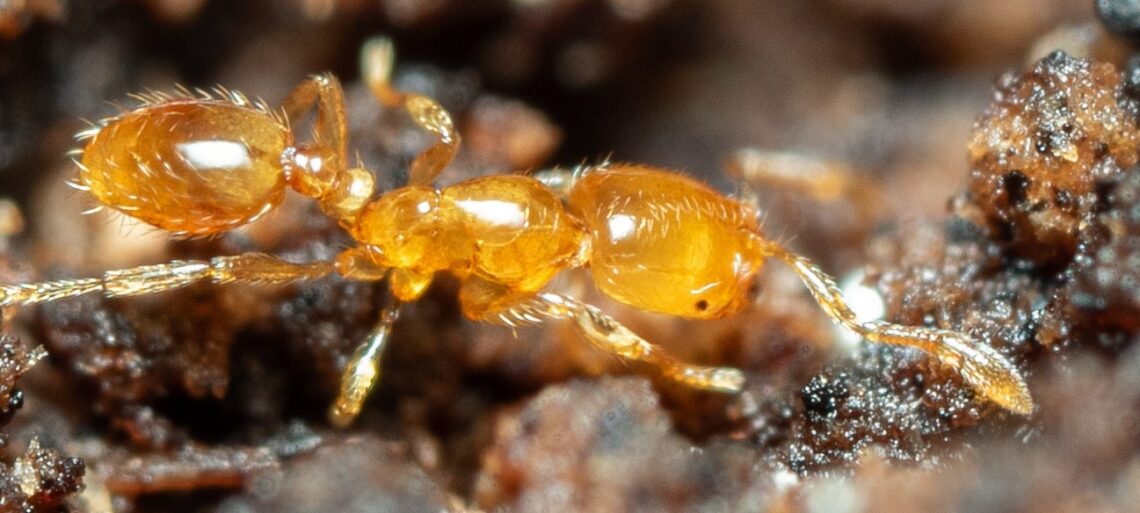
Overlooked Thief Ant
Solenopsis abdita
Species Info General
Other common names include: n/a
This ant garnered the common name “Overlooked Thief Ant” by failing to receive a scientific description until 1989 – this despite being a widespread ant in Florida, one of the most populous states in the U.S where many full-time entomologists have been combing the leaf litter for generations. Upon closer examination, however, and upon comparison to its many close cousins in that state, it’s more of a wonder that it got noticed at all: this is one of a group of a dozen of more virtually identical, tiny yellow ants. Even though it didn’t receive official recognition until 1989, it turns out that this ant had hitched a ride to Hawaiʻi two decades earlier: Huddleston & Fluker (1968) reported collecting it on Oʻahu. Thereafter, however, knowledge of its presence in Hawaiʻi faded from memory. Few people were paying close attention to Hawaiʻi’s ants from the 1970s to the 1990s, so it’s not clear if this ant managed to thrive. Curiously, a statewide survey in the 1980s and 1990s (Martin 2012) failed to detect it, however in 2000 it was rediscovered by Gruner et al. (2003), this time on both Oʻahu and Hawaiʻi. Perhaps the population(s) detected by Huddleston & Fluker in the 1960s died out, and a new introduction from imported Florida material in the 1990s resulted in the detections starting in 2000. In any case, by 2010 this ant was becoming widespread and common throughout the islands and today it is a firmly established member of our ant fauna.
The genus Solenopsis, to which this ant belongs, is best known for its “fire ants” – such as our Tropical Fire Ant (Solenopsis geminata) and the Red Imported Fire Ant (S. invicta) that is such a horrid pest of the American South. However, around 85% of the nearly 200 species in the genus Solenopis species are not big, mean, stinging fire ants, but are rather these tiny, inconspicuous thief ants. Of the thief ants that have been carefully studied, many have been found to spend most of their time underground or deep in the leaf litter, sneaking into larger ants’ nests and raiding their brood and stealing from their food supplies. Whether or not the Concealed Thief Ant engages in this sort of dodgy behavior is as yet unknown: as a group, not a lot is known about the thief ants, or whether they all practice such thievery. Thompson (1989) wrote that “Most of the information on thief ants indicated that they were present in relatively small numbers in the soil, and usually in close association with nests of larger ants. . . . I found that, despite their name, they were most often freeliving and highly predatory. They readily killed and consumed colony-founding imported fire ant queens and the larvae of the sugar cane root stalk borer, Diaprepes abbreviatus (L.) . . . . This indicates that thief ants are important subterranean predators and may have potential as biological control agents.”
In Hawaiʻi, this ant is often detected in large numbers in traps baited with peanut butter, suggesting that it is not above foraging out and about and scavenging food sources that are neither live prey nor associated with other ant species. This ant is reported to raid cat food dishes on occasion, and its resemblance to Little Fire Ants causes consternation until the raider’s true identity is ascertained.
Identification/Description
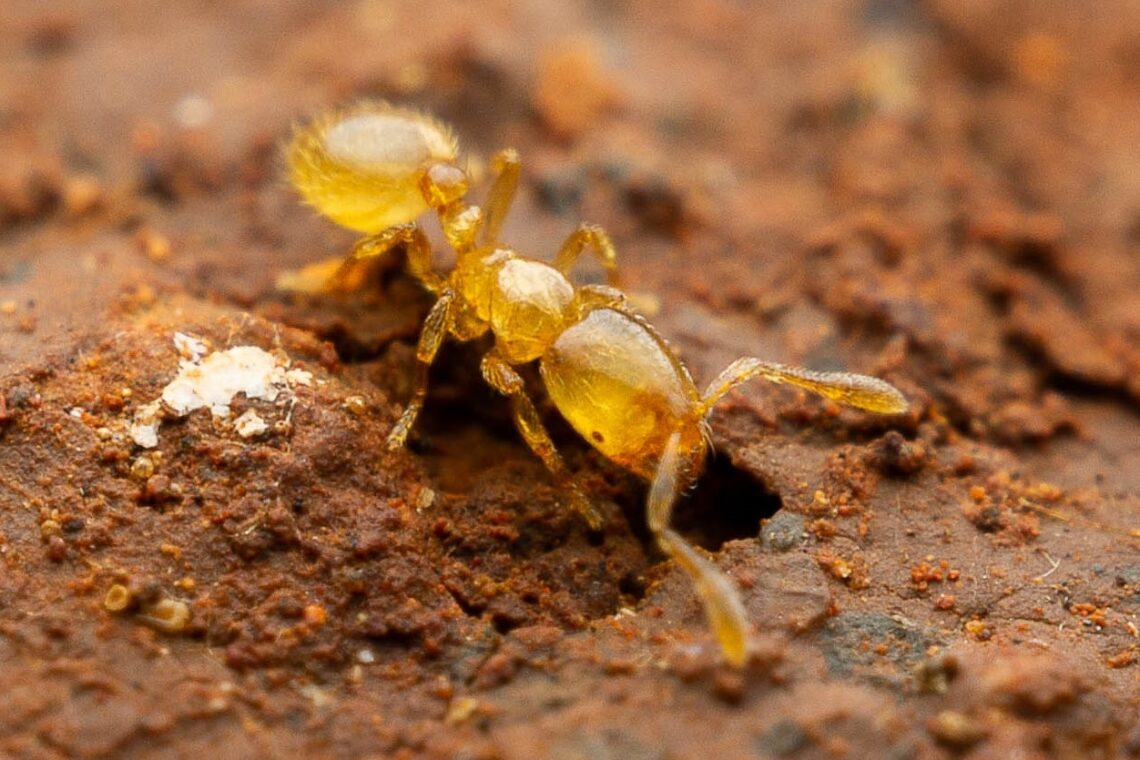
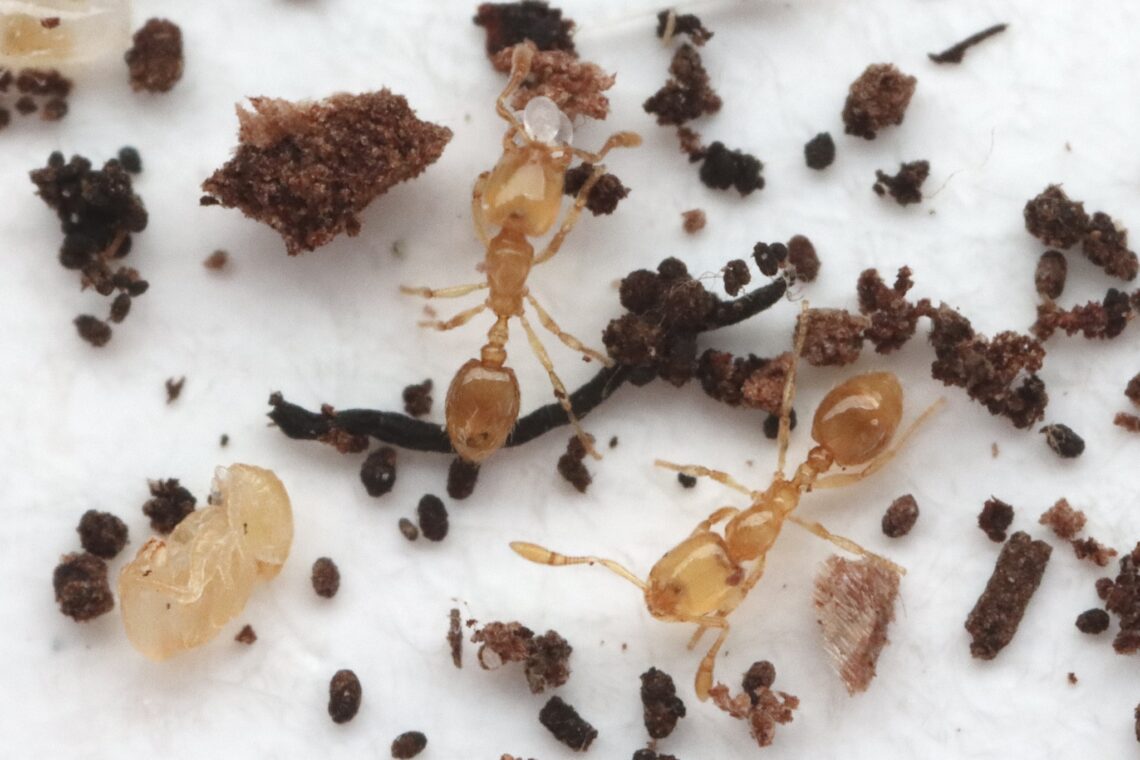
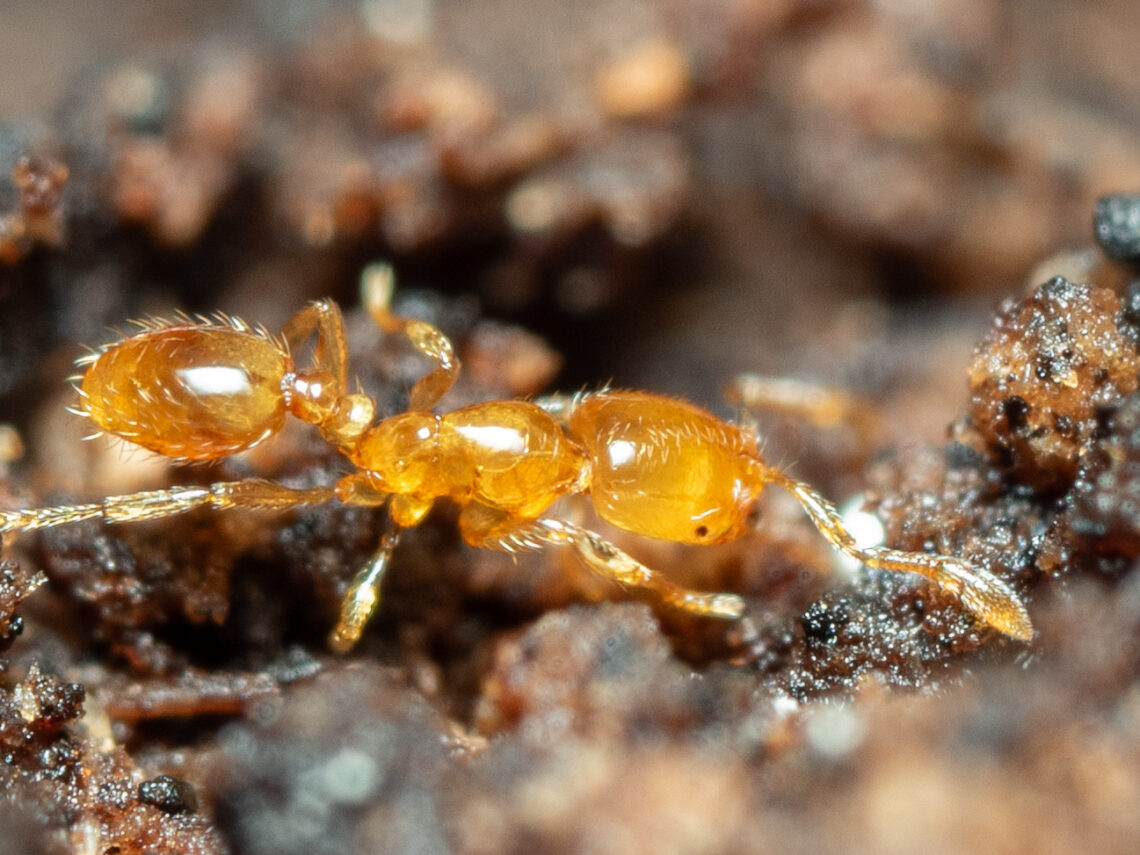
This is a tiny, slow-moving, pale yellow ant. It qualifies as an “LFA lookalike” because of its similarity to Little Fire Ants, at least when viewed with the naked eye.
Impacts
- Occasionally a minor nuisance, showing up in gardens and in the cat’s food dish.
History
- This ant was first detected on Oʻahu in the late 1960s (Huddleston & Fluker 1968). Further detections however were not recorded until the year 2000 (Gruner, Heu & Chun 2003). Its date of first detection on Maui is unclear but appears to have been sometime between 2008 and 2014. It was collected on Molokaʻi in 2011 (Starr & Starr 2012), and on Lānaʻi in 2021 (Maui Invasive Species Committee, unpub. data). It has not yet been detected on Kahoʻolawe.
Resources/References
- Solenopsis abdita – AntWiki
- Gruner, D. S., Heu, R. A. & Chun, M. E. 2003. Two ant species (Hymenoptera: Formicidae) new to the Hawaiian Islands. Bishop Museum Occasional Papers 74: 35–40.
- Huddleston, E. W. & Fluker, S. S. 1968. Distribution of Ant Species of Hawaii. Proceedings of the Hawaiian Entomological Society 20(1): 45–69.
- Martin, C. F. 2012. A Survey of Invasive Exotic Ants Found on Hawaiian Islands: Spatial Distributions and Patterns of Association. Department of Plant and Wildlife Sciences, Brigham Young University Scholars Archive – All Theses and Dissertations 3854: 1–167.
- Starr, F. & Starr, K. 2012. New Arthropod Records from Maui, Molokaʻi, and Lānaʻi. Bishop Museum Occasional Papers 112: 39–42.