White-footed Ants
Technomyrmex albipes, T. difficilis, T. pallipes & T. vitiensis
Species Info General
Other common names include: Techno Ants
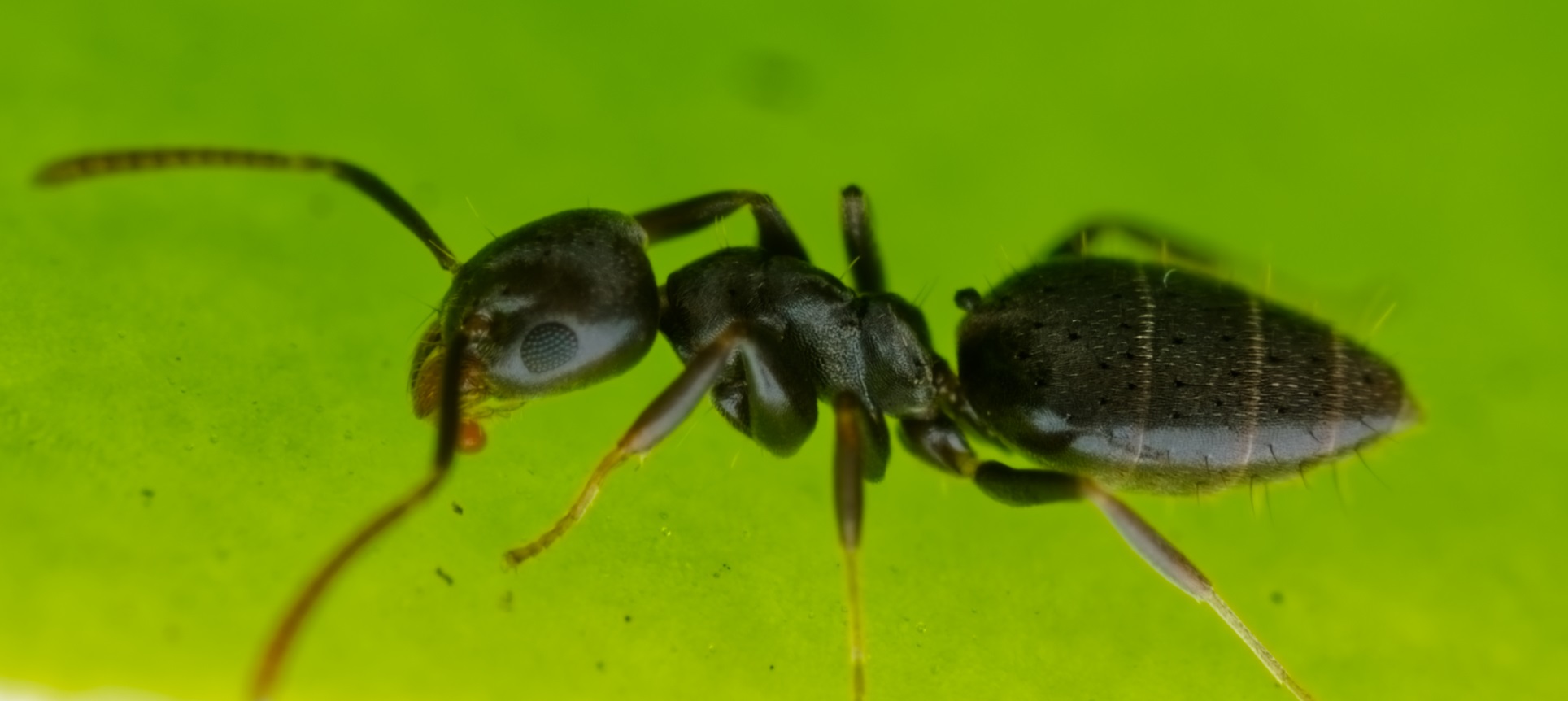
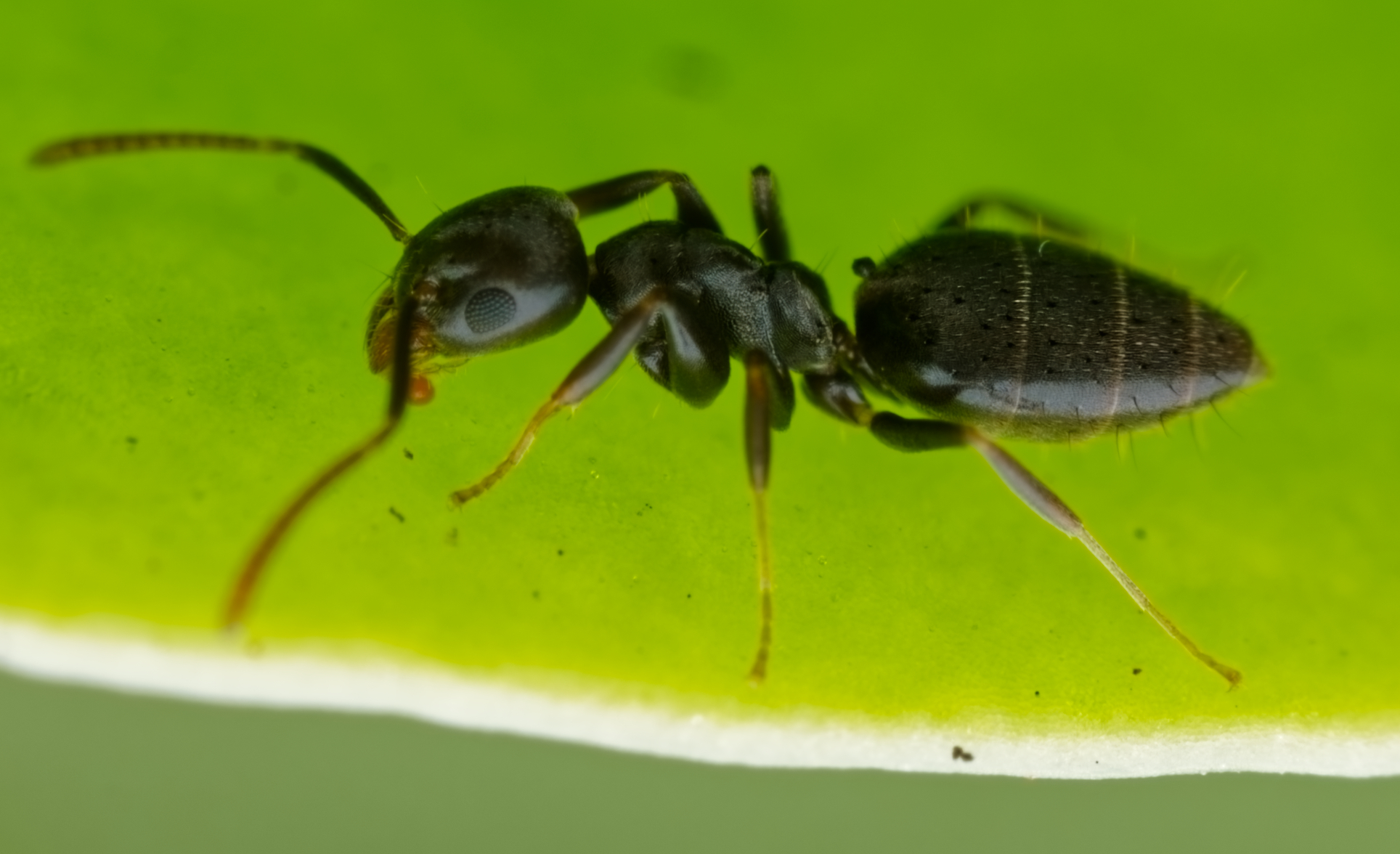
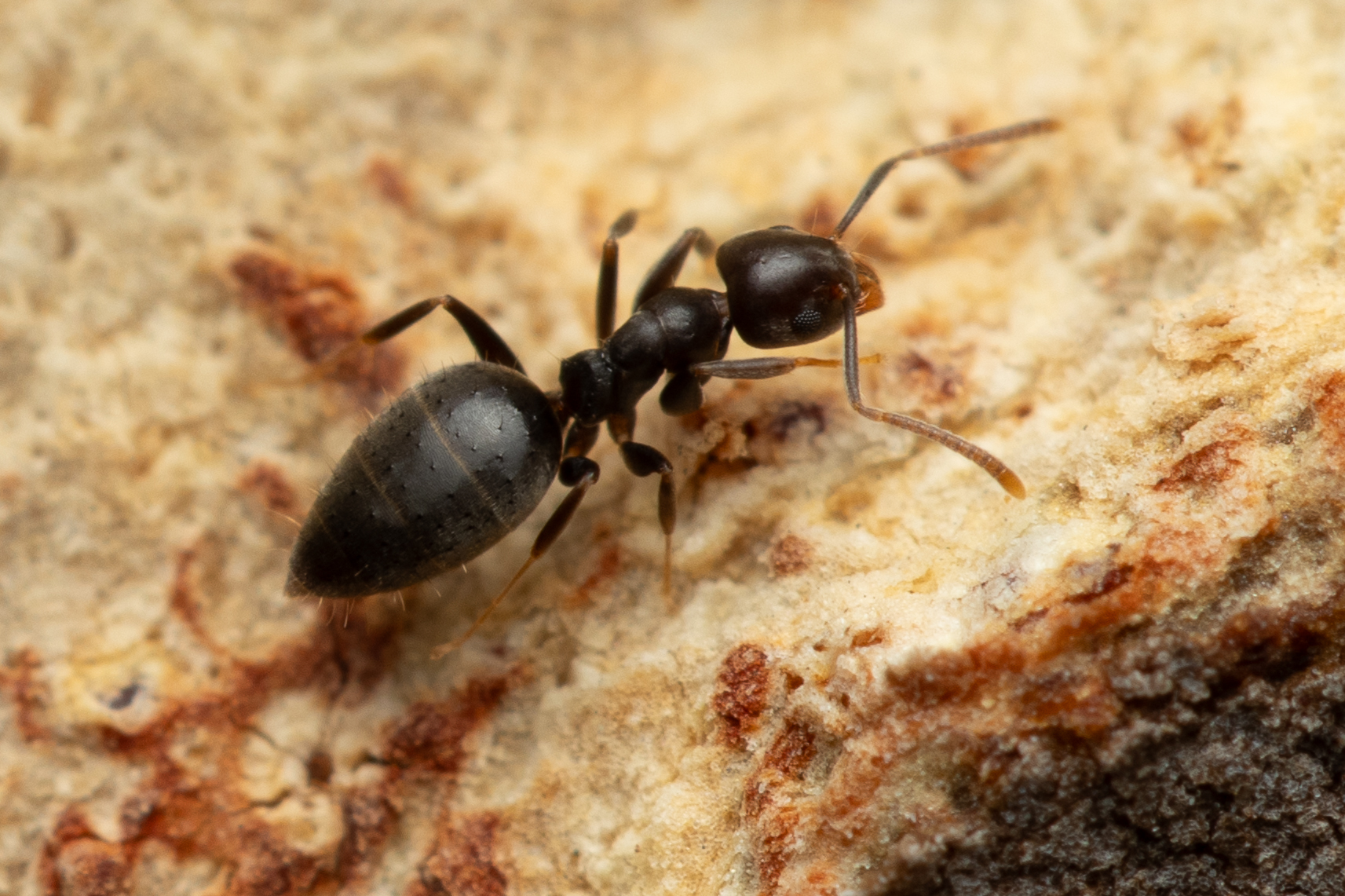
White-footed Ants are medium-sized black ants commonly found upon vegetation in disturbed habitats ranging from scrubby open areas and urban yards to forested areas dominated by non-native trees. Writing about these ants in Hawaiʻi, Huddleston & Fluker (1968) stated that they are “Nowhere very abundant, usually found in areas having more than 60 inches of rainfall. Often numerous in forested areas from 1000 to 5000 ft elevation.” Some might say that that is a misleading statement (or that things have changed in the ensuing years) as today these ants are often quite abundant and readily found in large numbers near sea level.
Deyrup, Davis & Cover (2000) wrote “Nests are in rotten wood, under loose bark on trees, in piles of debris on the ground, in ‘Spanish style’ roofs with curved tiles, and other dry sites off the ground outdoors. It is a general scavenger and attracted to honeydew.” Deyrup (2017) adds “Nests are concealed in mulch or debris, or above ground in trees and buildings”. In the main office of Maui Invasive Species Committee a thriving nest was found inside a large unopened laser printer ink cartridge box.
Writing about the genus Technomyrmex in general, Bolton (2007) reported that “In certain restricted localities individuals of single Technomyrmex species may be very numerous but in general they form only a relatively minor fraction of the total local ant fauna, both in terms of number of species and number of individuals. Locations where individuals of single species occur in huge numbers, other than when invading houses, are generally in stands or plantations of tree crops.” Quoting an unpublished thesis by Warner (2003), Bolton (2007) reported that Technomyrmex difficilis can also be found nesting in “rain gutters, wall voids, and attics . . . [although] [n]ests tend to be found outside of structures more than inside.”
Identification/Description
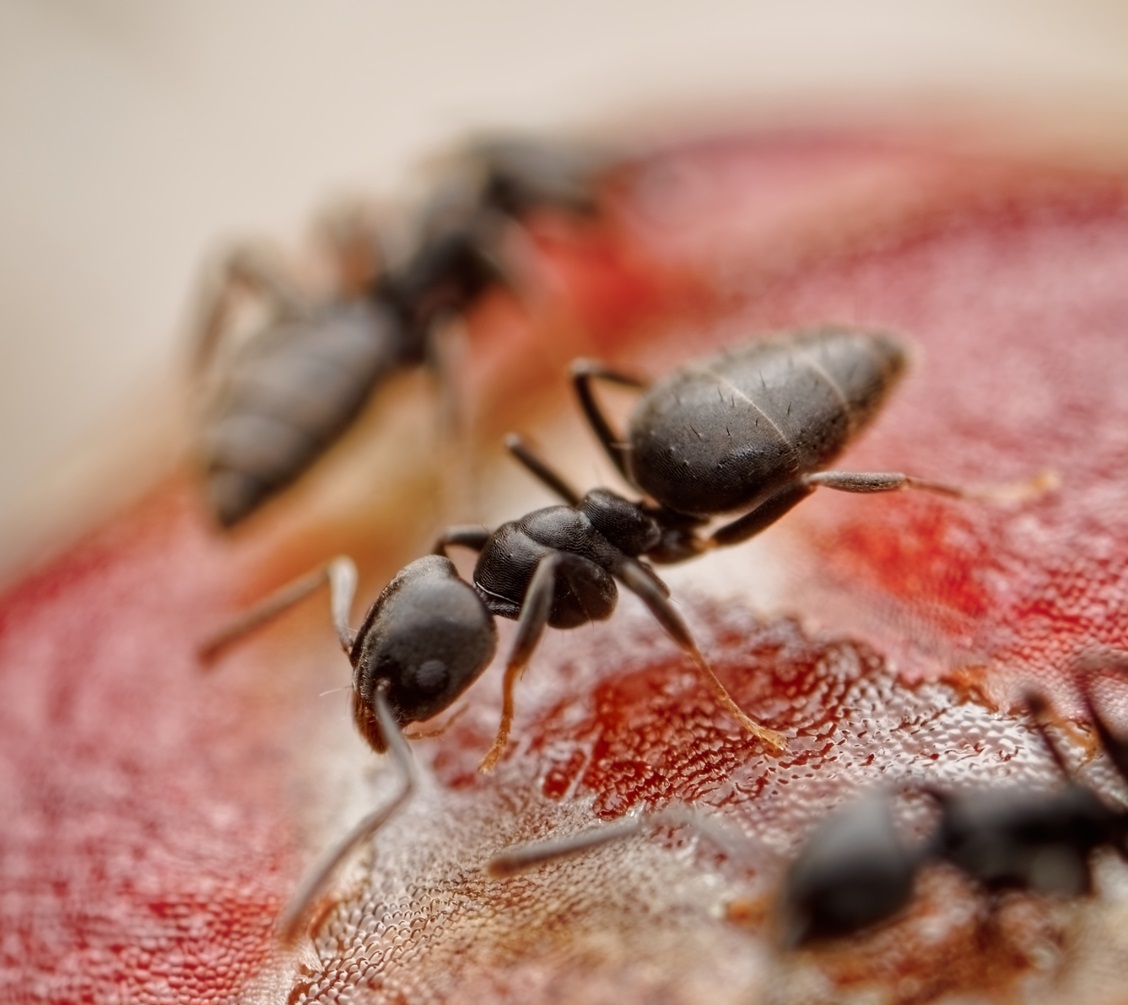
There are four nearly-identical species found in the Islands, lumped together here because even under a microscope it is a challenge to tell them apart. Their “white feet” are pretty much impossible to see with the naked eye. Instead they appear rather similar to the Copper-bellied Ant (Ochetellus glaber) and our three dark “crazy ants” (Nylanderia bourbonica, Nylanderia vaga and Paratrechina longicornis, or Robust Crazy Ant, Brown Crazy Ant and Longhorn Crazy Ant, respectively).

Impacts
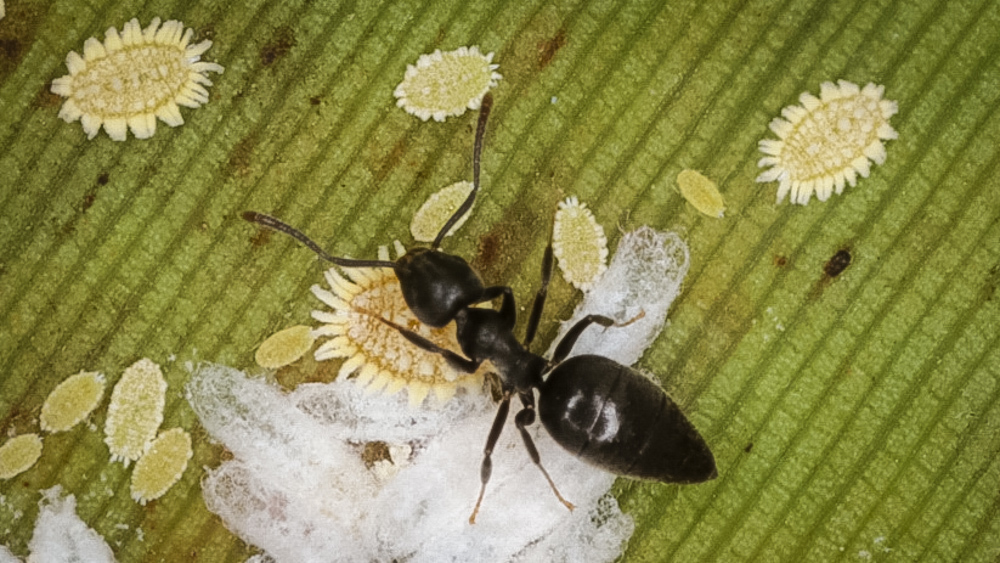
- Although “Honeydew from a wide range of homopterous insects appears to form the main diet” (Bolton 2007), there are no clear reports of these ants being problematic in agricultural settings. Bolton added: “Although usually regarded as a pest or invasive species, . . . [Technomyrmex] albipes also has value as an important predator of the eggs of destructive insect species on coconuts . . .”.
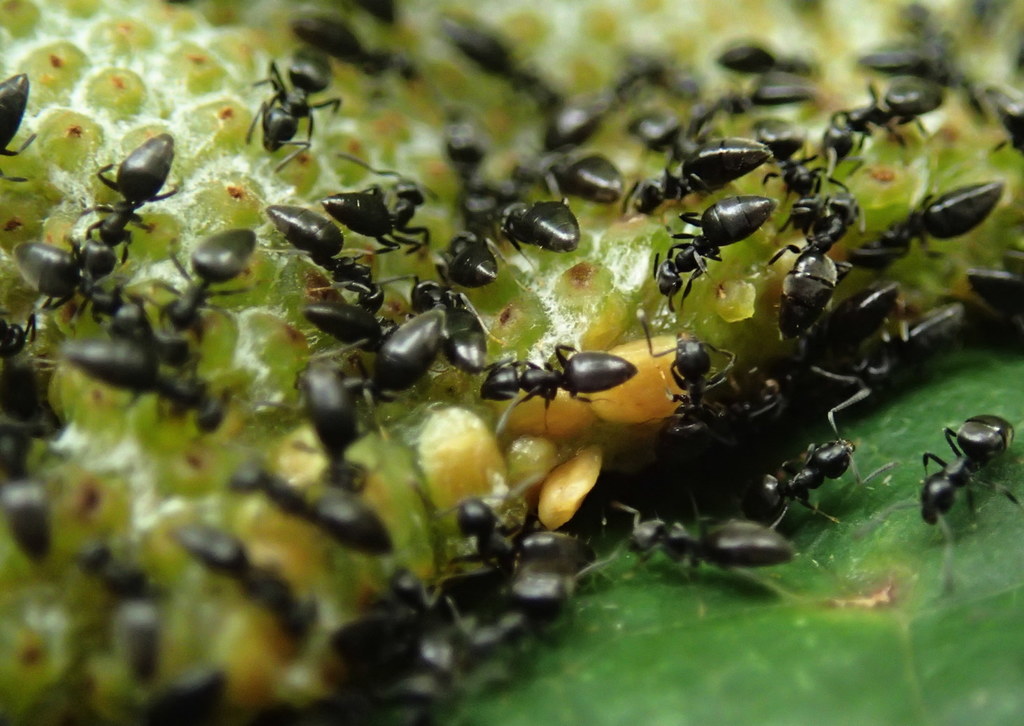
- “[C]an achieve high densities locally, and become a pest at outdoor eating areas; it may enter buildings when there is easy access from outside.” (Deyrup, Davis & Cover 2000)
- Writing about Technomyrmex difficilis, Wetterer (2018) reported that it “has quickly become the dominant arboreal ant at sites across much of Florida and the West Indies. It is probable that over the next few years T. difficilis will become increasingly important as a pest.”
- These ants do not sting and are not reported to bite people.
History
- White-footed Ants were first noted in Hawaiʻi in 1909 and were quickly seen to be rapidly spreading. Swezey (1915) wrote “Apparently the species has been established for several years and widely spread already.” In Maui Nui they were first noted on Maui in 1919, Molokaʻi in 1927 and Kahoʻolawe in 2003 (Swezey & Bryan 1929; Starr, Starr & Loope 2004, 2008) . Although there are no records yet from Lānaʻi, one or more Technomyrmex species are undoubtedly present on that island as well.
Resources/References
- Technomyrmex albipes – AntWiki – Common White-footed Ant
- Technomyrmex difficilis – AntWiki – Difficult White-footed Ant
- Technomyrmex pallipes – AntWiki – Pallid-footed Ant
- Technomyrmex vitiensis – AntWiki – Mann’s White-footed Ant
- Bolton, B. 2007. Taxonomy of the Dolichoderine Ant Genus Technomyrmex Mayr (Hymenoptera: Formicidae) Based on the Worker Caste. Contributions of the American Entomological Institute 35(1): 1–150.
- Deyrup, M. 2017. Ants of Florida – Identification and Natural History. CRC Press, Boca Raton, Florida. 423 pp.
- Deyrup, M., Davis, L. & Cover, S. 2000. Exotic Ants in Florida. Transactions of the American Entomological Society 126(3+4): 293–326.
- Huddleston, E. W. & Fluker, S. S. 1968b. Distribution of Ant Species of Hawaii. Proceedings of the Hawaiian Entomological Society 20(1): 45–69.
- Starr, F., Starr, K. & Loope, L. L. 2004. New arthropod records from Kahoʻolawe. Bishop Museum Occasional Papers 79: 50–54.
- Starr, F., Starr, K. & Loope, L. L. 2008. Survey for Ants on the Island of Maui, Hawaii, with emphasis on the Little Fire Ant (Wasmannia auropunctata). Pacific Cooperative Studies Unit Technical Report 156: 1–47.
- Swezey, O. H. 1915b. A Note on “Technomyrmex Albipes”. Proceedings of the Hawaiian Entomological Society 3(2): 56.
- Swezey, O. H. & Bryan, E. H. Jr. 1929. Further Notes on the Forest Insects of Molokai. Proceedings of the Hawaiian Entomological Society 7(2): 293–314.
- Wetterer, J. K. 2018. Native and Exotic ants (Hymenoptera: Formicidae) nesting in red mangroves (Malpighiales: Rhizophora mangle) of eastern Florida. Transactions of the American Entomological Society 144: 345–356.