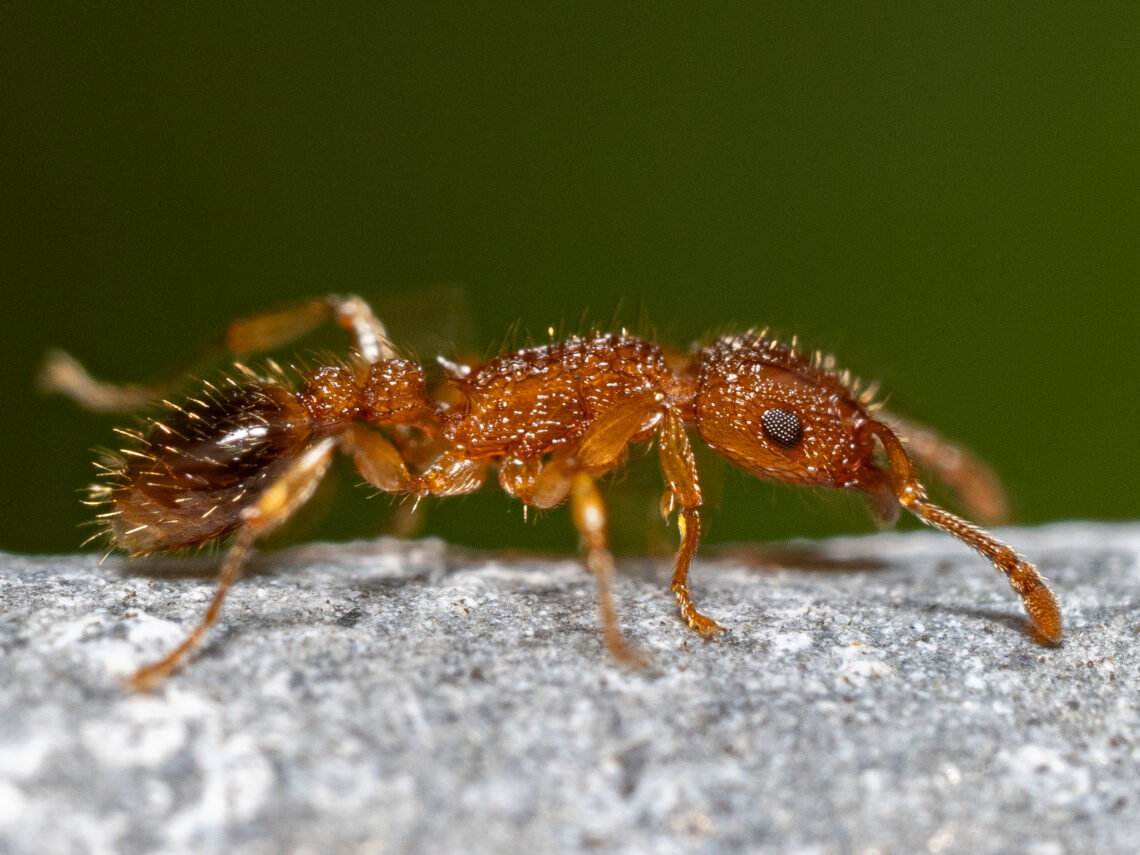
Bicolored Pennant Ant
Tetramorium bicarinatum
Species Info General
Other common names include: Guinea Ant, Guinea Groove-headed Ant, Larger Imported Pennant Ant
The Bicolored Pennant Ant is relatively common in Hawaiʻi. One of the first ants recorded in the Islands (Smith 1879), it is a widespread tramp species around the world, achieving an almost universal distribution throughout the tropics by the end of the 19th century. This is a medium to medium-large ant with a color scheme that brings the phrase “fire ant” to many people’s minds. But it is not an aggressive species and is not known to bite or sting. In fact, it is usually quite docile: Forel (1893) wrote “The ants are rather active, but not very pugnacious, even when the whole nest is dug up.”
Identification/Description
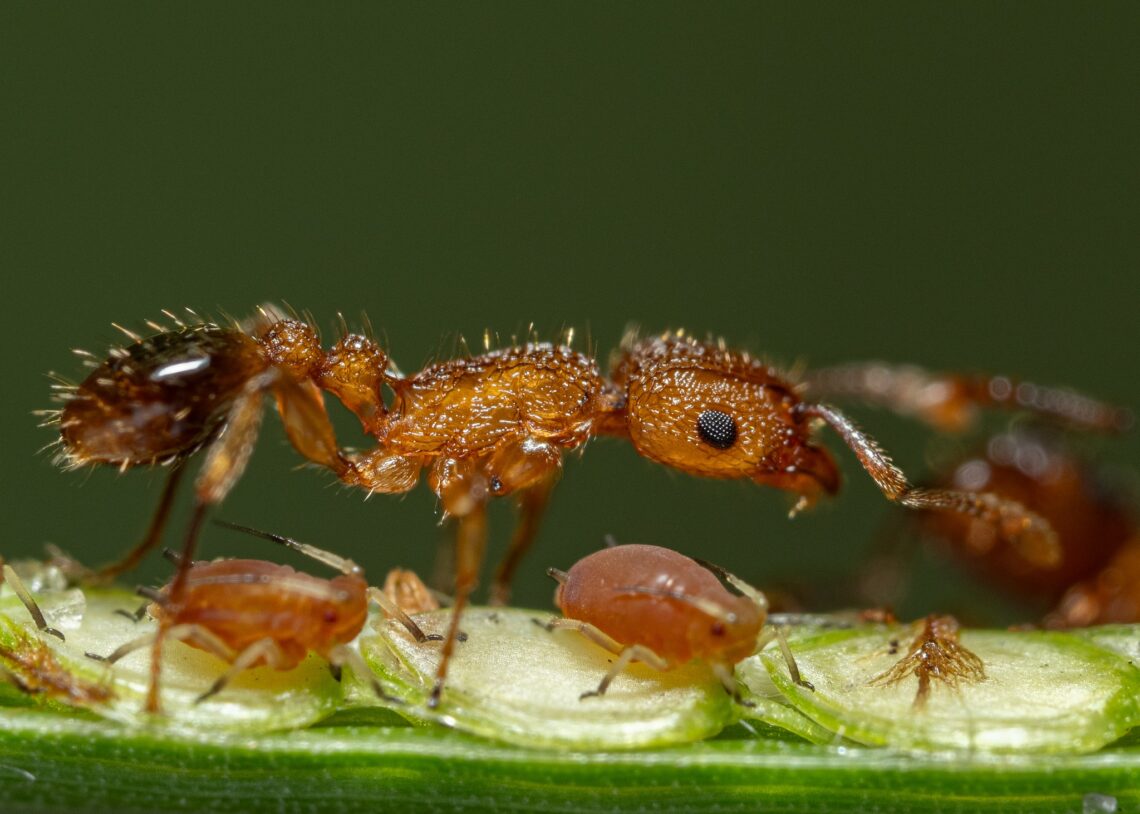
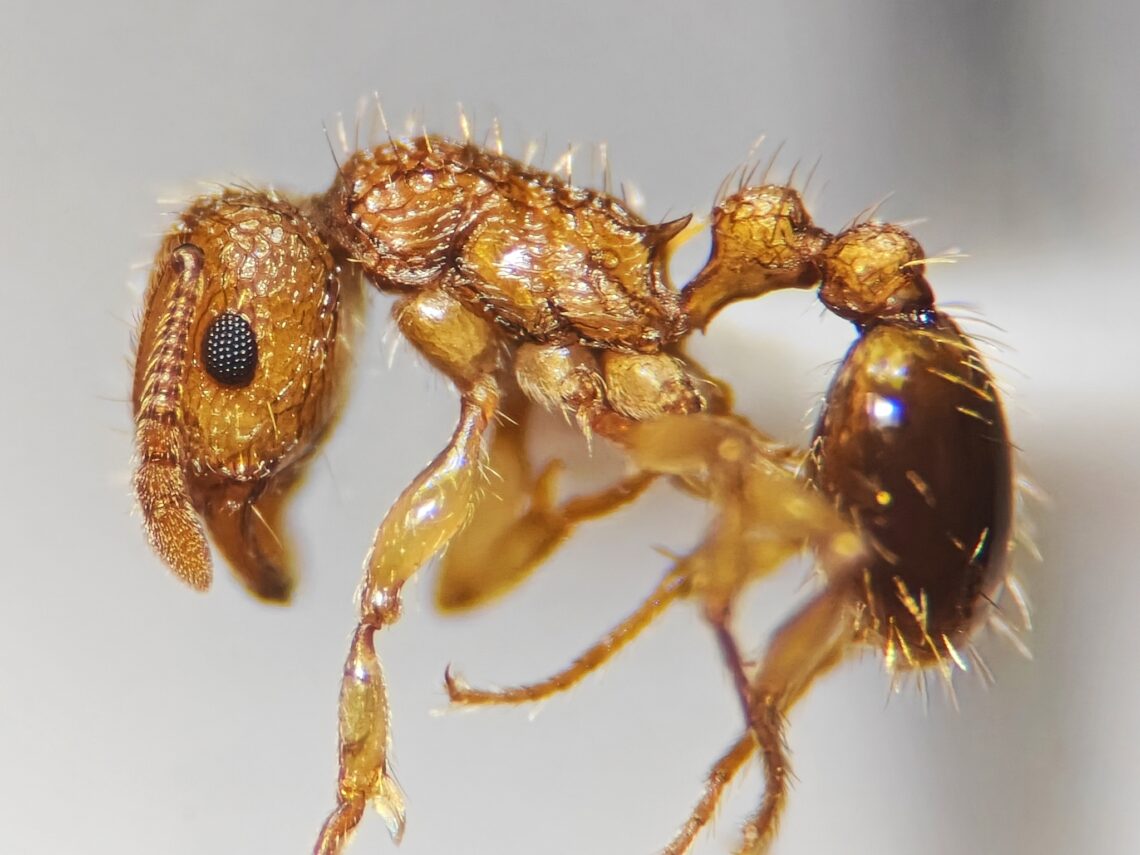
This is a robust reddish ant with a gaster that is usually noticeably darker than the ant’s head and body. It is the more common of a pair of nearly identical species present in the Islands, the other being the Insolent Pennant Ant (Tetramorium insolens). To the naked eye both species are quite reminiscent of Tropical Fire Ants (Solenopsis geminata). Tropical Fire Ants, however, are a polymorphic species, with multiple sizes including large soldiers with outsized heads, while our Pennant Ants are monomorphic – all the same size. The behavior of these similar-looking ants can also help separate them: the Pennant Ants may very well ignore you if you sit on their nest, while Tropical Fire Ants will climb up your legs and attack if you simply look at them askance.
Impacts
- Bicolored Pennant Ants can be a minor agricultural pest at times. Williams et al. (1931) wrote that “it is often found attending aphis and mealybugs on sugar cane”. On the whole, however, this species has few recognized impacts: “Although this species is widely distributed and quite well known it has no particular economic importance” (Bolton 1977).
- Otherwise, not a lot is known about the impacts of this species. Smith (1965) wrote “Very little information has been published on the biology of this species”, and not a lot has changed since then.
History
- This species was recorded (on Oʻahu) in the first itemization of Hawaiʻi’s ants, published by Frederick Smith in 1879. By the 1930s it had also been documented on Hawaiʻi, Maui, Molokaʻi and Kauaʻi (Forel 1899, Wheeler 1934). It likely was also established on Lānaʻi by then or not long after, however it was not formally documented on that island until 2011 (Starr & Starr 2012). It has not yet been recorded on Kahoʻolawe.
Resources/References
- Tetramorium bicarinatum – AntWiki
- Bolton, B. 1977. The Ant Tribe Tetramoriini (Hymenoptera: Formicidae). The Genus Tetramorium Mayr in the Oriental and Indo-Australian Regions, and in Australia. Bulletin of the British Museum (Natural History)(Entomology) 36(2): 67–151.
- Forel, A. 1893. Formicides de l’Antille St. Vincent. Récoltées par Mons. H. H. Smith. Décrites par le Dr. Auguste Forel [Ants of the Antilles of St. Vincent. Collected by Mr. H. H. Smith. Described by Dr. Auguste Forel]The Transactions of the Entomological Society of London for the Year 1893 4: 333-418.
- Forel, A. 1899. Formicidae of Hawaii – Heterogyna. (Formicidae.), Fauna Hawaiiensis 1(1): 116–122.
- Smith, F. 1879. Descriptions of new Species of Aculeate Hymenoptera collected by the Rev. Thos. Blackburn in the Sandwich Islands. The Journal of the Linnean Society (Zoology) 14: 674–685.
- Smith, M. R. 1965. House-Infesting Ants of the Eastern United States: Their Recognition, Biology, and Economic Importance. Agriculture Research Service, U.S. Department of Agriculture. Technical Bulletin No. 1326: 1–105.
- Starr, F. & Starr, K. 2012. New Arthropod Records from Maui, Molokaʻi, and Lānaʻi. Bishop Museum Occasional Papers 112: 39–42.
- Wheeler, W. M. 1934. Revised list of Hawaiian ants. Bishop Museum Occasional Papers 10(21): 2–21.
- Williams, F. X., Muir, F., Van Zwaluwenburg, R. H. & Swezey, O.H. 1931. Handbook of The Insects and Other Invertebrates of Hawaiian Sugar Cane Fields. Advertiser Publishing Co., Honolulu. 400 pp.