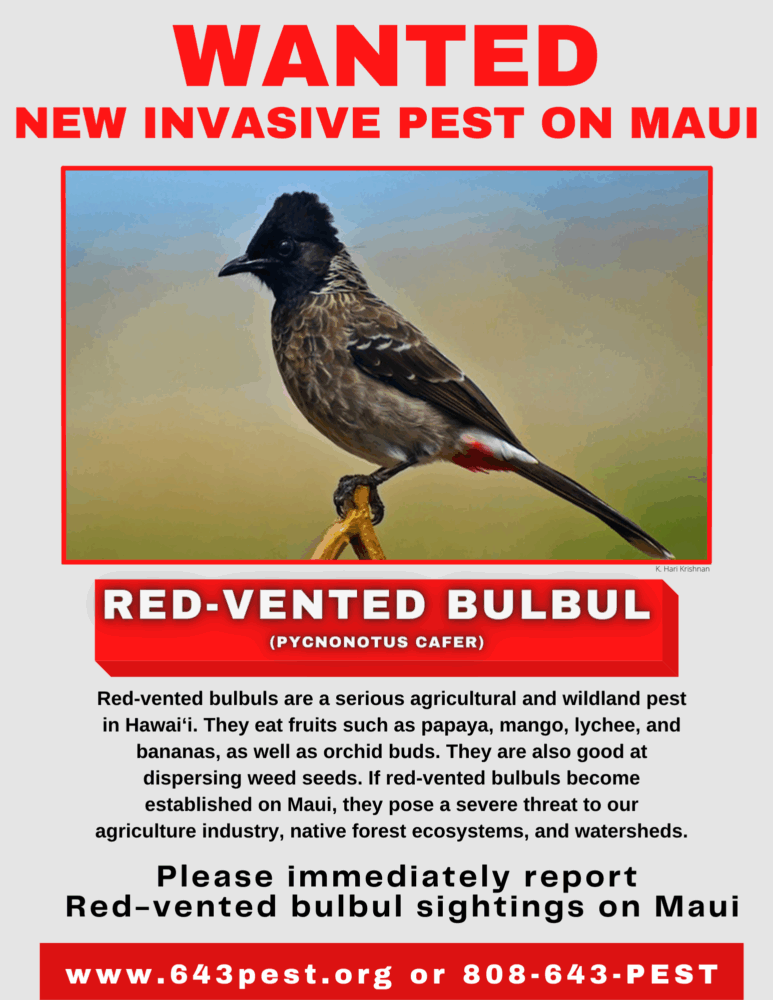
February 2025 – MISC Seeks the Community’s Help in Search for the Highly Invasive Red-Vented Bulbul: Recently Spotted Near Kā‘anapali
Agriculture and wildlife officials are raising concerns after a red-vented bulbul was spotted near Kā‘anapali. This high-priority invasive pest appears on the Hawai‘i Injurious Species list and the International Union for Conservation of Nature’s (IUCN) Top 100 Invasive Species list. The bird poses a serious threat to Maui’s agriculture as well as native ecosystems. To better determine the bird’s presence on Maui and develop an effective response strategy, MISC is asking the public to report any red-vented bulbul sightings immediately.
Resource managers heard and saw a red-vented bulbul during a routine bird survey near Kā‘anapali in February. This marks the first confirmed sighting on Maui since 2021 when a bulbul was seen in Kahului. That bird (or birds) were never successfully captured.
Native to Asia, the red-vented bulbul was introduced to O‘ahu in the 1950s, likely due to an illegal cage release. While widespread on O‘ahu, it has not established breeding populations on any other Hawaiian Island. However, vigilance is crucial statewide, as red-vented bulbul is known to nest in shipping containers and is capable of flying between the islands.
Red-vented bulbuls are notorious agricultural pests and have caused considerable damage on O‘ahu. They consume large amounts of commercial fruit crops like banana, lychee, mango, papaya, and other fruits, resulting in significant losses for farmers. They also feed on orchid buds, with the O‘ahu orchid industry reporting $300,000 in annual losses due to bulbuls.
Beyond damaging agriculture, the red-vented bulbul is adept at dispersing seeds from high-priority invasive plants like ivy gourd and miconia, which threaten Hawaii’s watersheds.
Bulbuls are highly territorial, and there are concerns that they may displace native birds when competing for food and space.
Adult red-vented bulbuls are about 8.5 inches long with a black body, pointed black crest, light gray abdomen and rump, and crimson under the tail. They also have a slight white marking at the tip of their tail. It’s the only black bird in Hawai‘i with a cardinal-like crest. Juveniles resemble adults but have brownish edging on the feathers.
In addition to their physical traits, red-vented bulbuls can be identified by their behavior and vocalization. Red-vented bulbuls have loud, frequent, and distinctive calls. They are often seen perching on telephone wires, foraging for insects in the evening, and they are one of the few birds that tend to land on the sides of trees.
It’s not too late to prevent these pests from becoming established on Maui. One notable example of red-vented bulbul eradication is in New Zealand, where a population of about 50 bulbuls was successfully eliminated in the 1950s. Community reports were critical in this effort, helping authorities track and eliminate the birds. Eradicating this species will help preserve Maui’s natural resources, biodiversity, and beauty and safeguard local farms and orchards that contribute to the island’s tourism and economy.
Residents in and around Kā‘anapali are urged to be vigilant and report any red-vented bulbul sightings at (808) 643-PEST or 643pest.org. Clear descriptions of the bird, time, and place observed, as well as photos and videos, are helpful when submitting reports.