Copper-bellied Ant
Ochetellus glaber
Species Info General
Other common names include: Black House Ant, Glaber Ant, Bicolored Tongue-node Ant, Australian Shining Ant
The Copper-bellied Ant was first detected here in 1977 on Oʻahu. It is now a common household pest on all the main islands. Tenorio & Nishida (1995) called it “the most serious ant pest on Oʻahu today.” It does particularly well in dry and mesic environments from sea level up to at least 4000 feet elevation. Nests are often found in dead wood or under tussocks of grass (Deyrup, Davis & Cover 2000). Though it’s not particularly aggressive and does not sting, it does impart an annoying bite. This ant readily invades kitchens, bathrooms and bedrooms, eagerly pouncing on any crumbs left behind after food prep, meals or snacking. It also seems to become more numerous indoors during extended dry spells, times during which it has more luck finding moisture inside your house than it does in your yard.
Unfortunately, controlling this ant with pesticides is not very easy. It does not consistently respond to typical ant baits – some days it might take the bait, other days it won’t.
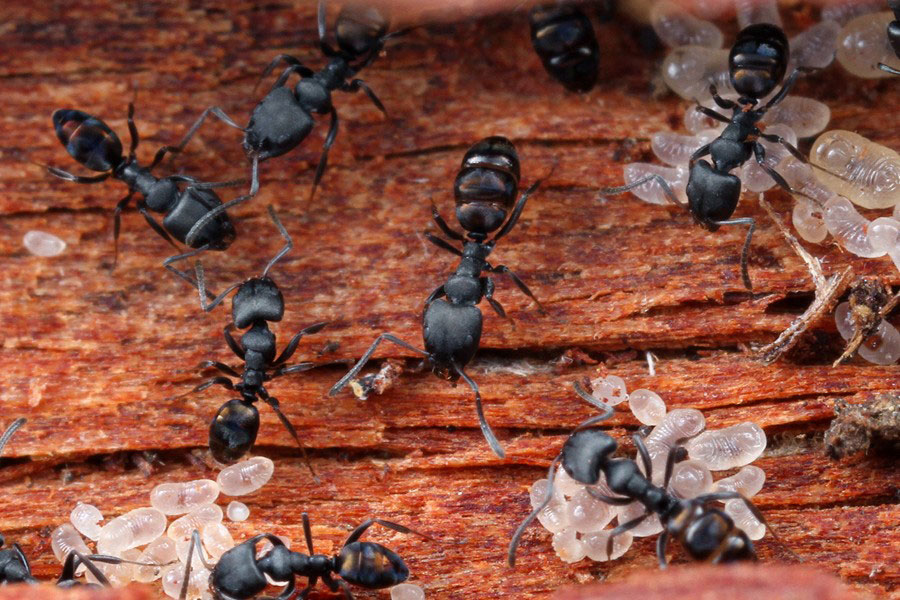

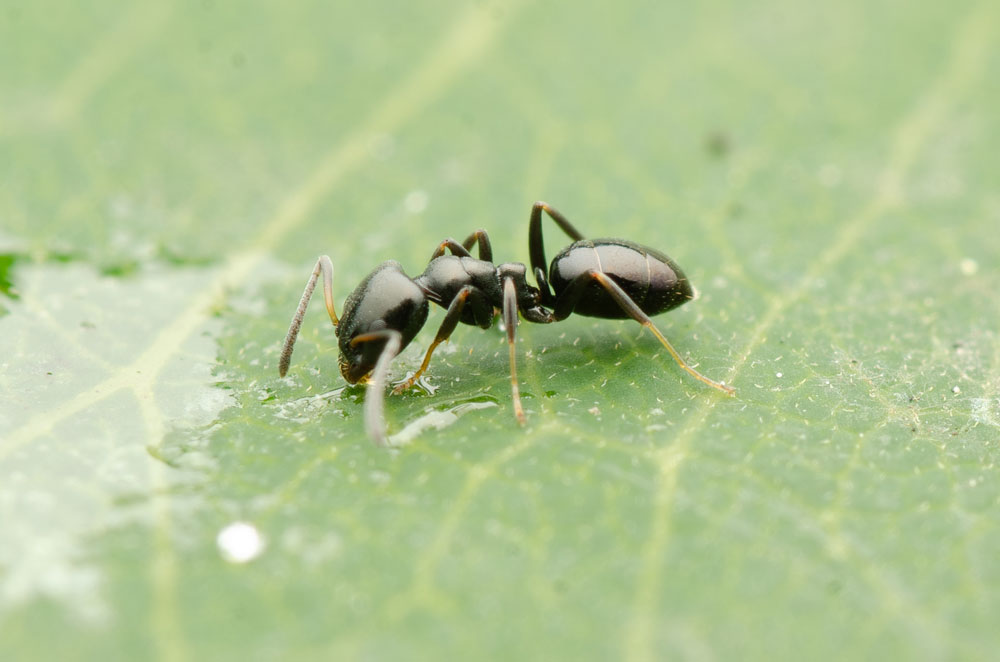
Identification/Description
While in some parts of the world this species has a bicolored appearance (with a reddish or orangish mid-section), here in Hawaiʻi the ants are consistently a shiny, solid black. Their size, speed, and trailing habits are quite typical of indoor pest ants – not especially large, not especially small, not especially fast, not especially slow.
Impacts
- Significant indoor nuisance
- Has an annoying bite
- Can be an agricultural nuisance through the tending of homopterous pests (Reimer 1993)
- Some research suggests this ant can displace Formosan subterranean termites (Deyrup 2017)
History
- Copper-bellied Ants were first detected in the Islands at Hickam Air Force Base on Oʻahu in 1977 (Beardsley 1980). On Maui they were first detected in 1992, near Makawao (Reimer 1993). In 2003 it was collected on Kahoʻolawe (Starr, Starr & Loope 2004), and then in 2010 it was recorded on both Molokaʻi and Lānaʻi (Starr & Starr 2011).
Resources/References
- Ochetellus glaber gracilipes – AntWiki
- Beardsley, J. W. 1980. [Notes & Exhibitions]. Iridomyrmex glaber (Mayr). Proceedings of the Hawaiian Entomological Society 23(2): 186.
- Deyrup, M. 2017. Ants of Florida – Identification and Natural History. CRC Press, Boca Raton, Florida. 423 pp.
- Deyrup, M., Davis, L. & Cover, S. 2000. Exotic Ants in Florida. Transactions of the American Entomological Society 126(3+4): 293–326.
- Reimer, N. J. 1993. [Notes and Exhibitions]. Iridomyrmex glaber Mayr (Hymenoptera: Formicidae). Proceedings of the Hawaiian Entomological Society 32: 9–10.
- Starr, F. & Starr, K. 2011. New arthropod records from Maui Nui. Bishop Museum Occasional Papers 109: 35–42.
- Starr, F., Starr, K. & Loope, L. L. 2004. New arthropod records from Kahoʻolawe. Bishop Museum Occasional Papers 79: 50–54.
- Tenorio, J. M. & Nishida, G. M. 1995. What’s Bugging Me? University of Hawaii Press, Honolulu. 184 pp.