Workshops participants experience lessons as students would, preparing them to teach the lesson in the classroom.
The Ho’ike o Haleakala Steering Committee will be hosting a series of one- and two-day teacher’s workshops starting in January 2012.
Join us in exploring exciting new lessons that spotlight native and invasive species issues on Maui. You will leave with innovative tools for teaching native Hawaiian science in the classroom and field. Commit to testing these materials in your classroom and receive a $75 stipend.
One day workshops:
January 14
March 10
Two day workshop:
February 18-19
R.S.V.P required. Workshops run from 9 a.m. to 4 p.m. at the Maui Invasive Species Committee (MISC) Headquarters in Pi’iholo. Space is limited; call 573-6472 or email miscpr@hawaii.edu to reserve your spot and for directions.
The one-day workshops will include hands-on experience and demonstration. The two-day February workshop adds a native Hawaiian forest hike and participants will receive an advance hard copy of Ho’ike o Haleakala’s new Invasive Species Module, including multimedia components and game pieces.
A sampling of the activities we will cover:
Come learn how to use Hawaii as a perfect natural laboratory for your students.
Mark your calendar!
If you can’t attend the workshop, but would like to test these activities, email miscpr@hawaii.edu or call (808) 573-MISC.
How does a two-person team control 850 invasive trees? If you’re MoMISC, you ask for permission first—from the landowner, the ancestors, and the trees themselves.
When Lori Buchanan of the Moloka‘i/Maui Invasive Species Committee (MoMISC) learned that albizia trees were invading a steep gulch in Nā‘iwa, she started strategizing. Native to the Indonesian archipelago, albizia rapidly monopolizes disturbed mesic and wet forests in Hawai‘i, and can rise to over 120 feet tall with wide, interlocking canopies. Because albizia trees fix nitrogen in the soil, they alter Hawaiian forests to favor non-native plants.
The Nā‘iwa discovery was the only albizia population on Moloka‘i—making it a good candidate for eradication. But controlling the trees would be a huge project, requiring the cooperation of many stakeholders.
First Buchanan approached the landowner, who granted access to the site. Land and air surveys revealed a fifteen-acre patch of mature trees, some with trunks measuring seven feet in circumference. Before rounding up extra hands to help with control work, Buchanan consulted kumu Mikiala Pescaia, who has genealogical ties to the area.
“It’s a good idea to ask permission before you do anything,” says Buchanan. “Every place is sacred, or has some history, and so it’s always a good idea to consult the indigenous culture.
“Nā‘iwa is makahiki and hula grounds. The crew needed to know why it’s special before working there.”
Pescaia agreed to ask her ancestors to bless the project and to share the importance of the site’s numerous platforms and heiau with the crew. She explained how killing during the makahiki season would be inappropriate, since it was a time of peace and rest.
“She took us to the edge of Kalaupapa and said, ‘This is where the spirits leap off,’” says Buchanan. “After that, the crew was hyped. We knew we were going to sweat and work our butts off, but people would appreciate what we were trying to do. It put our work in a whole new light.
“Mikiala sees all her cultural sites being taken over by invasive species. Our work is important to her, to her ancestors, and to future generations. It’s a step in restoring a whole genealogy.”
Mikiala Pescaia asked her ancestors for permission before entering the work site. She outlined appropriate behavior for the crew to observe while working: no swearing, negative thoughts, smoking, or removing anything from the area.
Then, says Buchanan, “She went to the edge of the gulch and said to the trees, ‘You guys have to go. Thank you for what you’ve provided—oxygen, shade, etcetera, but you have to go. Lori and MoMISC are going to come and take you out.’”
Actually, it was Lori, MoMISC, and a small army. Kamalani Pali, the other half of MoMISC, helped organize crews from The Nature Conservancy, Maui Invasive Species Committee, and U.S. Fish and Wildlife Service. John Neizman from the Department of Land and Natural Resources assisted with clearing the access road. Two retired foresters volunteered to cut and treat trees. The U.S. Department of Agriculture Plant Materials Center donated ninety pounds of native kāwelu, ‘a‘ali‘i, and ‘āweoweo seed mix. Before controlling the trees, Pescaia and the crew spread the seeds throughout the site, to repopulate the forest with native plants and suppress albizia regrowth.
Scientists and cultural advisors agreed that the best time to start work was the first week of March, after makahiki had passed. The crew girdled massive trunks, scraping the bark off with chainsaws to get to the heartwood and swabbing the cuts with small amounts of herbicide. Despite the heavy labor—three days of wielding chainsaws and rappelling to reach cliff-side trees—no one was injured.
Local businesses pitched in, too. Moloka‘i Community Federal Credit Union and Ron Kimball of Kamehameha Schools helped feed the workers. Mac Poepoe and Kanohowailuku Helm, local fishermen who have published a Hawaiian moon calendar, gave a pau hana workshop on how to be a pono fisherman. Realtors Diane and Larry Swenson accommodated visiting crews in their roomy warehouse.
A year later, only four of 850 albizia trees required re-treatment. The project brought together community members, field staff, and cultural practitioners. Work crews valued the opportunity to practice traditional protocols while working to free the island’s native forests from invasive pests. There’s no arguing that involving the community and asking for permission resulted in resounding success. The lessons learned during the albizia project will be applied to future control efforts on Moloka‘i and Maui.
“So many components had to come together. Everybody had to be on board,” says Buchanan. “But that’s our job: to make it easy for people to help us.” •
By Shannon Wianecki
MISC Editor and Curriculum Writer
This article originally appeared in the Winter 2010 edition of Kia‘i i Nā Moku o Maui Nui, the newsletter of the Maui Invasive Species. Find the full newsletter at www.hear.org/misc/newsletter/.
‘Tis the season, and tradition calls for pine trees to decorate Maui residents’ homes, although there are many palms decorated in Christmas lights as well. Most Christmas trees are shipped in, but there’s a history of growing pines in Hawai‘i. Ralph Hosmer, Hawai‘i’s first forester, came on the job in 1904. At the time, forests throughout Hawai‘i were in a sorry state. Since Polynesian times, people have greatly altered lowland forests, initially for settlement and taro cultivation, then for sugar cane and pastureland. Feral pigs, goats and cattle escaped into intact forests, trampling shallow-rooted plants and browsing slow-growing plants. Honolulu, prospering from the sugar boom, was exceeding existing water supplies by the 1870s. Recognizing the need to protect and restore vital watersheds, everyone from sugar cane barons to King Kalākaua began fencing out animals and planting trees, some of which were pines.

Mexican weeping pine (Pinus patula) creeps into the native forest of the Waikamoi preserve. Forrest and Kim Starr photo
Hosmer helped turn sentiments about forest protection into cohesive action. He established the first forest reserves in Hawai‘i, beginning in 1906 when Alexander & Baldwin ceded management of acreage on Maui to the territorial government. With newly acquired land, Hosmer accelerated efforts to fence out cattle and goats and planted fast-growing hardy trees. The goals were three-fold: to stop erosion, restore the watershed and provide for Hawai‘i’s timber needs. Hosmer’s experimental plantation high on the slopes of Haleakalā now bears his name, “Hosmer’s Grove.” He planted species familiar from his Mainland forestry background: redwood, ash and pines. For years to come, foresters continued planting non-native species. These trees did prevent erosion on overgrazed lands, but some escaped cultivation to invade nearby ecosystems and crowd out native species.
Three species – Monterey pine (Pinus radiata), Mexican weeping pine (Pinus patula) and maritime pine (Pinus pinaster) – are particularly invasive. They persistently threaten Haleakalā National Park and The Nature Conservancy’s Waikamoi Preserve, transforming native stands into pine forests. Pines grow fast, up to one foot per year and reach maturity quickly, producing seeds within six to eight years. A massive amount of tiny seeds spread easily on the wind, help these pines colonize new areas. Removing pines has proven essential to maintaining the shrub-land and alpine habitat of Haleakalā.
Over the years, crews at Haleakalā National Park have stopped a veritable woodland of pines. Bill Haus and the crew he works with have removed 87,920 pines from the park and surrounding areas since 1982. According to Natural Resource Program Manager Steve Anderson, “Without control, the slopes of the subalpine shrub land would be a pine forest.” Subalpine shrub land is critical habitat for a native plants and animals; conversion to a pine forest would turn this rare Hawaiian ecosystem into a biological desert – no native plants like māmane, pūkiawe, ‘ōhelo or ‘a‘ali‘i; no native birds like the ‘i‘iwi and ‘amakihi.

Monteray pine (Pinus radiata) growing inside Haleakalā crater alongside silverswords. There have been a flush of pine seedlings inside the crater in the last few years. Forrest and Kim Starr photo.
Pines threaten the crater as well. Haus and his crew have removed more than 1,500 pines from inside the crater, with a peak of 778 in 2010.
Anderson said: “I wouldn’t have thought it was possible (for the crater to become a pine forest) several years ago, but it’s clear that potential exists now.”
The recent flush of pine could be the result of the 2007 Polipoli fire. Pines, including those invading Haleakalā Crater, are serotinous, meaning certain pine cones are coated with a waxy substance. These cones stay closed until the heat of a fire melts the coating to release seeds. As an ecological adaptation, it helps pines take advantage of the ash-fertile conditions following a fire. But in Hawai‘i, this adaptation may offer a unique seed-scattering advantage. The Polipoli fire possibly spurred a huge seed release and associated winds carried the seeds into the crater. Pine seedlings are even growing alongside silverswords.
You can help protect the crater from pines, and take home a pine tree! Several organizations will be working with volunteers to remove pines in time for the holidays. Friends of Haleakalā National Park leads efforts to remove pine trees from the crater. Check out their website at fhnp.org for more information.
The Nature Conservancy will be working below Hosmer’s Grove on Dec. 17. Call or email Pat Bily at 856-7665 or pbily@tnc.org for details and to confirm attendance. Both trips are free and open to the public. Dress for wintery weather and bring rain gear, water, tools and rope to bring home your tree or wreath making supplies. Participants also may bring food. Eggnog is optional.
By Lissa Fox Strohecker
Originally published in the Maui News, December 11, 2011 as part of the Kia‘i Moku Column. Check out all of the MISC articles in the Kia`i Moku series at: www.hear.org/misc/mauinews/

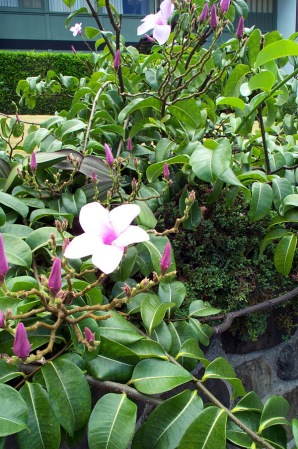
The rubber vine may appear to be a beautiful plant but it is actually poisonous. The vines will also creep up trees and into their canopies and foul up streams. (Photo by MISC)
When the crew from the Maui Invasive Species Committee (MISC) arrived on Moloka‘i in February of 2005, they soon realized this was not going to be just another week at work. They were assisting the Moloka‘i/Maui Invasive Species Committee (MoMISC) in controlling a large infestation of rubber vine plaguing the Kamalō and ‘Ualapu‘e areas. The pest had invaded over five acres, forming impenetrable thickets that made it difficult to control. Just looking at the vast amount of area conquered by this one invasive plant made the MISC crew realize why the two-person MoMISC team called in reinforcements.
Controlling the large population was a daunting task and, at first, overwhelming. But one by one, vine by vine, the crew attacked the rubber vine as if they themselves were an invasive species, quickly devouring everything in their path. By the end of the week, the once dark forest of rubber vine blanketing the treetops was transformed into a more open area with sunlight. By helping to initially suppress the pest, MISC was making it manageable for MoMISC to monitor and treat it in the future.
Here on Maui, we are fortunate that we do not have such large rubber vine populations. Instead, we have limited infestations growing in residential areas. There is hope that we can eradicate this invader before it affects our natural and agricultural areas as well as quality of life.
Rubber vine (Cryptostegia grandiflora on Maui, C. madagascariensis on Moloka‘i) are vigorous climbing vines from Madagascar that can scramble their way 30 meters up a tall tree or grow as an unorganized shrub-like clump of vines one to two meters tall. The plant invades waterways forming dense, impenetrable thickets that smother riparian vegetation and decrease biodiversity. Rubber vine can also impact ranching operations by restricting livestock access and lowering pasture productivity.
This invasive plant is extremely poisonous; it contains cardiac glycosides, chemicals that interfere with heart function in humans and animals when the plant is ingested. Contact with the plant’s milky sap can cause burning rashes and blisters. When the vine is dry, a powdery dust emerges that can cause violent coughing, swelling of the nose, and painful blistering of the eyelids.
Rubber vine has large, showy pinkish-purple flowers with five petals arranged like a funnel. Its shiny, dark green leaves, directly opposite each other, range from two to four inches long. The distinctive triangular seed pods average three to four inches in length and grow in wing-like pairs. Approximately 200 days after formation, the seed pods dry out and split open. Seeds with silky hairs are released into the wind and waterways. Approximately 95% are viable – increasing the potential for rubber vine to rapidly spread.
In addition to natural dispersal, rubber vine can be introduced to an area by animals or humans. Livestock can carry seeds long distances through agricultural fields. Contaminated vehicles and machinery transport seeds from one worksite to another. Cultivation of rubber vine as an ornamental plant makes the problem much worse, especially since a plant may live for up to 80 years. Rubber vine is widely available to the public through Internet seed companies, few of which describe the plant’s noxious qualities.
In order to prevent the spread of rubber vine, areas downstream and downwind from known infestations must be inspected. Do not import, purchase, or plant this toxic species in your yard. If you have rubber vine on your property, call MISC and give permission to control it. If you see rubber vine growing or for sale, call MISC at 573-MISC. Encourage friends and family not to buy this or other pest plants so nurseries will stop selling them.
We are happy to report that since MISC assisted MoMISC in February 2005, the five-acre rubber vine population has been significantly reduced and eradication of this pest is within reach for the Friendly Isle. Inclusion of rubber vine on the Hawai‘i State Noxious Weed List is currently under consideration. Until it is listed, it is up to residents and visitors to protect Maui from this aggressive pest so that we can avoid dealing with large populations such as that once found on Moloka‘i.
By Joylnn Paman
Originally published in the Maui News, January 13, 2008 as part of the Kia‘i Moku Column. Check out all of the MISC articles in the Kia`i Moku series at: www.hear.org/misc/mauinews/
It starts with a spot, a tiny dot of orange on a leaf bound for Hawai‘i. It could be on cut foliage destined for a florist or on a tree fated for a Hawai‘i yard. The miniscule speck of orange grows, produces spores, and covers the plant. Hawai‘i’s moist climate creates the perfect habitat for the little orange organism, a type of fungus known as a rust that attacks plants—often fatally. The trade winds spread the rust spores to more hosts and within months trees across Hawai‘i have turned brown, lost their leaves, and begun to die.
In 2005 the rust attacked an invasive tree in the myrtle family–rose apple, but the rust grows on many

If a new strain of this fungus rust arrives in Hawaii it could devastate ohia forests. Orange rust fungus covers the leaves of a rose apple tree. FOREST & KIM STARR photo
myrtaceae species, including ‘ōhi‘a. The Hawai‘i Department of Agriculture identified the rust as Puccinia psidii and named it “‘ōhi‘a rust” in recognition of its impact on ‘ōhi‘a. If a new strain of the rust arrives there is a very real chance that it will attack ‘ōhi‘a and cause the same level of damage as it did to rose apple. This could be devastating: ‘ōhi‘a makes up 80% of our native rainforest and is the keystone species in the watershed. In an effort to protect ‘ōhi‘a and our rainforest–the source of our water–the Hawai‘i Department of Agriculture is proposing a ban on the import of plants that could carry a new variety of the rust.
In 2008 HDOA implemented an interim rule, a temporary ban on the import of ‘ōhi‘a, but it was only active for one year. This new rule will protect ‘ōhi‘a as well as other, commercially important myrtle species, such as eucalyptus and ornamental trees.
‘Ōhi‘a covers nearly 1,000,000 acres in Hawai‘i, provides food for ‘i‘iwi, ‘apapane, ‘ākohekohe, and other rare birds; shelter for their nests; and habitat for native insects, snails, and other species.
Like a flu or a cold, there are different strains of rust. The strain of ‘ōhi‘a rust currently in Hawai‘i does kill ‘ōhi‘a seedlings, but very few. However, the impact could be much higher. To evaluate the rust’s threat, Hawaiian ‘ōhi‘a seedlings were grown in Brazil, the home range of the fungus. Researchers exposed the seedlings to various strains of the rust, some which proved deadly. These tests showed that a new rust strain is a potent threat to the Hawaiian forests and watersheds.
The ban will stop the import of plants and foliage of myrtle family that hitchhike into Hawai‘i from out-of-state or international sources. This material is commonly used in flower arrangements, but after the interim ban, many florists quit using eucalyptus as cut greens in flower arrangements. Local sources of eucalyptus can still be used, and in doing so, local jobs are protected along with ‘ōhi‘a. If growers want to import a myrtle species into Hawai‘i, they can do so after obtaining a permit and agreeing to quarantine the plant for one year.
Before the ban goes into effect HDOA will hold public hearings throughout the state. Buy local–support florists who use locally grown flowers and foliage, or use locally grown flowers and foliage yourself. By making this choice you are helping to protect ‘ōhi‘a and our forests. Visit www.hear.org/species/puccinia_psidii/ to learn more.
Article by Lissa Fox Strohecker
Originally published in the Maui News, October 9th, 2011 as part of the Kia‘i Moku Column.
You can find all the articles in the Kia‘i Moku series http://www.hear.org/misc/mauinews/