archives

For Teachers

This category contains 2 posts

“Unless someone like you cares a whole awful lot, nothing is going to get better. It’s not.” —the Once-ler from “The Lorax” by Dr. Seuss

In anticipation of “The Lorax” movie opening March 2, a national restaurant chain has been giving away bookmarks with seeds of blue-spruce and Canadian white pine.

A press release dated February 21st 2012 explains the program: “In keeping with the animated adventure’s theme that one person can make a difference, IHOP is distributing three million limited-edition bookmarks embedded with seed paper that can be planted to flourish across a range of climates and forest condition.”

It’s great to encourage kids to plant trees. Unfortunately these aren’t the Truffula trees that the Lorax fought to protect. Planting alien trees in Hawai‘i can be tricky. The characteristics of the bookmark trees that allow them flourish across a range of climates and forest conditions can also help them invade and outcompete native species. In Hawai‘i pines have a reputation of escaping cultivation into high-elevation ecosystems. Think twice before planting these pines in our forests. As the voiceover from the movie trailer says when the boy receives the last seed of the Truffula tree, “It’s not about what it is, it’s about what it can become.”

After concerns were raised, distribution of the seeds was discontinued in Hawaii.

Make the Lorax proud and plant a tree that is regionally appropriate to the area. Find suggestions of native Hawaiian plants here: www.nativeplants.hawaii.edu

And on a final note: ever notice how a lehua blossom on an ‘ōh‘ia looks a bit like a Truffula tree?

A Truffula tree for Hawai‘ (‘ōh‘ia photos by Forest & Kim Starr).

A Truffula tree for Hawai‘i (‘ōh‘ia photos by Forest & Kim Starr).

Teachers and environmental educators: get your hands on hot new Maui-based science tools!

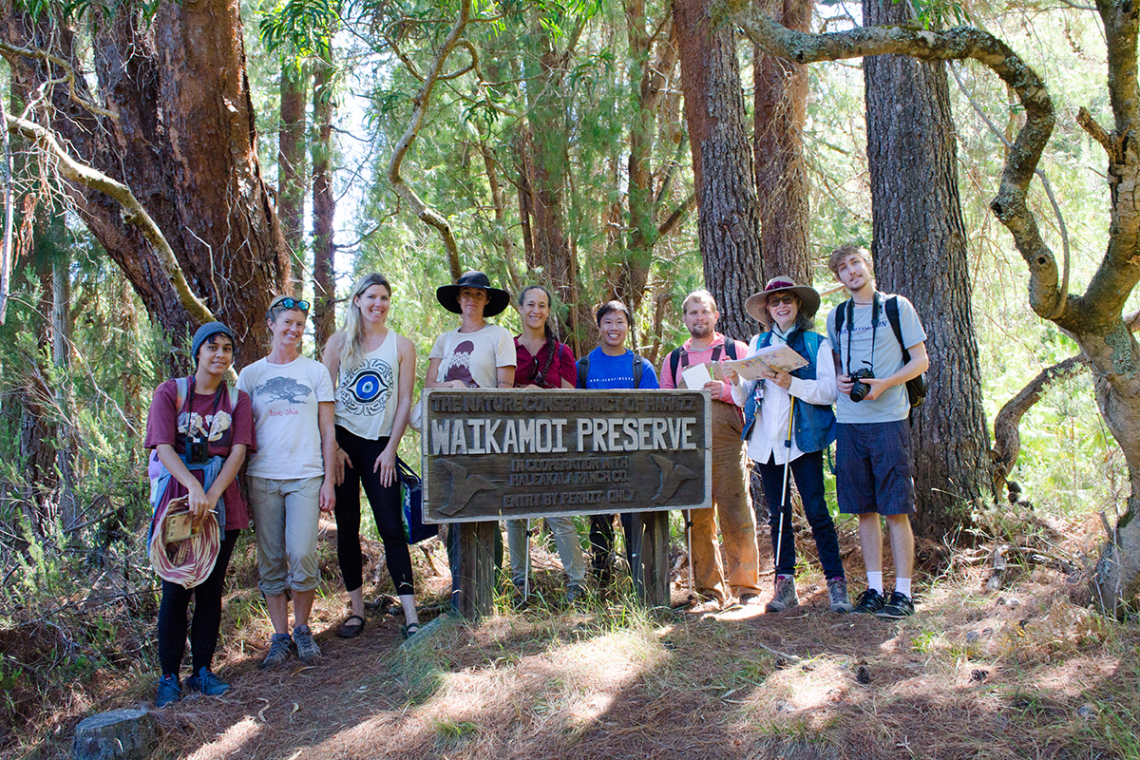
Teachers at Hoike workshop

Workshops participants experience lessons as students would, preparing them to teach the lesson in the classroom.

The Ho’ike o Haleakala Steering Committee will be hosting a series of one- and two-day teacher’s workshops starting in January 2012.

Join us in exploring exciting new lessons that spotlight native and invasive species issues on Maui. You will leave with innovative tools for teaching native Hawaiian science in the classroom and field. Commit to testing these materials in your classroom and receive a $75 stipend.

One day workshops:
January 14
March 10

Two day workshop:
February 18-19

R.S.V.P required. Workshops run from 9 a.m. to 4 p.m. at the Maui Invasive Species Committee (MISC) Headquarters in Pi’iholo. Space is limited; call 573-6472 or email miscpr@hawaii.edu to reserve your spot and for directions.

The one-day workshops will include hands-on experience and demonstration. The two-day February workshop adds a native Hawaiian forest hike and participants will receive an advance hard copy of Ho’ike o Haleakala’s new Invasive Species Module, including multimedia components and game pieces.

A sampling of the activities we will cover:

  • Raindrops and Watersheds.” In this lab, students recreate the effect of miconia leaves on rainfall and watershed functionality. Can the size of a leaf change the health of a forest? Find out!
  • Pathways and Vectors.” Students employ Google Earth technology to investigate the wiliwili gall wasp invasion of 2005, that threatened Maui’s native wiliwili forest. Working in small groups and using real-life data, students predict how the wasp spread and how it was ultimately controlled.
  • Hotel Manager Scenario.” Students grapple with the economics of invasive species while balancing the budget for a hotel overrun with coqui frogs. This multidisciplinary activity incorporates math, problem-solving, and delegation.
  • What’s in a Name?This creative writing and drawing activity uses naupaka as a platform to discuss the usage of scientific, common, and Hawaiian names.
  • Mascots, Icons, & Amakua.” This thought-provoking lesson asks students to investigate state and national symbols, such as the American bald eagle, and the qualities they embody. Why are so many Hawaiian schools represented by non-native mascots? In answer to this, students craft arguments for or against changing their school’s mascot.
  • Weed Risk Assessment Bingo.” This fun, fast-paced game mimics the official Weed Risk Assessment tool, helping students determine which characteristics make a plant a potential weedy threat.
  • Introducing Invasives.” What makes one plant native and another invasive? Why do biologists call Hawaii “an unparalleled showcase for evolution?” Students gain a basic understanding of how island ecosystems formed and how they work today by watching a dynamic slide show and completing a crossword.
  • Timeline.” When did the first mosquito hit Hawaiian shores? Students identify key points in the natural history of the Islands, from the emergence of Kure Atoll to today. They create a visual tool for assessing the dramatic increase in biological “traffic” to the Islands.

Come learn how to use Hawaii as a perfect natural laboratory for your students.
Mark your calendar!

If you can’t attend the workshop, but would like to test these activities, email miscpr@hawaii.edu or call (808) 573-MISC.

Follow

Get every new post delivered to your Inbox.