archives

Get Involved!

This category contains 14 posts

The “yellow dragon disease” is perched on Hawaii’s doorstep

Tangerines, oranges, lemons, limes, pummelo and grapefruit— sharing a box of citrus just picked from the backyard is part of life in Hawai‘i, much as leaving your slippers outside the front door.

But imagine walking outside to find your trees covered in bitter, misshapen fruit: no more fresh lemons, tangerines, or oranges from your yard. Backyard gardeners and commercial growers across the mainland are scrambling to protect their citrus in the face of one of the most serious citrus diseases in the world, a disease perched on Hawai‘i’s doorstep.

Citrus greening disease, also known as huanglongbing or yellow dragon disease, originated in Asia. It was first detected in the United States in Florida in August of 2005. By July of 2008 it had spread across the state. It has since sprung up in backyards and farms throughout the Southern United States. Once infected, plants don’t recover and thousands of trees throughout the Southeast have died. The impacts to the citrus industry in Florida have been profound. California citrus growers are bracing themselves after the disease popped up in a Los Angeles suburb last summer.

A tiny, gnat-sized insect, the Asian citrus psyllid (Diaphorina citri), is responsible for spreading citrus greening disease. These psyllids feed on the stems and leaves of citrus and must feed on an infected tree to spread the bacterial disease. Currently, citrus greening is not present in Hawai‘i, but we do have sizeable populations of non-native Asian psyllid. Across the mainland the trend has been for the arrival of the psyllid to be followed by the disease.

The Asian citrus psyllid was first detected on the Big Island in 2006. Monica Tauyan is a plant pest

The pattern of "blotchy mottle" on this citrus leaf is an classic sign of a citrus greening infection. Photo courtesy of the University of Florida Institute of Food and Agricultural Sciences-Citrus Canker.

The pattern of “blotchy mottle” on this citrus leaf is an classic sign of a citrus greening infection. Photo courtesy of the University of Florida Institute of Food and Agricultural Sciences-Citrus Canker.

control technician with the Hawai‘i Department of Agriculture. She is part of a team that regularly surveys citrus across the state for citrus greening. Tauyan has no problem finding the Asian psyllid living on a variety of different citrus. “The psyllid causes leaf curl,” she says, “but the major concern is the disease.” If citrus greening arrives, the psyllids will carry the disease from tree to tree. Tauyan conducts surveys on Maui several times a year, and on Moloka‘i and Lāna‘i annually. Her efforts have been focused on farms, nurseries, and residences, and to date, have come up empty handed.

She’s looking for blotchy mottling on the leaves in an asymmetric pattern, “It’s the classic symptom.” according to Tauyan. When she finds this, or other indicators—such as yellowing leaves or misshapen, bitter fruit that don’t ripen—she collects samples and sends them to the University of Hawai‘i for testing. “We’ve been doing surveys since 2009. So far we’ve had no positives.”

If citrus greening makes it to Hawai‘i, Tauyan thinks it will likely arrive in the form of an infected psyllid. Psyllids carry the disease for life. A miniscule psyllid slipping undetected into Hawai‘i could spell big trouble for our citrus and inspectors with the Hawai‘i Department of Agriculture are on the lookout.

Malformed fruit also indicate and infection of citrus greening. Photo courtesy of the University of Florida Institute of Food and Agricultural Sciences-Citrus Canker.

Malformed fruit also indicate and infection of citrus greening. Photo courtesy of the University of Florida Institute of Food and Agricultural Sciences-Citrus Canker.

You can help. First, don’t bring citrus plant material into Hawai‘i from the mainland or other parts of the world without first checking with the Hawai‘i Department of Agriculture. Secondly, regularly check your citrus. If the leaves are blotchy and mottled unevenly, or the fruit is misshapen and not ripening correctly your citrus could be infected. Confirming the diagnosis requires lab work, as there are also mineral deficiencies that resemble a greening infection. Contact Tauyan at the Department of Agriculture on O‘ahu 808-973-9528 if you are concerned about your citrus plants, or collect a sample yourself and submit it to the local extension office of the College of Tropical Agriculture and Human Resources in Kahului or Ho‘olehua on Moloka‘i. Submission guidelines are online at www.ctahr.hawaii.edu/dnn/yellowdragon/SampleSubmission.aspx. Learn more about the disease and find an app for reporting possible cases of citrus greening at www.saveourcitrus.org

By Lissa Fox Strohecker. Originally published in the Maui News, April 14th, 2013 as part of the Kia‘i Moku Column from the Maui Invasive Species Committee.

Maui Activities for Invasive Species Awareness Week

contestlogoweb

It’s Hawaii Invasive Species Awareness Week and on Maui, we’re focusing on ant awareness (more activities to follow).

What do you know about the little fire ant?  Here’s a change to test your knowledge and win some great prizes. Teachers-here’s an activity for you and your students!

Tune into KPOA 93.5 & KISS 99.9 March 4-8th for the Spot the Ant & Stop the Ant contest  from the Maui Invasive Species Committee and the County of Maui.

Be ready to answer the trivia questions (all information from fireantfreemaui.org) on-air for a chance to win one of these great prizes from our sponsors:antcostumeweb

*Special thanks to the Hawaii Islands Land Trust

Think you have little fire ants on your property?
On Maui test & send in a sample to Maui Invasive Species Committee, PO Box 983, Makawao, HI 96768

Know an invasive-species-savy landscaper or nursery?

The Maui Association of Landscape Professionals, Maui Invasive Species Committee, and the County of Maui will recognize a professional landscaper, plant provider, or commercial/agricultural property owner’s efforts to protect Maui County from invasive species.

The 10th Annual Mālama i ka ‘Āina Award winner will be announced at the MALP Lawn and Garden Fair, November 3rd, at the Maui Mall. Nomination forms are available below or by calling 573-MISC or visiting http://www.mauiisc.org or http://www.malp.org.

Application Deadline is Saturday October 20th.

2012 Malama i ka `Aina Award On-line Application

2011 Malama i ka Aina Award Winners Elaine Molina and Sarge McBride (center with plaque and lei) and presenters (from left to right) Rob Parsons with the County of Maui, Teya Penniman and Pat Bily with MISC, and Gary Mohrlang with the Maui Association of Landscape Professionals.

2010 Malama i ka Aina Award Recipient Mach Fukada

2010 Malama i ka Aina Award Recipient Mach Fukada

The ‘Ua‘u and the threat of invasive species

Hawai‘i is famous for rare birds: scarlet honeycreepers that dart through the rainforest and gold-flecked owls that hunt at twilight. But another Hawaiian bird lives most of its life at sea. The ‘ua‘u , or Hawaiian petrel, returns to land under the cover of darkness—and then only to nest. Now is the time to be on the look out for this cryptic bird; the chicks are fledging.

An ‘ua‘u chick hides in his burrow awaiting his parents return. In the meantime the chick is vulnerable to passing rats, cats, and mongoose who can quickly scoop the chick from his hiding place.Photo by Jay Penniman

­­Named for their eerie nighttime call, “uuua-uuuu,” the ‘ua‘u  alight on land for only a few minutes before ducking into their underground burrow. Their nesting locations are remote, difficult to access. Counts at sea estimate the population at around 20,000, low enough to earn a place on the Federal Endangered Species list.

Fossils indicate that ‘ua‘u were once so plentiful in Hawai‘i  they blackened the sky. Prior to humans’ arrival in these Islands, ‘ua‘u  and their feathered friends ruled these Islands. ‘Ua‘u  built burrows from the coastline to the mountaintop, digging into soil and taking advantage of existing crevices. But populations have dwindled to a fraction of what they were, due to habitat loss and predation. Now invasive species threaten to overrun the sliver of habitat remaining for native birds, while predators lurk outside their burrows.

Having evolved without mammalian predators, ‘ua‘u  are particularly naïve, both in their choice of nesting location and how they rear their young. Ground nesting, even in a burrow, leaves petrel chicks and eggs vulnerable to attacks by stealthy rodents or felines. Pigs, goats, cattle, deer, and people trample burrows, crushing the egg or the chick inside.

‘Ua‘u  only lay one egg per season, and both parents invest much energy and effort in rearing the chick. A trip to the grocery store for an ‘ua‘u  parent is a two-week, 6000 mile journey along the northwest Hawai‘i an islands to the Aleutians and circling back down to Hawai‘i , among the longest feeding routes of any known seabird. Unfortunately, there is no babysitter; the chick’s safety depends on remaining underground, hidden from predators.

While the species as a whole demonstrates remarkable flexibility in choosing nesting sites—from dense thickets of uluhe fern to frigid cliff faces on the summit of Haleakalā –individual birds are guided by habit. They return to the same burrow year after year, despite the likelihood of a cat laying in wait.

Many people are working to protect the ‘ua‘u . Biologists arelearning more about these remarkable birds by observing their burrows and tracking their movements. A major colony was re-discovered on Lāna‘i in 2006, but the birds’ native habitat was being choked out by invasive trees. To protect this colony, staff from the Lāna‘i Native Species Recovery Program and volunteers are fighting back acres of strawberry guava and replanting the uluhe fern that form a protective blanket over the burrows. Within Haleakalā National Park, park staff controls predators that attack ‘ua‘u .

‘Ua‘u, like this one, are often disoriented by streetlights and end up on the ground. If you find an ‘ua‘u safely pick it up and call the Maui Nui Seabird Recovery Project, (808) 280-4114. Photo by Jay Penniman

You can help as well. When petrel chicks leave the burrow for their first time they can become disoriented by the bright lights of civilization. Some birds come crashing down onto buildings or roads. A grounded chick is defenseless against predators and threatened by cars. If you see a petrel on the ground, carefully pick it up with a cloth or towel and place it in a well ventilated box. Do not try to feed the bird. Call Maui Nui Seabird Recovery Project (808) 280-4114.­­­

By Lissa Fox Strohecker. Originally published in the Maui News, September 9th, 2012 as part of the Kia‘i Moku Column from the Maui Invasive Species Committee.
You can find all the articles in the Kia‘i Moku series
http://www.hear.org/misc/mauinews/

Check out the MISC Summer 2012 Newsletter: Kia’i i Na Moku o Maui Nui

Click this link for a PDF version of the newsletter: 2012 MISC Newsletter Kia’i i na Moku o Maui Nui

In this issue:

Moeana Besa and her family live in a part of Tahiti plagued by little fire ants. Photo by Masako Cordray

Moeana’s Message―What Tahiti Can Teach us about Little Fire Ants
“This place used to be paradise” said Moeana Besa. Find out what happened.
On Page 1

Fire at the Farm
How Christina Chang helped stop the establishment of the little fire ant on Maui.
On Page 3

On the Job
Where can you find a snake handler, exploratory entomologist, educator, advocate, law enforcer, pesticide applicator examiner, irrigation specialist, and ant wrangler? Try the Hawaii Department of Agriculture.
On Page 5

New Science
Paintball guns,  scuba tanks, and spacklers—the promising new techniques for treating little fire ants.
On Page 6 (check out the video of the spackler in action!)

Tiny Ants, Huge Nuisance
Learn more about the little fire ant and why this wee creature is such a big problem
On Page 6

Education Saves the Day!
How a class visit led to the detection of the little fire ant on Maui.
On Page 9

Dauntless Darrell

MISC field crew leader Darrell Aquino is up for any challenge

The keen eye of Darrell Aquino, pig hunter and dedicated MISC employee.
On Page 10

PLUS:

  • MISCommunication-The Comics of Brooke Mahnken
  • Managers Corner
  • Is that fire ant Little? Tropical? or Red Imported? Dr. MISCellaneous knows the difference!

To receive a hard copy version of the newsletter fill out the form below and we will add you to our mailing list. Be sure to subscribe to our blog to stay updated on all things MISC!

Learn more about the little fire ant at lfa-hawaii.org or littlefireants.com

Grow bananas? Guard against BBTV.

Check for "J-hooks" along the midrib of the of the banana leaf. This is a symptom of BBTV infection. Photo Courtesy of Scott Nelson, UH-CTAHR.

Check for "J-hooks" along the midrib of the of the banana leaf. This is a symptom of BBTV infection. Photo Courtesy of Scott Nelson, UH-CTAHR.

In the spring of 2009, Angela Kepler found a diseased banana plant on her neighbor’s property. “It really freaked us out! As soon as we found out we ran next door and sprayed for aphids.” The neighbor’s banana plant was infected with banana bunchy top virus (BBTV). “BBTV is the worst,” Kepler explains. “Now we help check everyone in the neighborhood.”

Angela Kepler and Frank Rust study bananas. Of the 32 different kinds on their property, most are rare Polynesian bananas collected from the wild or someone’s backyard. They photograph and observe each plant from keiki to fruiting to learn the key characters that make each type unique. Kepler and Rust are writing a book on how to identify different types of bananas. They know what BBTV can do.

The plant on the left is infested with BBTV. Note how the new growth is bunched together, a symptom that gives the disease its name. Photo courtesy of Scott Nelson, UH-College of Tropical Agriculture and Human Resources

BBTV is the most serious known disease of bananas. Infected plants produce shrunken, malformed leaves and distorted fruit—if they fruit at all. BBTV eventually kills all plants in an infected mat (root mass)there is no cure for the disease. Removing infected plants and preventing spread is the only control for BBTV—a necessary precaution if bananas are to continue being grown in Hawaii. BBTV threatens the banana industry, backyard farmers, and rare, culturally significant banana varieties, such as those grown and collected by Kepler and Rust. “We’ve seen a tremendous demise in the last 10 years,” says Kepler.

BBTV is spread between plants by banana aphids. The virus is passed from an infected plant to the aphid and transmitted when the aphid feeds on a healthy plant. People then spread BBTV great distances when they transport infected plants. Anyone who moves or harbors infected plants puts their neighbors’ plants at risk.

Banana bunchy top virus is widespread in Southeast Asia, the Philippines, Taiwan, the South Pacific, and in parts of India and Africa. It was first discovered in Hawaii in 1989. BBTV is widely established on O‘ahu and has been detected on Hawai‘i Island, Kaua‘i, Maui, and Moloka‘i. “We haven’t been able to collect bananas from other islands, or share ours due to BBTV,” says Kepler.

On Maui, backyards in Kīhei and Pukalani suffer the densest infestations of the disease. Banana farms in Kula and, most recently, central Maui have been wiped out. Not surprisingly, BBTV thrives in Lahaina as well; drier climates are better aphid habitat. Scattered infestations of BBTV have been found in Ha‘ikū and Huelo as infested material has been brought into the area. To date, Hāna, Ke‘anae, and Kipahulū are free of BBTV.

Another indication of BBTV infection is a sporadic dark green streaking, as if in a Morse-code pattern along the leaf sheath. MISC file photo.

Another indication of BBTV infection is a sporadic dark green streaking, as if in a Morse-code pattern along the leaf sheath. MISC file photo.

Controlling and preventing the spread of BBTV is everybody’s business. If you have banana plants check them regularly for symptoms of the disease. Initial signs of infection are: 1) dark “Morse code” streaks along the leaf stem named for the irregular pattern of dashes and dots along the veins, 2) “J-hooks’ where the leaf veins along the blade of the leaf curve into the midrib. As the infection becomes established, new leaves emerge with difficulty, giving the plant the appearance of having the “bunchy top” that the disease is named for. New leaves are narrow and lance-shaped, often with yellowing around the leaf edges. Plants will stop producing fruit after infected and any keiki from the infected mat are severely stunted.

Check for "J-hooks" along the midrib of the of the banana leaf. This is a symptom of BBTV infection. Photo Courtesy of Scott Nelson, UH-CTAHR.

Check for "J-hooks" along the midrib of the of the banana leaf. This is a symptom of BBTV infection. Photo Courtesy of Scott Nelson, UH-CTAHR.

Controlling the spread of BBTV requires control of the vectors: aphids and movement of infected plants. Regularly spraying your plants with soapy water controls the banana aphid and can help prevent infection. The Maui Invasive Species Committee can help you identify infected plants and will control them for you. Infected plants should be killed on site and left standing until completely dead, typically within six months of treatment. Removing infected plants reduces spread of BBTV; aphids won’t feed on infested plants. Healthy bananas can be replanted in the same place after the mat has completely died.

If you suspect your banana plants are infected with BBTV and live in Maui County, call the Maui Invasive Species Committee at 573-6472.  Due to the risk of BBTV, banana plants should not be moved between communities. “We all want to share bananas. People want to give each other plants, but don’t bring bananas from O‘ahu, Hawai‘i Island, or Kaua‘i,” cautions Kepler. “And whatever you do, don’t take bananas to the Hāna and Kipahulu area.”

Article by Lissa Fox Strohecker

Originally published in the Maui News, February 13th, 2011 as part of the Kia‘i Moku Column.
You can find all the articles in the Kia‘i Moku series
http://www.hear.org/misc/mauinews/

Native plant growers throughout Hawai‘i replace IHOP’s “The Lorax” themed seed bookmarks with native plants

From March 9th, 2012 press release

HONOLULU —  Hawai‘i theater goers enjoying the new movie, “Dr. Seuss’ The Lorax,” and its theme of protecting local tree species can help honor that message by supporting the use of native Hawaiian plants rather than non-native species.

To that end, the Department of Land and Natural Resources (DLNR) worked with local IHOP managers and the IHOP corporate headquarters in California last week to voluntarily discontinue the distribution of promotional bookmarks embedded with seeds at Hawai‘i IHOP locations.

‘A‘ali‘i, or Dodonaea viscosa, is one of the Hawaiian plants being offered in exchange for pine-seed laced bookmarks. ‘A‘ali‘i range in size from shrubs to small trees such as this one at Maui Nui Botanical Gardens.

‘A‘ali‘i, or Dodonaea viscosa, is one of the Hawaiian plants being offered in exchange for pine-seed laced bookmarks. ‘A‘ali‘i range in size from shrubs to small trees such as this one at Maui Nui Botanical Gardens. Photo by Forest and Kim Starr

“Thanks to the quick action of DLNR and others involved, we have turned a potentially negative situation into a positive one by expanding on the movie’s underlying message of being better stewards of our natural environment,” said Governor Neil Abercrombie. “The collaborative effort to discontinue the distribution of spruce seeds engages those who may not be aware of the importance of the ‘right plant in the right place.’ Our forests will thrive with more native flora and that benefits all of us.”

The bookmarks are part of a promotional campaign for Universal Pictures’ new movie release, “Dr. Seuss’ The Lorax,” in which IHOP customers are being encouraged to help the Lorax by planting trees. The bookmarks are embedded with Engelmann spruce seeds, which are native to parts of the U.S. mainland but not to Hawai‘i.

IHOP in Hawai‘i has voluntarily discontinued distribution of seeds, and the DLNR and the Coordinating Group on Alien Pest Species have partnered with native Hawaiian plant nurseries to create an exchange program so that any Hawai‘i resident IHOP customers who may already have received a seed-laden bookmark can exchange their spruce seed bookmark for a free native Hawaiian plant.

While the specific species included in the bookmark may not pose a high risk to Hawai‘i’s native plants, other species of spruce trees have been observed to be invasive in parts of the Pacific, where they replace native plants and the animals that depend on them.

IHOP’s corporate office demonstrated its commitment to protecting the environment by also discontinuing this promotion in Puerto Rico and the U.S. Virgin Islands, where Engelmann spruce is also a nonnative species.

“We want to be responsible caretakers of our environment. When we learned that the trees in question would not be the best choice for Hawai‘i, we responded quickly. We hope our guests will take advantage of this exchange opportunity,” stated Patrick Lenow, spokesman for IHOP Restaurants.

First published in 1971, Dr. Seuss’ The Lorax is a fictional story of a pristine environment where truffula trees provide food, clean air, and habitat for a community of unique animals. As they are overharvested to extinction, the Lorax tries to point out the environmental importance of the trees, but to no avail.  The animals leave and the environment is left in ruins.  However, the end of the story is one of hope:  replant the truffula trees to restore the environment.

A close-up of ‘a‘ali‘i fruit showing their distinctive shape and color. Photo by Forest and Kim Starr

A close-up of ‘a‘ali‘i fruit showing their distinctive shape and color. Photo by Forest and Kim Starr

“Updating the message of The Lorax to include the value of native species is key for the next generation of conservationists to understand the problems facing our environment,” said Joshua Atwood, coordinator for the interagency Hawai‘i Invasive Species Council housed at the DLNR.

“An important part of The Lorax story is that the truffula trees grow nowhere else, and the Lorax is there to protect that limited resource. Similarly, many of Hawai‘i’s native plants and animals only exist on these islands, and we need to do what we can to protect them. That includes planting native, rather than nonnative, species whenever possible.”

One of the nurseries providing plants for the exchange is Hui Ku Maoli Ola, the largest native Hawaiian plant nursery in the state.   “We believe in the importance of perpetuating our native flora as a part of our unique culture and environment,” said Matt Kapaliku Schirman, Hui Ku Maoli Ola co-founder. “This is a great opportunity to help protect and restore the Hawaiian environment.”

DLNR also thanks the Native Nursery and Big Island Plants or Ku ‘Oh‘ia Laka, whose exchange agreements were facilitated by the Maui and Big Island Invasive Species Committees.

IHOP customers who received a Lorax bookmark can exchange the seed-embedded bookmark for a native Hawaiian plant free of charge through the end of April, 2012 at the following participating nurseries:

O‘ahu:
Hui Ku Maoli Ola Native Plant Nursery
46-403 Haiku Rd, Kane‘ohe, HI, 96744
Hours:  Monday-Friday 7:30 a.m. – 4 p.m., Saturday 7:30 a.m. – noon, closed Sunday
Contact: (808) 235-6165, www.hawaiiannativeplants.com

Maui:
Native Nursery and Ho‘olawa Farms, exchange facilitated by the Maui Invasive Species Committee (MISC)
Contact MISC at (808) 573-6472

Hawai‘i Island:
Big Island Plants or Ku ‘Oh‘ia Laka, exchange facilitated by the Big Island Invasive Species Committee (BIISC)
Contact: BIISC at (808) 933-3345

“Unless someone like you cares a whole awful lot, nothing is going to get better. It’s not.” —the Once-ler from “The Lorax” by Dr. Seuss

In anticipation of “The Lorax” movie opening March 2, a national restaurant chain has been giving away bookmarks with seeds of blue-spruce and Canadian white pine.

A press release dated February 21st 2012 explains the program: “In keeping with the animated adventure’s theme that one person can make a difference, IHOP is distributing three million limited-edition bookmarks embedded with seed paper that can be planted to flourish across a range of climates and forest condition.”

It’s great to encourage kids to plant trees. Unfortunately these aren’t the Truffula trees that the Lorax fought to protect. Planting alien trees in Hawai‘i can be tricky. The characteristics of the bookmark trees that allow them flourish across a range of climates and forest conditions can also help them invade and outcompete native species. In Hawai‘i pines have a reputation of escaping cultivation into high-elevation ecosystems. Think twice before planting these pines in our forests. As the voiceover from the movie trailer says when the boy receives the last seed of the Truffula tree, “It’s not about what it is, it’s about what it can become.”

After concerns were raised, distribution of the seeds was discontinued in Hawaii.

Make the Lorax proud and plant a tree that is regionally appropriate to the area. Find suggestions of native Hawaiian plants here: www.nativeplants.hawaii.edu

And on a final note: ever notice how a lehua blossom on an ‘ōh‘ia looks a bit like a Truffula tree?

A Truffula tree for Hawai‘ (‘ōh‘ia photos by Forest & Kim Starr).

A Truffula tree for Hawai‘i (‘ōh‘ia photos by Forest & Kim Starr).

Make National Invasive Species Week last all year

National Invasive Species Week is February 26 to March 3. While it’s great to pay attention for the week, here are a few simple actions, one for each month, to help make a difference on the invasive species front:

*Note: This list was originally published in the January 8th edition of the Maui News.

Start by removing invasive species in your own back yard, like this ornamental pampas grass.

Start by removing invasive species in your own back yard, like this ornamental pampas grass.

January—check backyard first. Take a look in your own yard to see what invasive species you might be harboring– then remove ‘em! Backyards are often the source for plants and animals that escape to wreak havoc in our environment. If the plant or animal is a target for the Maui Invasive Species Committee, such as pampas grass or coqui frogs, call us and we’ll give you a hand.

February—be pest-savvy. The last week of February is National Invasive Species Awareness week. Take part by learning about a new invasive plant or animal and how to control or report it. Start at mauiisc.org, mauiinvasive.org, reportapest.org, or check for monthly editions of this column, then share what you know.

March—buy local—Maui local. Many pests are limited to just one island, but they spread when potted plants, cut flowers, equipment, even produce is moved between islands. Support Maui’s economy and protect our island by bringing home locally grown products. Avoid ordering seeds on the Internet as some plants may be invasive in Hawaii.

April—clean your gear. Headed out diving, snorkeling or hiking?  Give your gear a thorough rinse or

Clean your gear-boots, fins, packs, and cars-regularly to prevent the spread of hithchiking invasive species.

Clean your gear-boots, fins, packs, and cars-regularly to prevent the spread of hithchiking invasive species.

scrub to remove any hitchhiking seeds (check the tongue of your boots), algae, or insect eggs before you head out. And don’t neglect to check your car periodically, both the underside as well as the inside.

May—volunteer. You will meet interesting people and learn more about Maui. Many groups have weekend volunteer trips where you can lend a hand removing invasive species or planting native species. Find an organization at hear.org/volunteer/maui/

June—survey your yard for the little fire ant. This tiny ant often arrives unnoticed, but it can become a huge problem. Currently no known infestations exist on Maui, but there is a high likelihood they will arrive again. Surveying is as easy as peanut butter and a chopstick. Learn more at lfa-hawaii.org

July—travel smart. Check twice before you bring something interisland. Plants and plant cuttings must be inspected by the Hawaii Department of Agriculture before being taken interisland to ensure there are no unwanted pests or diseases riding along.

August—take a hike, but with new eyes.  Public reports are one of the best ways we learn about new invasive species.  So cruise around the neighborhood, or go for a walk in the forest. See a bird you’ve never seen before or a new plant that looks like it’s taking over? Take a photo and let someone know.

September—be neighborly.  Some invasive species problems are too big to tackle alone, but left unchecked will become everyone’s problem.  Offer to help out your neighbors with an invasive species in their yard.

Landscaping with native species, like this ālula, will also help save water. Photo by Forest and Kim Starr.

October—go native in your yard. Hawaiian plants have never been more available for landscaping. In addition to being a unique addition to your landscape, these species won’t be invasive and offer habitat for native animals. Another plus – these plants evolved to survive on rainfall, so when selected to match your climate, they can help you save water.

November—eat an invasive. The season of eating offers plenty of edible invasive species, from axis deer to pigs to.  Make a meal, or part of a meal, in the spirit of removing invasive species. For more information (and recipes) check out invasivore.org.

December—celebrate in holiday style with an invasive pine tree.  Each year Friends of Haleakala National Park and The Nature Conservancy lead December trips to remove invasive pines from areas in and near Haleakala National Park. Find details for the Friends trip at fhnp.org and for the TNC trip by calling 572-7849. Other trips may be listed in the newspaper.

This year make a resolution to help address invasive species— just one simple activity a month can add up to make a big difference in our community.

Article by Lissa Fox Strohecker

Originally published in the Maui News, January 8th, 2012 as part of the Kia‘i Moku Column.
You can find all the articles in the Kia‘i Moku series
http://www.hear.org/misc/mauinews/

Give your loved one the gift of local this Valentine’s Day

Phalaenopis orchid

Locally-grown orchids-a great Valentine's gift that helps your neighborhood nurseryman and prevents the introduction of invasive species. Photo by Forest and Kim Starr

Flowers. When it comes to courting your Valentine, you gotta have ‘em. Roses may be the standby for the holiday, but don’t overlook the beautiful, locally grown cut flowers available. This year, express your love for Maui as you woo your Valentine with a creative choice of flowers.

The locavore movement is nothing new; eating locally grown food has steadily gained support over recent years with restaurants highlighting Kula greens and Maui onions. Buying other products grown on Maui, like flowers presented on Valentine’s Day, is yet another way to help our community by preventing the import of invasive species and growing the local economy.

Like agriculture, the floral industry has become increasingly globalized. During just one week in February 2008, flowers and foliage shipped to Maui came from Columbia, Italy, Thailand, New Zealand, the Netherlands, Ecuador, Peru, California and Florida. Some shipments are refused or incinerated at the Hawai‘i Department of Agriculture inspection facility because they carry pests and diseases not known to be in Hawai‘i. But consumers can help stem the introduction of hitchhiking pests.

“If we can buy locally grown things, there is less risk of invasive species being spread and it helps local businesses,” explains Glenn Sakamoto, training and education specialist with HDOA.

Anthuriums, another readily available flower on Maui. Photo by Forest and Kim Starr

Carver Wilson of Maui Floral knows firsthand about the hitchhiking pests carried in cut flowers and foliage. He and other florists throughout the state have voluntarily cut back on their use of eucalyptus and wax myrtle as foliage in arrangements. These plants in the myrtle family are imported from out-of-state and are the likely culprit for bringing in the invasive ‘ōh‘ia rust that spread quickly, killing rose apple trees throughout the state. “The rust is a detriment, so we chose to use something else,” Wilson says. The Hawai‘i Department of Agriculture is in the process of pursuing a permanent ban on the import of myrtle plants to protect against new strains of the rust out of concern for protecting native ‘ōh‘ia.

Some of Wilson’s suggestions for locally grown bouquets: Orchids, pincushion or king protea, anthuriums and ginger. These flowers are symbolic in their own right. Orchids represent love, luxury, beauty and strength; proteas represent diversity and courage; and anthuriums, hospitality.

To highlight the Hawai‘i floral industry, HDOA featured a bouquet of locally grown possibilities at last year’s Maui Agricultural Festival. Working with growers on Maui and the Big Island, HDOA showcased fabulous floral arrangements by professionals and offered festivalgoers the opportunity to create their own works of art using locally grown flowers. A similar event was held on the Big Island.

King Protea

Proteas symbolize beauty and strength, a perfect expression for the strong and beautiful Valentine in your life. Photo by Forest and Kim Starr

The events are one part of an effort to encourage replacing imported goods with Hawai‘i-grown products. This year consider where your flowers are coming from; it’s an opportunity to help protect Hawai‘i from invasive pests while showing a little love to your local flower grower and your loved one. As Wilson says, “I absolutely support and suggest people use locally grown flowers; it helps us all.”

Article by Lissa Fox Strohecker

Originally published in the Maui News, February 12th, 2012 as part of the Kia‘i Moku Column.
You can find all the articles in the Kia‘i Moku series
http://www.hear.org/misc/mauinews/

Help Hawai‘i–harvest a Christmas tree

‘Tis the season, and tradition calls for pine trees to decorate Maui residents’ homes, although there are many palms decorated in Christmas lights as well. Most Christmas trees are shipped in, but there’s a history of growing pines in Hawai‘i. Ralph Hosmer, Hawai‘i’s first forester, came on the job in 1904. At the time, forests throughout Hawai‘i were in a sorry state. Since Polynesian times, people have greatly altered lowland forests, initially for settlement and taro cultivation, then for sugar cane and pastureland. Feral pigs, goats and cattle escaped into intact forests, trampling shallow-rooted plants and browsing slow-growing plants. Honolulu, prospering from the sugar boom, was exceeding existing water supplies by the 1870s. Recognizing the need to protect and restore vital watersheds, everyone from sugar cane barons to King Kalākaua began fencing out animals and planting trees, some of which were pines.

Mexican weeping pine (Pinus patula) creeps into the native forest of the Waikamoi preserve. Forrest and Kim Starr photo

Hosmer helped turn sentiments about forest protection into cohesive action. He established the first forest reserves in Hawai‘i, beginning in 1906 when Alexander & Baldwin ceded management of acreage on Maui to the territorial government. With newly acquired land, Hosmer accelerated efforts to fence out cattle and goats and planted fast-growing hardy trees. The goals were three-fold: to stop erosion, restore the watershed and provide for Hawai‘i’s timber needs. Hosmer’s experimental plantation high on the slopes of Haleakalā now bears his name, “Hosmer’s Grove.” He planted species familiar from his Mainland forestry background: redwood, ash and pines. For years to come, foresters continued planting non-native species. These trees did prevent erosion on overgrazed lands, but some escaped cultivation to invade nearby ecosystems and crowd out native species.

Three species – Monterey pine (Pinus radiata), Mexican weeping pine (Pinus patula) and maritime pine (Pinus pinaster) – are particularly invasive. They persistently threaten Haleakalā National Park and The Nature Conservancy’s Waikamoi Preserve, transforming native stands into pine forests. Pines grow fast, up to one foot per year and reach maturity quickly, producing seeds within six to eight years. A massive amount of tiny seeds spread easily on the wind, help these pines colonize new areas. Removing pines has proven essential to maintaining the shrub-land and alpine habitat of Haleakalā.

Over the years, crews at Haleakalā National Park have stopped a veritable woodland of pines. Bill Haus and the crew he works with have removed 87,920 pines from the park and surrounding areas since 1982. According to Natural Resource Program Manager Steve Anderson, “Without control, the slopes of the subalpine shrub land would be a pine forest.” Subalpine shrub land is critical habitat for a native plants and animals; conversion to a pine forest would turn this rare Hawaiian ecosystem into a biological desert – no native plants like māmane, pūkiawe, ‘ōhelo or ‘a‘ali‘i; no native birds like the ‘i‘iwi and ‘amakihi.

Monteray pine (Pinus radiata) growing inside Haleakalā crater alongside silverswords. There have been a flush of pine seedlings inside the crater in the last few years. Forrest and Kim Starr photo.

Monteray pine (Pinus radiata) growing inside Haleakalā crater alongside silverswords. There have been a flush of pine seedlings inside the crater in the last few years. Forrest and Kim Starr photo.

Pines threaten the crater as well. Haus and his crew have removed more than 1,500 pines from inside the crater, with a peak of 778 in 2010.

Anderson said: “I wouldn’t have thought it was possible (for the crater to become a pine forest) several years ago, but it’s clear that potential exists now.”

The recent flush of pine could be the result of the 2007 Polipoli fire. Pines, including those invading Haleakalā Crater, are serotinous, meaning certain pine cones are coated with a waxy substance. These cones stay closed until the heat of a fire melts the coating to release seeds. As an ecological adaptation, it helps pines take advantage of the ash-fertile conditions following a fire. But in Hawai‘i, this adaptation may offer a unique seed-scattering advantage. The Polipoli fire possibly spurred a huge seed release and associated winds carried the seeds into the crater. Pine seedlings are even growing alongside silverswords.

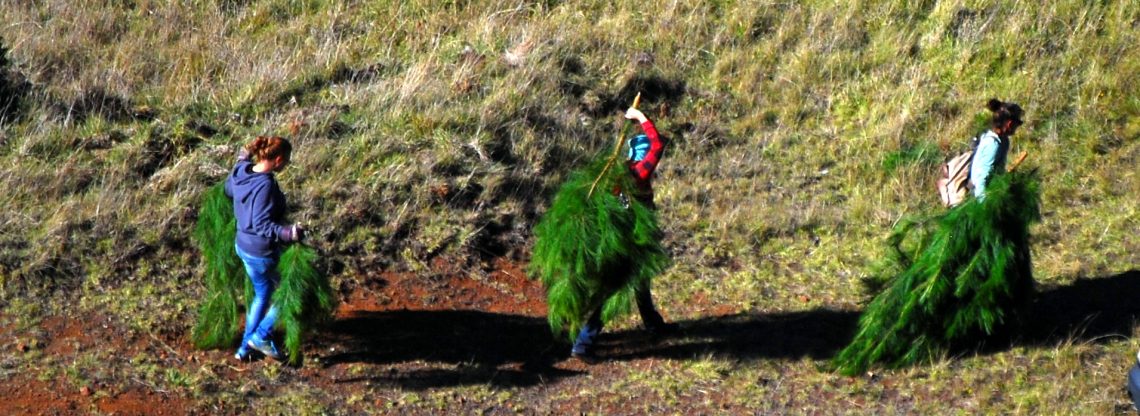
You can help protect the crater from pines, and take home a pine tree! Several organizations will be working with volunteers to remove pines in time for the holidays. Friends of Haleakalā National Park leads efforts to remove pine trees from the crater. Check out their website at fhnp.org for more information.

The Nature Conservancy will be working below Hosmer’s Grove on Dec. 17. Call or email Pat Bily at 856-7665 or pbily@tnc.org for details and to confirm attendance. Both trips are free and open to the public. Dress for wintery weather and bring rain gear, water, tools and rope to bring home your tree or wreath making supplies. Participants also may bring food. Eggnog is optional.

By Lissa Fox Strohecker
Originally published in the Maui News, December 11, 2011 as part of the Kia‘i Moku Column. Check out all of the MISC articles in the Kia`i Moku series at: www.hear.org/misc/mauinews/

Get involved! Help survey for Little Fire Ants Saturday, October 22.

MISC staff assist the Hawaii Department of Agriculture surveying for little fire ants. MISC file photo.

MISC staff assist the Hawaii Department of Agriculture surveying for little fire ants. MISC file photo.

Little fire ants (LFA) are devastating communities across the Pacific. Passive and deceitfully small in size, these South American imports pose a grave threat to Hawaii. They can deliver a painful sting, blind animals, and reduce biodiversity.

A cat on the big island blinded from a fungal infection, the likely outcome of little fire ant stings. MISC file photo.

A cat on the big island blinded from a fungal infection, the likely outcome of little fire ant stings. MISC file photo.

You can help!  We’re conducting a neighborhood survey for the LFA Saturday, October 22, from 8:30 am to 12pm. The little fire ant has been found once on Maui, and because the infestation was small it was eradicated. However, the source of the infestation has never been determined and there’s a good chance LFA are somewhere else on Maui. Your help in getting the word out is greatly appreciated!

Please contact us through the form below or at miscpr@hawaii.edu by October 19th if you are interested in participating. We’ll contact you with more details.

More about the little fire ant…

If LFA were to become established in Hawaii, they would become the state’s most devastating pest. Throughout the Pacific, LFA has overwhelmed communities. If we do not stop the spread of the little fire ant we stand to lose much of our agricultural industry. We will lose our ability to grow our own food, enjoy our yards, and hike through the forest. Ground nesting seabirds and sea turtle hatchlings will be attacked, along with many of our rare insect species. Once little fire ant is established, there is little hope of eradication. Learn more through the postings on this blog under the category invasive animals.

I thought we already had fire ants here?

Don't confuse the little fire ant with the much larger and widspread tropical fire ant (above). Photo courtesy of HDOA

Don't confuse the little fire ant with the much larger and widspread tropical fire ant (above). Photo courtesy of HDOA

Yes, the tropical fire ant, Solenopsis geminata, has been in Hawaii since the 1940s. While the tropical fire ant is a serious and unpleasant pest, it pales in comparison to the little fire ant. LFA are ½ the size of the tropical fire ant, only as long as a penny is thick. LFA typically sting people on their necks as they rain down from trees . Learn to tell the difference here or at www.reportapest.org.

To report suspected infestation of the little fire ant in Maui County call MISC at 573-6472. Visit www.lfa-hawaii.org to learn more and to report infestations throughout the state.

Residents urged to report unusual stinging fire ants


An infestation of the much-dreaded little fire ant (LFA), Wasmannia auropunctata, was discovered on a farm in Waihee, Maui, in early October of 2009, the first known LFA foothold on the island. As reported in the Oct. 16 Maui News, Hawaii Department of Agriculture (HDOA) will be working with the owner to eradicate the ½-acre infestation; LFA may have been at this site for a year. These tiny pale-orange ants deliver painful stings that develop into large red welts; some people are more sensitive to them than others. LFA may be perceived by many as less of a threat than the red imported fire ant but is nevertheless a very serious pest that can attain high densities, and its powerful sting poses problems for domestic animals, wildlife, agricultural workers and others who come in contact with it.  When populations build up outdoors, they eventually come indoors and sting people in their homes. In this regard it is actually worse than the other “imported fire ants” on the mainland.  Details of the LFA threat and how to combat it are nicely summarized in a CTAHR leaflet, available at www.ctahr.hawaii.edu/oc/freepubs/pdf/IP-LFA.pdf

An entire colony of the little fire ant can fit inside a macadamia nut shell. Photo by Hawaii Department of Agriculture

An entire colony of the little fire ant can fit inside a macadamia nut shell. Photo by Hawaii Department of Agriculture

Native to South and Central America, LFA has invaded locations in West Africa, Florida, the Galapagos Islands, several Pacific island nations (New Caledonia, Wallis and Futuna, Solomon Islands, Vanuatu, and Tahiti), Israel, and Australia.

Though LFA was first detected in Hawaii on the Big Island in March 1999, it is believed to have been there for at least four years before it was discovered; a lag between invasion and detection is regarded as “normal.” In retrospect, LFA likely had reached Hawaii from Florida; genotypes of Hawaii LFA are essentially identical to some LFA specimens from the Lake Placid area of central Florida. As soon as LFA was discovered in Puna in 1999, HDOA realized the seriousness of the situation. They developed a pest advisory and assigned an entomologist to lead efforts to address this new invasion, involving detection, experimental efforts at eradication of local populations, and inter-island quarantine.

A 2005 review of HDOA’s efforts to address this serious ant pest suggested that they were “hindered by low staffing levels; lack of public and commercial awareness; lack of access to nursery sales records; the difficulty of detecting this ant; lack of a registered ant control product for use in orchard fruit and vegetable crops; the failure of most people to take the threat of its invasion seriously. HDOA demurred from an all out eradication effort and enactment of an intra-island quarantine to prevent infected nurseries from selling plants.”  The fact that some plant nurseries were infested and probably selling infested plants made containment virtually impossible.  By September 1999, LFA was known to occupy 30 acres in three populations. By January 2004, there were known to be 31 populations totaling nearly 200 acres; eight of the populations at that time involved nursery infestations and the nurseries were still selling plants. LFA is currently coalescing in Hilo and Puna, much as coqui frogs are doing.

Don't confuse the little fire ant with the widespead tropical fire ant (top). Report little fire ants imediately!  Photo by Hawaii Department of Agriculture.

Don't confuse the little fire ant with the widespead tropical fire ant (top). Report little fire ants imediately! Photo by Hawaii Department of Agriculture.

Maui has been determined to keep this ant out. Early detection efforts have been underway here for almost a decade, some involving students in intermediate and high schools. HDOA has implemented largely effective interisland quarantine that has at least helped to delay the infestation for a decade. What’s next?

Maui residents have shown impressive resolve in keeping the coqui frog confined to a relatively few areas, and coqui eradication is still considered a possibility. Most on Maui consider LFA a much more serious pest than coqui. We have the advantage of being able to learn from the Big Island’s experience. Obviously, the community needs to play a major supporting role if there is to be hope of sustained LFA eradication. One way to prevent LFA from being established is to report unusual stinging ants.  True to their name LFA are small, about as long as a penny is thick, with a sting disproportionate to their size.  Please call HDOA at 873-3962 or MISC at 573-6472 if you think you may have found LFA.

Will Maui citizens be able to pull together to effectively address the LFA threat?

Visit www.lfa-hawaii.org to report an infestation or www.littlefireants.org to learn more.

By Committee Member Lloyd Loope. Dr. Loope is a research scientist with the U.S. Geological Survey stationed at the Haleakala Field Station.  He holds a doctorate in botany from Duke University and is an active member of the Maui Invasive Species Committee.

Originally published in the Maui News, September 14, 2009 as part of the Kia‘i Moku Column.
You can find all the articles in the Kia‘i Moku series
http://www.hear.org/misc/mauinews/

Positive spin on invasive species by artists, chefs

Crews harvest saplings of invasive eucalyptus for use in a sculpture by artist Patrick Dougherty. The sculpture is at the Hui No'eau Art Center in Makawao. Photo by Rose Gabriel

Crews harvest saplings of invasive eucalyptus for use in a sculpture by artist Patrick Dougherty. The sculpture is at the Hui No'eau Art Center in Makawao. Photo by Rose Gabriel


“One day I was pulling a weed and I realized there was a little grain of hostility there toward this invasive plant,” said Washington D.C. artist, Patterson Clark, in an interview with National Public Radio. “And I stopped and thought: I don’t want to be this way in nature. I don’t want to be in an adversarial mode when I’m in nature. How can I change my attitude to make this more of a positive experience? And the word ‘harvest’ came to mind.” Patterson shifted his perspective and began turning weeds into resources — brushes, inks, and even paper.

It’s happening throughout the country — artists, chefs, hunters, and fisherman are using their talents to harvest invasive plants and animals, transforming them in innovative ways–each example regionally appropriate. In the Southeast, artists weave kudzu into lampshades, baskets, and sculpture. In the Pacific Northwest, printmakers are making paper out of Japanese knotweed.  In Maryland, the forest-choking vine, oriental bittersweet, is morphing into lighthearted sculpture. In some places, it’s work you can sink your teeth into. “Invasivores” control pests by dining upon them: Asian carp, Himalayan blackberries, even nutria, the semi-aquatic rodent that invades the wetlands of the South, can be dinner. Fishing derbies have tapped into the competitive spirit, controlling venomous lionfish in Florida and removing voracious roi from Hawaii’s reefs. This month, on the lawn of the Hui No’eau art center, sculptor Patrick Dougherty will be twisting watershed-choking strawberry guava into imaginative shapes.

The best an invasive species can look!  This scupture on display at the Hui No'eau Visual Arts Center was made out of strawberry guava, eucalyptus, and white ash. Photo by Hui No'eau.

The best an invasive species can look! This scupture on display at the Hui No'eau Visual Arts Center was made out of strawberry guava, eucalyptus, and white ash. Photo by Hui No'eau.

Many of the plants and animals that overrun our environment have useful attributes: they taste good, have beautiful wood or nice flowers. But the value of the species may come at a high cost– the health of an ecosystem, quiet nights, locally grown produce or livestock.

By harvesting (or overharvesting!) these invaders we can recycle unwanted species while helping the environment. The carbon footprint of using locally available material is less than importing it from the mainland and the process provides a connection with the land while giving back to the place we live.

There are risks. Invasive plants and animals carry a reputation for jumping the fence and escaping. Keep the following points in mind when using invasive materials and you’ll help ensure that your work is making a difference, but not planting the seeds of a new invasion, literally and figuratively.

How does this species spread? Tiny seeds, resilient vegetative roots? If you are going to move an invasive species, be sure to bag the flowers and fruit, and make sure fruit, flowers, and roots are disposed of properly (not Green Waste!).

  • Toxic invaders: Many species have chemicals harmful to people and animals. Research the species and how it can safely be used. Roi are toxic to eat, every part of oleander is toxic, and the sap of some plants, like the pothos vine, can cause a bad skin rash.
  • Do you have permission? Check with the landowner before removing any species.
  • Is it legal? State laws restrict the transport of some plants and animals. Some species are on the noxious weed list or targets for control by local invasive species committees. Check with them for guidance.

Finally, remember to stay slightly detached from the material which, ideally, will become harder and harder to find. Perhaps then it will be time to find a new invasive to work with. It’s unlikely that a hunting tournament, new recipe, or art sculpture will lead to the eradication of an invasive plant or animal, but by harvesting invasive species you’re helping restore balance to the ecosystem.

So by all means, jump in. Lend a hand to control invasive plants and animals. Cook with ‘em, carve, weave, or sculpt them, mash a weed into paper, or even turn your project into a contest! Tell people why and what you are doing. Just be extra careful you’re not accidentally making the problem worse.

For more information on the sculpture at the Hui visit  their website and check out the day-by-day building of the sculpture entitled On The Wild Side at their blog.

Dining on invasive species? Check out invasivore.org for recipes.

By Lissa Fox. Originally published in the Maui News, September 11, 2011 as part of the Kia‘i Moku Column.Check out all of the MISC articles in the Kia`i Moku series at: www.hear.org/misc/mauinews/

Follow

Get every new post delivered to your Inbox.