archives

watershed

This tag is associated with 2 posts

The Big Drip: Possible Water and Soil Impacts of the Miconia Invasion in Hawai‘i

By Thomas Giambelluca

Anecdotal evidence suggests that, besides impacting biodiversity, the invasive tree Miconia calvescens is causing landslides and other soil erosion problems in Tahiti, where it has displaced native forest. As miconia takes hold in Hawai‘i, local scientists and environmental organizations have voiced concerns about its potential hydrological impacts: increased flooding, diminished groundwater supply, loss of topsoil, and siltation of coral reefs.

Miconia invasions lead to dense, monotypic stands with little or no ground-covering vegetation. Miconia’s large, dark leaves reduce light levels beneath the canopy, thereby inhibiting the germination and growth of other plant species. Large leaves also produce relatively large throughfall drops during and after rain events.

“Throughfall” refers to rainwater that reaches the forest floor. Some throughfall consists of raindrops that fall through the forest canopy without hitting any leaves or branches. The rest comes from drops that splash or drip from wetted vegetation. Water that drips from the leaves of tree canopies can be much larger than raindrops. If falling from a great enough height, these large drops can reach kinetic energy levels that exceed that of natural rainfall in open areas. Because these large drops hit the ground with greater force, they can result in greater impacts to the soil.

The soil surface, exposed due to the lack of ground cover, is vulnerable to higher rates of “detachment,” the breakup of clumps of soil into small particles. Mobilized by large, high-energy throughfall drops, these particles can clog soil pores and reduce rates of infiltration. This leads to overland flow during rainfall events, a process unlikely to occur on undisturbed soils of native forests on Pacific Islands.

In a pilot study funded by the U.S. Fish and Wildlife Service we were able to verify that light levels under miconia stands in Onomea on Hawai‘i Island are very low.* Based on a limited survey, we also observed ground cover to be very sparse under miconia, with very little live vegetation and meager leaf litter. Most studies have shown that runoff and soil erosion become severe as ground cover declines below fifty percent, as was the case for the Onomea miconia stands.

Using laser disdrometers, Japanese researcher Dr. Kazuki Nanko helped us measure the size and velocity of throughfall drops under miconia and other tree canopies at Onomea and nearby field sites. Dr. Nanko found that miconia produced throughfall drops up to seven millimeters in diameter, much larger than typical two-millimeter diameter rainfall drops and significantly larger than throughfall drops under native trees.

Large miconia leaves act as umbrellas, shading out sunlight

The next step in this research is to observe runoff and erosion processes at miconia plots and control sites. Due in part to the effectiveness of miconia eradication efforts in Hawai‘i, we have not been able to find stands large enough and in proximity to appropriate control sites to do the research in Hawai‘i. It is therefore likely that further study of hydrological impacts of miconia will be based in French Polynesia, where the miconia invasion is much more advanced.

Thus far, our studies indicate that in areas invaded by miconia, the effects of sparse ground cover, high-impact throughfall, and overland flow could combine to produce excessively high rates of soil erosion. Accelerated soil erosion removes topsoil, depriving native plants of access to nutrients and water and leading to siltation of streams and the near-shore marine environment.

Thomas Giambelluca is a professor at the University of Hawai‘i at Mānoa, where he has been conducting research on the climate and hydrology of Hawai‘i and other tropical areas for nearly 30 years.

*Dr. Ross Sutherland, professor and chair of the Geography Department at the University of Hawai‘i (UHM); Ryan Mudd, UHM graduate assistant; and Dr. Alan Ziegler, Singapore National University, contributed to this study.

Originally published in the Summer 2010 edition of the Maui Invasive Species Committee’s newsletter Kia‘i i Nā Moku o Maui Nui. The full newsletter is posted at hear.org/misc/newsletter/

Pampas Gone Wild-Haipua‘ena Part 2

Here’s a young, but mature, pampas grass in a mostly native rainforest…pulling this guy up will leave a big hole in the groundcover, a hole means a foothold for another invasive species, in many ways doing more harm than good.

Here's a young, but mature, pampas grass in a mostly native rainforest...pulling this guy up will leave a big hole in the groundcover, a hole mean a foothold for another invasive species. So how can we remove it Keep reading...But if we leave the plant alone we’ll continue to loose our watershed and native species to this high-threat invasive plant.  How can we remove it?  Keep reading…

1. Remove the seed-heads.

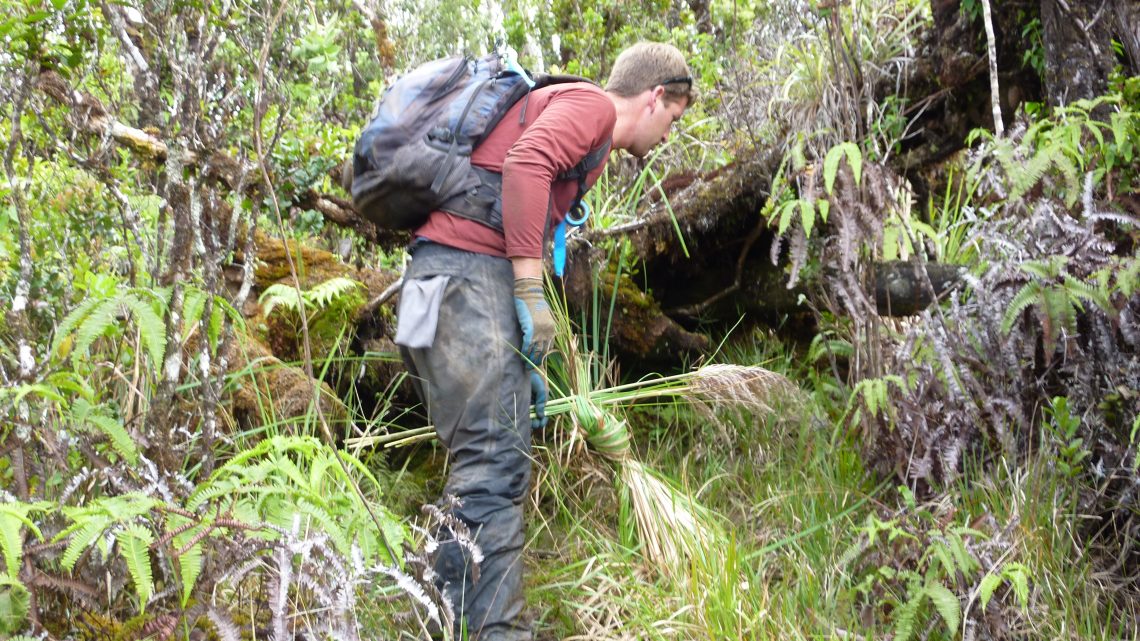
tie it in a knot2. Tie the pampas in a knot. this is what we refer to as the “ponytail” method; bringing all the pampas leaves together makes it easier to treat and marks the plant as one we’ve treated.

3. Bury the seed-heads deep within the plant. This keeps the seeds from dispersing on the wind, likely how this plant arrived here in the first place.

spray plant4. With the seed-heads tucked away and the plant tied together crews can apply a low-concentration herbicide directly to the plant (another benefit of the ponytail method-no over-spray). Within a month the plant will be dead and beginning to decompose and native vegetation will be intact and poised to reclaim this patch of invaded rainforest. The location of each plant we control is recorded with a GPS so it can be monitored in the future to ensure no seedlings have germinated.

There you have it-how to control invasive pampas grass a native rainforest on Maui.

Stay posted to learn how to spot a pampas grass.

Sunset in Haipuena

The sun sets on another day of field work in the remote rainforest of East Maui

Follow

Get every new post delivered to your Inbox.

Join 381 other followers