Click this link for a PDF version of the newsletter: 2012 MISC Newsletter Kia’i i na Moku o Maui Nui In this issue: Moeana’s Message―What Tahiti Can Teach us about Little Fire Ants “This place used to be paradise” said Moeana Besa. Find out what happened. On Page 1 Fire at the Farm How Christina … Continue reading
In the spring of 2009, Angela Kepler found a diseased banana plant on her neighbor’s property. “It really freaked us out! As soon as we found out we ran next door and sprayed for aphids.” The neighbor’s banana plant was infected with banana bunchy top virus (BBTV). “BBTV is the worst,” Kepler explains. “Now we … Continue reading
In anticipation of “The Lorax” movie opening March 2, a national restaurant chain has been giving away bookmarks with seeds of blue-spruce and Canadian white pine. A press release dated February 21st 2012 explains the program: “In keeping with the animated adventure’s theme that one person can make a difference, IHOP is distributing three million … Continue reading
National Invasive Species Week is February 26 to March 3. While it’s great to pay attention for the week, here are a few simple actions, one for each month, to help make a difference on the invasive species front: *Note: This list was originally published in the January 8th edition of the Maui News. January—check … Continue reading
Flowers. When it comes to courting your Valentine, you gotta have ‘em. Roses may be the standby for the holiday, but don’t overlook the beautiful, locally grown cut flowers available. This year, express your love for Maui as you woo your Valentine with a creative choice of flowers. The locavore movement is nothing new; eating … Continue reading
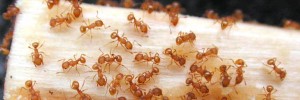
Check out the video below to see Dr. Cas Vanderwoude and the “Spackler of Death,” a creative solution to solve the problem of getting ant bait into trees to control the little fire ant or Wasmannia auropunctata. Learn more about the little fire in Hawai‘i and the Pacific at lfa-hawaii.org and littlefireants.com.
How does a two-person team control 850 invasive trees? If you’re MoMISC, you ask for permission first—from the landowner, the ancestors, and the trees themselves. When Lori Buchanan of the Moloka‘i/Maui Invasive Species Committee (MoMISC) learned that albizia trees were invading a steep gulch in Nā‘iwa, she started strategizing. Native to the Indonesian archipelago, albizia … Continue reading
It starts with a spot, a tiny dot of orange on a leaf bound for Hawai‘i. It could be on cut foliage destined for a florist or on a tree fated for a Hawai‘i yard. The miniscule speck of orange grows, produces spores, and covers the plant. Hawai‘i’s moist climate creates the perfect habitat for … Continue reading
In the early 1870s an enterprising nurseryman in Southern California imported a tall, clumping grass with distinctive feathery plumes to his ranch. Over the next several decades he created an entire industry for the plumes of the plant called pampas grass. At the height of the plume boom, he was exporting 500,000 plumes a year … Continue reading
In the final installment of the “Pampas Gone Wild” series, we’ll cover some of the key identification features of pampas grass that differentiate it from the native sedge, Carex. These features can also be used to identify immature pampas in other habitats. If you think you have seen a pampas grass in Hawaii, please contact … Continue reading
Last month I began to present my point of view as a conservation scientist relevant to current “controversy” over biocontrol of strawberry guava (Psidium cattleianum), Hawaii’s most damaging invasive plant species. I touched upon the generally accepted theory that many highly invasive plant species, held in check by insects and pathogens in their home range, … Continue reading